
Good scientific practice at TU Dresden
The TU Dresden has issued the Guidelines for Good Scientific Practice at the TU Dresden and the Statutes for Safeguarding Good Scientific Practice, Preventing Scientific Misconduct and Dealing with Violations. All members and associates of TU Dresden are obliged to follow these statutes, to make them the basis of their scientific work and to actively contribute to the prevention of scientific misconduct in their area of activity.
The following statements are an excerpt from and commentary on these guidelines and do not claim to be exhaustive.
What is good scientific practice?
Every scientist is obliged to work to the best of his or her knowledge and belief in accordance with the rules of his or her discipline, to document his or her results transparently, to always question them critically and to comply with ethical and moral principles. It goes without saying that the strictest honesty is required in all scientific activities. For scientists in leading and responsible positions, the principles of care for dependents and fairness must also be observed. This applies to both employees and students.
The principles of honesty, transparency, documentation and traceability apply in particular to all scientific publications; every author is equally responsible for complying with these principles. Authorship is based on a substantial contribution, but not on financial, technical or other support.
The use of AI tools in student research projects and theses is considered an aid and must be identified as such.
Examinations, assessments and review activities must always be carried out in a fair and balanced manner on the basis of the latest scientific findings.
Who are affected by these regulations?
In principle, all members of TU Dresden working in academia. For students, there is a corresponding obligation for all academic work, e.g. protocols, seminar papers and term papers, theses and independent research.
What is academic misconduct?
Academic misconduct occurs when the standards of good scientific practice have been violated intentionally or through gross negligence in a scientifically relevant context, false statements have been or are being made, the intellectual property of others has been or is being violated or their research activity has been or is being impaired in any other way. The circumstances of the individual case are decisive, taking into account the respective subject culture.
Scientific misconduct (excerpt from Section 9 of the Statutes on Safeguarding Good Scientific Practice, Preventing Scientific Misconduct and Dealing with Violations) is caused, for example, by
- Incorrect information about the authorship (ghostwriting),
- fabrication, falsification or incomplete use of data or sources,
- incomplete use of data and sources, non-consideration of undesired results, as well as manipulation of sources, representations or illustrations,
- unauthorized use under presumption of authorship (plagiarism),
- Exploitation of research approaches and ideas of others (theft of ideas),
- Assumption of scientific authorship or co-authorship,
- falsification of the content,
- unauthorized disclosure of data, theories and findings to third parties,
- unauthorized publication or unauthorized making available to third parties as long as the work, finding, hypothesis, doctrine or research approach has not yet been published,
- Damaging, destroying or manipulating primary data, results, literature, archive and source material.
What to do in the event of scientific misconduct?
If the above-mentioned principles are violated intentionally or through gross negligence in a scientific context, this is considered "scientific misconduct". A detailed catalog of possible violations can be found in §9 of the statutes on safeguarding good scientific practice, preventing scientific misconduct and dealing with violations. By tolerating scientific misconduct of which you are aware, you may be partly responsible for it. If you are aware of academic misconduct or are affected by it, please seek a confidential discussion with a person of trust, e.g. your supervisor, the Director of the Institute of your department, your Dean or the Faculty Student Council. If this is not possible for you or if this conversation is not helpful, you can contact the Ombudsperson of TU Dresden.
The Faculty of Chemistry and Food Chemistry also offers you Prof. Thomas Doert as a person of trust.
Contact:
Dean of the Faculty of Chemistry and Food Chemistry
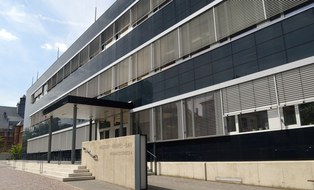 © M. Mann 2016
Faculty Deanery Chemistry
Send encrypted email via the SecureMail portal (for TUD external users only).
Visiting address:
Walther-Hempel-Bau, Room 207 Mommsenstr. 4
01069 Dresden
Postal address:
TUD Dresden University of Technology The Faculty of Chemistry and Food Chemistry
01062 Dresden