
Teacher training
Professional Development Day on "Math Difficulties in Lower Secondary School" on March 19, 2026, at TU Dresden
Description
A significant proportion of children do not develop a solid understanding of natural numbers, arithmetic operations, or calculation strategies in elementary school. Often, these children still manage to earn a grade of 3 in elementary school by memorizing answers, relying on a good memory, and practicing diligently, allowing them to advance to lower secondary school in all types of schools. In lower secondary school, however, they face massive difficulties, because without a “foundation in arithmetic,” it is virtually impossible to perform calculations involving negative numbers, fractions, decimals, variables, and terms—since memorization and practice alone are insufficient here.
In this professional development session, we will therefore focus on the topic of dyscalculia and address questions such as how to identify or characterize it, what legal changes have taken place in Saxony, and how to address this challenge in the classroom—as well as what limitations exist.
Target Audience
Mathematics teachers at secondary schools and high schools
Notes
Please feel free to bring examples from your own classroom, which we will discuss together.
Event Number: R08147
Title: Math Difficulties in Lower Secondary School
Date: March 19, 2027, 9:00 a.m. to 4:00 p.m.
Location: Willersbau, Zellescher Weg 12–14, Room WIL C 202
Trainer: Andrea Hoffkamp
Direct link to the catalog: https://www.schulportal.sachsen.de/fortbildungen/detail/R08147
1st MINTGeo Day at TU Dresden: Learning for the Future—Shaping the Future
On September 14, 2026, the first professional development day for STEM and geography teachers will take place at TU Dresden. With this event, we are creating a diverse professional development program for all STEM and geography teachers. Following a joint keynote presentation on the central theme “Learning for the Future – Shaping the Future,” parallel workshops on mathematics, computer science, biology, chemistry, physics, and geography will be offered in three consecutive workshop slots.
The focus will be on future-oriented topics. Workshops will be offered on topics including: digital media and digital literacy in individual subjects and across disciplines; the use of AI for lesson planning; education for sustainable development from a subject-specific perspective; critical thinking in the context of climate change; and addressing heterogeneity and providing support. There will also be time and space for networking over coffee, tea, and pastries.
The event is open to all teachers, student teachers, and individuals enrolled in continuing education programs for career changers who teach mathematics, computer science, biology, chemistry, physics, or geography.
Registration:
Please register here for the professional development workshop.
The registration deadline is August 31, 2026.
The training course is listed under event number EXTP00657 in the online training catalog on the Saxony School Portal.
Update:
Due to high demand, the workshops “Deepening and Expanding the Concept of Functions in 10th Grade and Upper Secondary School” and “Ensuring Basic Skills—Enabling Future Opportunities” are now being offered twice. Registration for the workshops is therefore open again.
Program
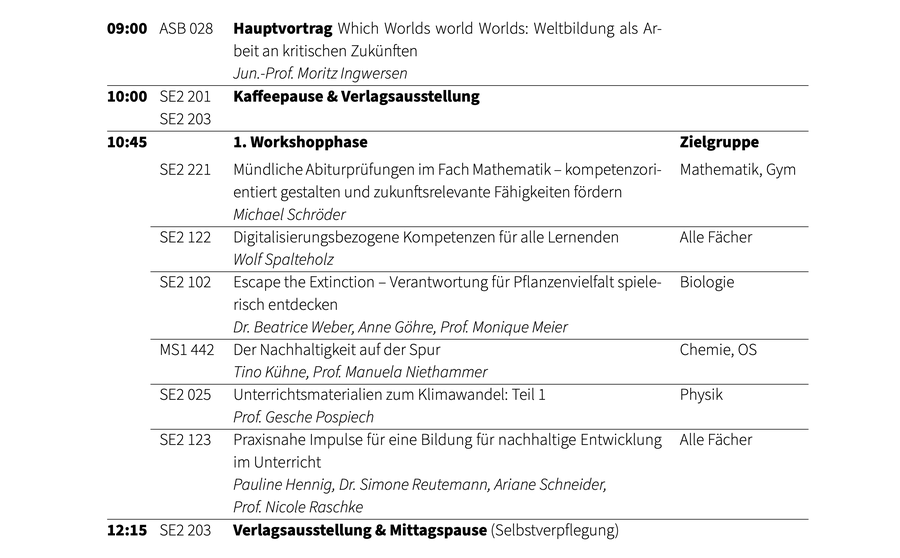
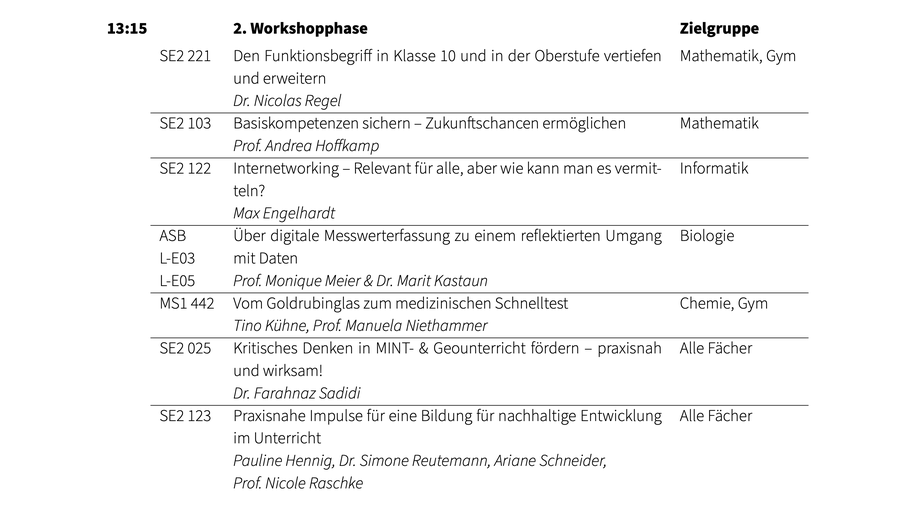
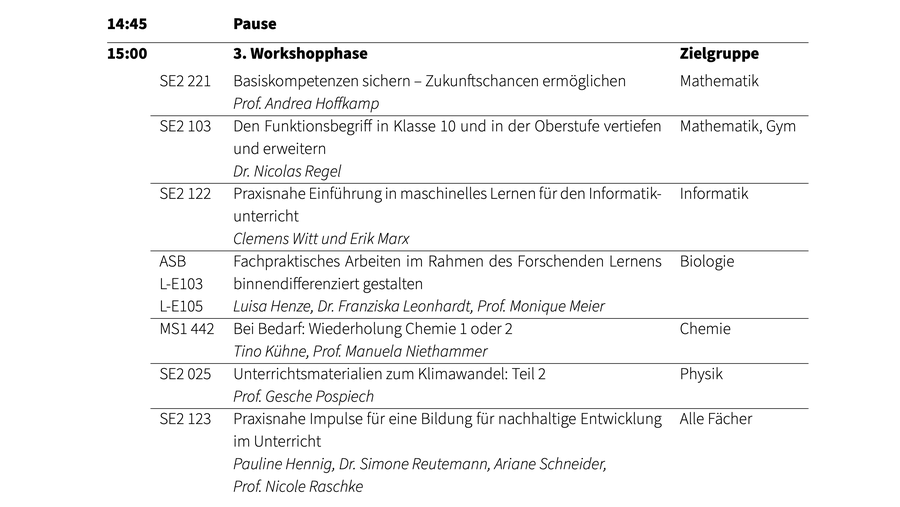
You can download the complete program, including abstracts for the individual workshops, here.
Organizers:
Prof. Dr. Andrea Hoffkamp (Chair of Didactics of Mathematics)
Prof. Dr. Gesche Pospiech (Chair of Didactics of Physics)
Assistant Professor Dr. Salome Flegr (Chair of Didactics of Physics)
Prof. Dr. Manuela Niethammer (Chair of Construction, Wood and Paint Technology and Interieur Design / Vocational Didactics)
Prof. Dr. Mareen Grillenberger (Chair of Didactics of Computer Science)
Prof. Dr. Monique Meier (Chair of Didactics of Biology)
Prof. Dr. Nicole Raschke (Chair of Geographic Education)
If you have any questions regarding the content of the event, please feel free to contact Professor Andrea Hoffkamp ( ).
With the kind support of
- 1st MINTGeo Day at TU Dresden: Learning for the Future—Shaping the Future On September 14, 2026, the first professional development day for STEM and geography teachers took place at TU Dresden. With this event, we are offering a diverse professional development program for all STEM and geography teachers. Following a joint keynote presentation on the central theme “Learning for the Future – Shaping the Future,” parallel workshops on mathematics, computer science, biology, chemistry, physics, and geography will be offered in three consecutive workshop slots. The focus will be on future-oriented topics. Workshops will be offered on topics including: digital media and digital literacy in individual subjects and across disciplines; the use of AI for lesson planning; education for sustainable development from a subject-specific perspective; critical thinking in the context of climate change; and addressing heterogeneity and providing support. There will also be time and space for networking over coffee, tea, and pastries. The event is open to all teachers, student teachers, and individuals enrolled in continuing education programs for career changers who teach mathematics, computer science, biology, chemistry, physics, or geography.
Program
You can download the complete program, including abstracts for the individual workshops, here.
Organizers:
Prof. Dr. Andrea Hoffkamp (Chair of Didactics of Mathematics)
Prof. Dr. Gesche Pospiech (Chair of Didactics of Physics)
Assistant Professor Dr. Salome Flegr (Chair of Didactics of Physics)
Prof. Dr. Manuela Niethammer (Chair of Construction, Wood and Paint Technology and Interieur Design / Vocational Didactics)
Prof. Dr. Mareen Grillenberger (Chair of Didactics of Computer Science)
Prof. Dr. Monique Meier (Chair of Didactics of Biology)
Prof. Dr. Nicole Raschke (Chair of Geographic Education)
If you have any questions regarding the content of the event, please feel free to contact Professor Andrea Hoffkamp ( ).
- 6th Teacher Training Day on Mathematics Education Organized by Saxony’s Universities on March 14, 2025, at TU Dresden Topic: Teaching Stochastics in Secondary Levels I and II—Focus on Secondary Level II OnFriday, March 14, 2025, the 6th Teacher Training Day on Mathematics Education at Saxon Universities will take place at TU Dresden. The professional development day is integrated into the “Stochastik Tage 2025” (GPSD) conference. For this one-time event, a fee of 15 euros will be charged, but this can be reimbursed through travel expense reimbursement.The event is aimed at mathematics teachers and student teachers at vocational schools and high schools. It is also open to students pursuing a teaching degree. It is jointly organized by the Chairs of Didactics of Mathematics at the Dresden and Leipzig campuses. The program consists of two keynote lectures and two workshop blocks, each featuring three parallel 90-minute workshops. The professional development code on the school portal is EXTP00378. You can download the program, including the abstracts for the lectures and workshops, here.
- Digital Bites for Math Class as a Video Series: Digitaltools have become an integral part of everyday life, and we all use them as a matter of course. There are now a multitude of digital applications available for math class, but it is not always easy to decide whether—and in what form—these can be used effectively. In an online professional development series—which took place from April to June 2023 in eight sessions, each held on Mondays from 5:00 to 6:00 p.m.—lecturers from BQL Mathematics and the Chair of Didactics of Mathematics presented the potential of several tools. They offered suggestions on how various apps and software applications can support the understanding, discovery, and application of mathematics in algebra, geometry, and probability and statistics classes.The video recordings of this series have been compiled by the BQL.Digital team into learning modules titled “Digital Bites for Math Class.” Further information about the video series and how to access it can be found here.
- (Online) Teacher training session on September 16, 2024, by Nicolas Regel on the topic of MMS in the classroom: Theory and Practice in Dialogue as part of the training series “Digital Tools in Mathematics and Science Education”
Abstract:
After more than 30 years of research in mathematics education and practical experience in schools regarding the use of MMS (CAS), the following questions, among others, still remain:
Which MMS tasks actually facilitate real-world contexts, and which ones shift the focus from learning content to mastering the tool?
How should phases without the use of tools and phases with MMS be structured in classroom practice? Can approaches such as “black box” and “white box” help clarify the question, “What must students truly master without MMS?” In this session, we will address these and other questions using concrete examples and build a bridge between theoretical insights and everyday school practice.
Materials available here. - 5th Teacher Training Day on Mathematics Education at Saxon Universities on February 6, 2024, at TU Dresden Topic: Dealing with Heterogeneity and Inclusion in Mathematics Instruction OnFebruary 6, 2024, from 9 a.m. to 2 p.m., the 5th Teacher Professional Development Day on Mathematics Instruction at Saxony’s Universities took place at TU Dresden. The event was aimed at teachers, student teachers, and career changers teaching at secondary schools, vocational schools, and high schools. The program featured a keynote presentation followed by two workshop sessions with parallel workshops. During this professional development day, we offer a diverse program addressing the challenges posed by heterogeneity and inclusion in mathematics instruction. Key topics include assessment and support, language development, differentiation of instructional materials for various proficiency levels, and inclusion with a focus on learning disabilities. These topics are relevant not only to secondary schools or special education schools but also to high schools and vocational schools when it comes to supporting students at their own level and understanding any difficulties they may face.Our detailed program can be found at the following link:DetailedProgram The professional development course number on the school portal is EXT05579.
LOCATION: Willersbau (WIL), Zellescher Weg 12–14 (except for the workshop on “Inclusive Teaching”)With the kind support of the Förderverein für Mathematik zu Dresden e.V. - Teacher training by Kerstin Koch at the FTZ Meißen on the topic “GeoGebra—A Universal Tool for Teaching Mathematics” July 4–5, 2023 (basic course).
- Online Teacher Training: Digital Bites 2023, starting April 17, 2023 Mondays, 5:00–6:00 p.m. (8 sessions): Understanding, Discovering, and Applying Mathematics with Digital Tools
Digital tools have become an integral part of everyday life, and we all use them without a second thought. This training series aims to highlight the potential of several applications (GeoGebra, spreadsheet programs, the smartphone apps “PhotoMath” and “MathCityMap”) by providing ideas for instructional scenarios on topics from algebra, geometry, and probability and statistics. The focus is always on promoting the understanding, discovery, and application of mathematics.
| Date | Topic |
|---|---|
| April 17 | Creating interactive exercises with GeoGebra to promote thinking in functional contexts, Part 1 |
| April 24 | Creating Interactive Activities with GeoGebra to Foster Thinking in Functional Contexts, Part 2 |
| May 8 | Discovering and Applying Mathematics in Non-School Learning Environments with the “MathCityMap” App, Part 1 |
| May 15 | Discovering and Applying Mathematics in Non-School Learning Environments with the “MathCityMap” App, Part 2 |
| May 22 | Cognitively Stimulating Task Formats for Using the “PhotoMath” App: The Example of Linear Systems of Equations |
| June 5 | Using spreadsheet software for the simulation and graphical analysis of random experiments |
| June 12 | 3D Printing in Probability and Statistics Classes—Influencing Probability with Manipulated Dice |
| June 19 | Promoting spatial visualization skills with real and virtual objects |
Recognized as teacher professional development (training number: EXTP00015 on the Saxony School Portal); certificate of participation indicating the number of sessions completed
Registration opens on February 27, 2023, via the OPAL course. Please follow these instructions for (self-)registration on OPAL or use this guide.
- On February 8, 2023, the 4th Teacher Professional Development Day on Mathematics Instruction, organized by Saxony’s universities in cooperation with the Mathematics Education Working Group at the TUD Dresden University of Technology, will take place at the University of Leipzig . The theme of this event is: “Digital Worlds in Mathematics Instruction.”The event is aimed at teachers and student teachers, as well as career changers, at secondary schools, vocational schools, and high schools. The program will feature a keynote lecture followed by two workshop blocks, each offering four parallel workshops. The workshop topics will include, among others: • Reasoning with digital media • Digital teaching and learning scenarios • Escape rooms • Flipped classroom
Registration and Program - Interactive keynote presentation by Andrea Hoffkamp on the topic: “Reasoning with Digital Tools—Opportunities and Challenges.” Conference of the “Mathematics and Technology (MUT)” network in Hanover for teachers, department heads, teacher-training seminars, and subject advisors in Lower Saxony on November 1, 2022.
- Teacher training sessions led by Kerstin Koch at the FTZ Meißen on the topic “GeoGebra—A Universal Tool for Teaching Mathematics” January 12–13, 2022 (basics) and May 18, 2022 (advanced course)
- On February 8, 2022, from 9:00 a.m. to 2:00 p.m., the 3rd Teacher Training Day on mathematics education organized by Saxony’s universities will take place at TU Dresden on the topic of digital media in mathematics instruction.
The event is aimed at teachers, student teachers, and career changers teaching at secondary schools, vocational schools, and high schools. The program will feature a keynote presentation followed by two workshop sessions with four parallel workshops. Half of the workshops will be specifically tailored to high schools and the use of CAS. The other half will offer an interesting program for upper secondary schools as well.
You can find the professional development course on the school portal under course number EXT05069. Please submit a travel request to your local office of the State Office for Schools and Education.
A total of approximately 80 teachers can register. Registration was open until January 25, 2022. Eighty participants registered, and we were able to accommodate everyone’s first-choice workshop requests. Everyone should have received a confirmation email and an email with the login details for the training day. Please check your spam folder if necessary.
The professional development day will take place online using the Zoom video conferencing tool. We recommend downloading the Zoom client from the following website: https://zoom.us/download#client_4meeting - Event flyer
Program Overview - Online Teacher Training: “Digital Bites” starting March 4, 2021, on Thursdays from 5:00–6:00 p.m.:
In connection with the mandatory introduction of CAS in Saxony starting in the upcoming 2021–22 school year, we are offering online professional development sessions on this topic. These sessions are particularly aimed at teachers with little prior knowledge.
Contents:
- Ways to use CAS in the classroom and on exams
- Didactic potential, learning environments, and examples for the classroom, as well as risks and challenges
- Task design and variation with regard to CAS
- Use of various CAS systems: GeoGebra, Classpad, TI-Nspire, and others
Organizational Information:
- 10 sessions: Starting March 4, 2021, through June 3, 2021, on Thursdays from 5:00 to 6:00 p.m.
- Online training: Zoomvideo conferencing tool : It is best to install the Zoom client, but you can also participate via your web browser.
- Access to the course:
Register on OPAL to access all information, the detailed program, and the course materials.
Instructions for registering on OPAL - Recognized as teacher professional development (professional development number: EXT04864 on the Saxony School Portal); certificate of participation indicating the number of sessions completed
- No limit on the number of participants
The training sessions are designed so that participants can join at any time; however, continuous participation is recommended. In principle, any CAS system can be used to participate, even though the various sessions may switch between different school-relevant CAS systems. Unless the focus is on operating a specific tool, the basic principles presented apply equally to every CAS system.
- Cancelled due to the pandemic!
On March 25, 2020, from 9:00 a.m. to 3:35 p.m. , the 3rd Teacher Training Day on mathematics instruction organized by Saxony’s universities will take place at TU Dresden, focusing on stochastics in secondary levels I and II . The event is aimed at teachers, student teachers, and career changers at secondary schools, vocational schools, and high schools. It will feature two keynote lectures, followed by two workshop sessions with four parallel workshops. A total of 80 teachers can register. For the first time, this teacher training day is integrated into the international conference “Stochastiktage 2020 .” More detailed information can be found here. On the school portal, the professional development eventcan be found under the external number EXT04560 . Travel expenses and fees will be reimbursed by LaSuB upon request.
Registration is now open (you’ll also find the program for the training day under the registration link). Please note that you must first register, as a special conference tool is being used for organizational purposes. - Teacher professional development session led by Andrea Hoffkamp at the Carl-von-Ossietzky Community School in Berlin-Kreuzberg on “Teaching Terms and Equations with a Focus on Understanding” on February 19, 2020 (in collaboration with Malgorzata Schneier, subject coordinator).
- Teacher training session led by Kerstin Koch on working with GeoGebra in mathematics classes for lower and upper secondary levels on November 19, 2019, at the fall academy “Media Education in Schools” at the Gymnasium Bürgerwiese in Dresden.
- Teacher training session led by Andrea Hoffkamp at the Carl-von-Ossietzky Community School in Berlin-Kreuzberg on “Teaching Mathematics in Highly Heterogeneous Groups” – September 4, 2019.
- Teacher training session at Erlebnisland Mathematik led by Andrea Hoffkamp and Marie Bothe (in collaboration with Robert Päßler) on the topic “On Vertices, Edges, and Faces—Platonic Solids, Euler’s Formula, and Minimal Surfaces” on July 12, 2019.
- Teacher training session led by Andrea Hoffkamp on the Day of Mathematics and Science Education in Meissen, at Siebeneichen Castle, on the topic “Teaching Mathematics in Heterogeneous Classes—What Is Possible… and What Isn’t?” on April 4, 2019.
- Teacher training sessions led by Kerstin Koch at the FTZ Meissen on the topic “GeoGebra—A Universal Tool for Teaching Mathematics” November 1–2, 2018 (basics) and March 8, 2019 (advanced course).
- Teacher training session led by Andrea Hoffkamp at the Carl-von-Ossietzky Community School in Berlin-Kreuzberg on “Developing Differentiated Teaching Materials for Mathematics Instruction” on February 13, 2019 (in collaboration with Malgorzata Schneier, department head).
- On Tuesday, February 12, 2019, the second teacher training day on mathematics instruction at Saxon universities tookplace at the University of Leipzig in cooperation with the Chair of Didactics of Mathematics at TU Dresden. The theme of the day was: Geometry and Analytical Geometry in Secondary Levels I and II.
Information about the program is available at the following link. - On Saturday, October 27, 2018, the first Saxony-wide symposium on mathematics instruction for new teachers, student teachers, and teacher trainees took place in Dresden under the title “Finally a Math Teacher—Infinite Questions,” with approximately 100 participants.
It was organized and conducted by the Saxon universities in Dresden and Leipzig, subject advisors, and teacher-training institutions from all regions of Saxony. The keynote speaker was Prof. Dr. Regina Bruder from the Technical University of Darmstadt.
You can find the detailed program here. - Teacher training session led by Andrea Hoffkamp for teachers of mathematics as a second subject at the Carl-von-Ossietzky Community School in Berlin-Kreuzberg on “Teaching Decimal Fractions in Grades 5–6—Assessment, Support, and Managing Heterogeneity” - September 26, 2018.
- Teacher training session led by Andrea Hoffkamp at the Carl-von-Ossietzky Community School in Berlin-Kreuzberg on “Teaching Mathematics in Highly Heterogeneous Groups” – September 12, 2018.
- On February 6, 2018, the first teacher training day on mathematics instruction organized by TU Dresdenand Saxony’s universities
in cooperation with the Chair of Didactics of Mathematics at the University of Leipzig.
Detailed program and directions - Teacher training session led by Andrea Hoffkamp at the Carl-von-Ossietzky Community School in Berlin-Kreuzberg on “Teaching Calculus in an Accessible Way” – November 22, 2017.
- Teacher training session led by Kerstin Koch at the SBI, FTZ Meissen, on the topic “GeoGebra—A Universal Tool for Teaching Mathematics,” November 15–16, 2017.
- Teacher training session led by Heino Hellwig and Andrea Hoffkamp at INSPIRATA in Leipzig on approaches and materials for a comprehension-oriented approach to concepts in calculus – October 18, 2017
- Until 2017, the Dresden Colloquium on Mathematics and Its Didactics was held annually. Information on past colloquia:
1. Dresdner Kolloquium - 30. Januar 1996
- Formale Begriffsanalyse - was ist das?
Prof. Dr. B. Ganter / Dresden - Regeometrisierung der Schulgeometrie - durch Computer?
Prof. Dr. H. Schupp / Saarbrücken - Erfahrungen und Konsequenzen aus den ersten Abiturprüfungen an sächsischen Gymnasien im Fach Mathematik
Dr. R. Heinrich / Dresden - Wie zuverlässig sind Rechenergebnisse?
Priv.-Doz. Dr. R. Grothmann / Eichstätt
2. Dresdner Kolloquium - 28. Januar 1997
- Das Gesetz der Großen Zahlen - Phänomen und Theorem
Prof. Dr. Volker Nollau / Dresden - Entdeckendes computerunterstützes Lernen am Beispiel des Kurvenbegriffs
Dr. Thomas Weth / Würzburg - Zur Nutzung von grafikfähigen Taschenrechnern im Mathematikunterricht der SII
Dr. Manfred Pruzina / Wallwitz - Das 3n+l Problem
Priv.-Doz. Dr. Günther Wirsching / Eichstätt
3. Dresdner Kolloquium - 10. Februar 1998
- Geometrie - Geisteswissenschaft zwischen Technik und Kunst
Prof. Dr. Gunter Weiß / Dresden - Zeitdokumente, Paradoxien, Beispiele als motivierende Materialien für den Stochastikunterricht
Prof. Herbert Kütting / Münster - Zur Frühgeschichte der Analysis
Prof. em. Dr. Hans Wußing / Leipzig - Graphikrechner im Mathematikunterricht der SII: Neue Konzepte - auch neue Ziele? (Unterrichtsbeispiele - Schülerreaktionen - neue Aufgaben)
Prof. Günter Steinberg / Oldenburg
4. Dresdner Kolloquium - 23. Februar 1999
- Angewandte Mathematik heute: Vom mathematischen Modell zum Computerprogramm
Prof. Dr. H. Schwetlick / Dresden - Normaler, produktiver Mathematikunterricht
Prof. Dr. Th. Jahnke / Potsdam - Der Zwei-Quadrate-Satz der elementaren Zahlentheorie als Gegenstand zur Übung heuristischen Denkens
Prof. Dr. H. Winter / Aachen - Welche Aufgaben passen auf einen Unterricht mit neuen Technologien?
StD Günter Schmidt / Bad Kreuznach
5. Dresdner Kolloquium - 08. Februar 2000
- Über Konvergenz, Metriken und Kugeln in der Analysis
Prof. Dr. A. Rhodius / Dresden - Extremwertaufgaben: Ja! - aber wie?
Prof. Dr. R. Danckwerts / Siegen - Statistisch gesichert? - Über die Anfänge des statistischen Schließens
Prof. em. Dr. R. Ineichen / Fribourg (Schweiz) - Algorithmen - fundamental für Mathematik und Mathematikunterricht
Prof. Dr. J. Ziegenbalg / Karlsruhe
6. Dresdner Kolloquium - 06. Februar 2001
- Die Anwendung von Differentiationsregeln auf Computerprogramme
Prof. Dr. A. Griewank / Dresden - Der grafikfähige Taschenrechner im Stochastikunterricht
Prof. Dr. P. Borneleit / Leipzig - Ziel-Vorstellungen zu Folgen und Grenzwerten
Prof. Dr. P. Bender / Paderborn - Computerisierte Behandlung funktionaler Beziehungen an geometrischen Figuren
Prof. Dr. H. Schumann / Weingarten
7. Dresdner Kolloquium - 05. Februar 2002
- Paradoxien und ihre Bedeutung für das Lehren und Lernen von Mathematik
Dr. Manfred Schwier / Dresden - Kettenbrüche - ein Porträt.
Prof. Dr. Harald Riede / Koblenz-Landau - Elementargeometrische Konstruktionen einst und heute
Prof. Dr. Michael Toepell / Leipzig - TIMSS und Taschenrechner, PISA und Computer - und Die etwas andere Aufgabe
Prof. Dr. Wilfried Herget / Halle-Wittenberg
8. Dresdner Kolloquium - 04. Februar 2003
- Partielle Differentialgleichungen, unentbehrlich in den Naturwissenschaften
Prof. Dr. J. Voigt / Dresden - Fördern des innermathematischen Problemlösens mithilfe offener Aufgaben
Prof. Dr. W. Schulz / Berlin - Geschichte im Stochastikunterricht
OStD a. D. R. Haller / München - PISA 2000 - Welche mathematische Grundbildung haben Schüler in Deutschland?
Prof. Dr. A. Wynands / Bonn
9. Dresdner Kolloquium - 03. Februar 2004
- Denken in Bildern: Über die PEIRCEsche algebraische Logik und den Umgang mit Relationen
Prof. Dr. R. Pöschel / Dresden - Modellbildung und Realitätsbezug am Beispiel der Funktionen von zwei Variablen
Prof. Dr. M. Klika / Hildesheim - Mathematikunterricht weiterentwickeln - Verständnis fördern
Prof. Dr. P. Baptist / Bayreuth - Lust statt Frust - Mathematik soll (auch) Spaß machen
Dr. I. Lehmann / Berlin
10. Dresdner Kolloquium - 01. Februar 2005
- Mathematische Hintergründe in der bildenden Kunst
Prof. Dr. G. Bär / Dresden - Das SINUS-Programm und die Bildungsstandards - Chancen und Probleme der Qualitätsentwicklung im Mathematikunterricht
Prof. Dr. W. Blum / Kassel - Zweistellige Mittelwertfunktionen
Prof. Dr. H. Hischer / Saarbrücken - Probleme und Möglichkeiten der Behandlung der bedingten Wahrscheinlichkeit
Prof. Dr. H.-D. Sill / Rostock
11. Dresdner Kolloquium - 07. Februar 2006
- Die Entwicklung der Koordinatenmethode und des Funktionsbegriffs im Rahmen der Geschichte der Analysis
Prof. Dr. Th. Riedrich / Dresden - Der Goldene Schnitt - Faszination des Schönen in der Mathematik
Prof. Dr. H. Henning / Magdeburg - Der Erwartungswert, ein Mittel zum Zweck - der Zweck heiligt das Mittel
StD i. R. F. Barth / München - Computer-Algebra-Systeme - Junger Wein oder neue Schläuche?
Prof. Dr. H.-W. Henn / Dortmund
12. Dresdner Kolloquium - 06. Februar 2007
- Klassische und moderne Verfahren in der Kryptographie
Prof. Dr. U. Baumann / Dresden - Albrecht Altdorfer (ca. 1480-1538): Künstler, Baumeister, Stadtpolitiker - Nutzung einer historischen Situation für den Mathematikunterricht
Dr. H. Säckl / Regensburg - Känguru-Wettbewerbsaufgaben - eine neue Aufgabenkultur?
Dr. M. Noack / Berlin - Wachstums- und Zerfallsprozesse als vielseitiges Unterrichtsprojekt
Prof. Dr. H. Junek / Potsdam
13. Dresdner Kolloquium - 29. Januar 2008
- Bayes’sche Formel und ihre Anwendungen
Prof. Dr. Jürgen Franz / Dresden - Schnittstelle Schule – Hochschule
Berliner Aktivitäten zur mathematischen Bildung
Prof. Dr. Jürg Kramer / Berlin - Analytische Geometrie – Kompetenzen und Leitideen mit Objektstudien
StD Prof. Günter Schmidt / Stromberg - Zum Problem des Problemlösens – Befunde und Überlegungen zur
Förderung der Problemlösefähigkeit
Prof. Dr. Frank Heinrich / Braunschweig
14. Dresdner Kolloquium - 03. Februar 2009
- Die Reliefperspektive als Testfall für angewandte Mathematik
Dr.-Ing. Daniel Lordick / Dresden - Langfristige Kompetenzentwicklung im Mathematikunterricht
Prof. Dr. Regina Bruder / Darmstadt - Wie der Zufall es will? - Keine Angst vor Stochastik
Dr. Elke Warmuth / Berlin - Fehlerkultur und Lernen aus Fehlern im Mathematikunterricht
Prof. Dr. Gerald Wittmann / Schwäbisch Gmünd
15. Dresdner Kolloquium - 02. Februar 2010
- Symmetrien von Polyedern, Färbungen und Harmonien
Prof. Dr. Rolfdieter Frank / Koblenz - Entwicklung von Mathematikunterricht mit math-il.de – das Beispiel „Zahlenteufel“
Prof. Rainer Kaenders / Köln - Wie wichtig sind Strahlensätze?
Dr. Axel Brückner / Potsdam - Vorstellung des Erlebnislandes Mathematik durch Prof. Nollau mit ausführlicher Erläuterung einiger ausgewählter Exponate
Prof. Dr. Volker Nollau / Dresden
16. Dresdner Kolloquium - 08. Februar 2011
- Markov-Ketten und Bonus-Malus-Systeme
Prof. Dr. K.-D. Schmidt / TU Dresden - Graphentheorie im Mathematikunterricht – Von Knoten, kürzesten Wegen und Gerüsten
Dr. B. Leneke / TU Magdeburg - Mathematik erleben – das EU Projekt Fibonacci
- Prof. P. Baptist / Universität Bayreuth
- Daten und Zufall – eine realitätsorientierte (Leit)-Idee für beide Sekundarstufen
Prof. Dr. A. Eichler / PH Freiburg
17. Dresdner Kolloquium - 07. Februar 2012
- Zur historischen Entwicklung der Auffassung von Analysis
am Beispiel der Regel von l’Hospital
Dr. I. Witzke / Universität zu Köln - Intelliboard, iPad & Co – das Klassenzimmer der Zukunft
Prof. Dr. U. Kortenkamp / PH Karlsruhe - Von der Knotentheorie zum Klettergerüst
Prof. Dr. D. Lordick / TU Dresden
... anschließend Führung durch das 3D-Labor
18. Dresdner Kolloquium - 29. Januar 2013
- Transportphänomene in dynamischen Systemen
Jun.-Prof. Dr. K. Padberg-Gehle / Dresden - Vom Lotfällen bis zum JPEG-Format
Prof. Dr. J. Heitzer / Aachen - Zu den Anfängen der Algebra im deutschen Sprachraum
Prof. Dr. R. Gebhardt / Honorarprofessor TU Dresden / Chemnitz - Objektorientiertes Modellieren am Beispiel mathematischer Begriffsbildung
Dr. W. Eid / Magdeburg
19. Dresdner Kolloquium - 11. Februar 2014
- Dissipativität oder steilster Abstieg: Gradientensysteme in Theorie und Beispielen
Prof. Dr. Ralph Chill / Dresden - Mathematik mit digitalen Werkzeugen - Chancen und Risiken
StD Henning Körner / Oldenburg - Reale Daten im Stochastikunterricht der Sekundarstufe I
Prof. Dr. Katja Krüger / Paderborn - Mathematik zur Freude des Fürsten - und zur Bereicherung des Unterrichts: Historische Instrumente der Mathematik aus dem Mathematisch-Physikalischen Salon
Dr. Michael Korey / Dresden
20. Dresdner Kolloquium - 3. Februar 2015
- Funktionalgleichungen verstehen: Charakteristika der Lösungsfunktionen erkennen
Dr. Eva Müller-Hill / Köln - Experimentelle Geometrie und Projektarbeit am Beispiel „Einparken"
Prof. Dr. Jürgen Roth / Landau - Fabelhafte Fehler in der Mathematik
PD Dr. Ingmar Lehmann / Berlin - Über ein wenig beachtetes Exponat im Erlebnisland Mathematik Dresden
Prof. Dr. Bernhard Ganter / Dresden
21. Dresdner Kolloquium - 2. Februar 2016
- Schülerförderung - Angebote und Erfahrungen der Fachrichtung Mathematik TU Dresden
Dr. B. Böttcher / Dresden - Unterrichten mit CAS und anderen digitalen Werkzeugen - Auswahl.Mehrwert.Ideen
Prof. Dr. B. Barzel / Duisburg-Essen - Mathematische Aktivitäten rund um die Leonardo-Brücke
Prof. Mag. Dr. H. Humenberger / Wien - Mit digitalen Werkzeugen Funktionen entdecken
StD a. D. H.-J. Elschenbroich / Korschenbroich
22. Dresdner Kolloquium - 7. Februar 2017
- Mathematik und Computer
Prof. Dr. Gunar Matthies / Dresden - Unendlichkeit im Mathematikunterricht
StD Dr. Jörg Meyer / Hameln - Die Fachsprache Mathematik als Stolperstein oder Baustein im Wissensbildungsprozess? Grundlagen und Merkmale eines sprachsensiblen Mathematikunterrichts
Prof. Dr. Barbara Schmidt-Thieme / Hildesheim - Spielzeug - mathematisch betrachtet
Prof. Dr. Hans-Wolfgang Henn / Dortmund