
Offene Themen für Abschlussarbeiten
Unsere Gruppe bietet Studierenden jederzeit gerne Gelegenheit zur Anfertigung von physikalischen Abschlussarbeiten wie Bachelorarbeit Physik, Forschungsjahr Master (Wissenschaftl. Arbeiten + Masterarbeit) sowie Staatsexamensarbeit Lehramt (in Zusammenarbeit mit der Arbeitsgruppe Wissenschaftsvermittlung). Auf unserer Veröffentlichungen-Liste finden sich auch Beispiele für bisherige Abschlussarbeiten. Folgende Themen werden derzeit angeboten:
Bachelorthemen Teilchenphysik und deren Simulation
Comparisons of theoretical calculations with experimental data require some definition of particles that are typically chosen to closely match the selection in measurements. This project will study particle-level definitions of the lepton and photon isolation, and their effect on the theoretical predictions.
For hadron decays with only 2 or 3 final state particles, the partial width can be calculated with simple equations of low dimensionality. Their evaluation with Monte Carlo methods is not efficient and this thesis should extend our current Monte Carlo event generator with an evaluation of these based on standard numerical integration techniques, e.g. similar to 6.2 in [https://arxiv.org/pdf/2512.16645].
The matrix elements for the decay of a B meson into a D meson resonance typically assumes the momenta of all external particles to be on-shell. But some D resonances can have a large width, which is currently accounted for kinematically in an a posteriori shift of the momenta to an offshell mass, but the matrix element calculation is not corrected for these offshell effects. This effect has been shown to be important [https://arxiv.org/abs/2602.18378] and in this thesis we want to study its impact within the Sherpa simulation and possibly implement mitigation strategies.
The calibration of the energy scale of the ATLAS electromagnetic calorimeter typically uses decays of the Z boson to two electrons, and the energy scale is determined relative to the (precisely known) Z-boson mass. This approach leads to large uncertainties in measurements of the (less precisely known) W-boson mass. To overcome this limitation, this project will used W->ev decays to determine the electron energy scale relative to the momentum measured in the ATLAS inner detector.
The longitudinal polarisation of the W and Z bosons is a direct consequence of electroweak symmetry breaking via the Brout-Englert-Higgs mechanism. A measurement of polarisation implies the treatment of multiple correlated quantities reconstructed in the detector, e.g. by using machine learning techniques. This project will explore an alternative method, the so-called Matrix Element Method, to reconstruct the polarisation in the hadronic decay of W bosons. A probability that measures the compatibility of experimental data with a given hypothesis is computed for each event, based on the theoretical knowledge of this process, i.e. the underlying Lagrangian from which the matrix element of the partonic process is derived.
Our simulation program Sherpa is capable of simulations beyond the Standard Model theory using a universal format. This topic is about exploring this in a model contain doubly-charged H++ bosons, which another student in our group is analysing in ATLAS data.
Current experimental constraints on the Higgs-boson decay width are obtained indirectly through the interference of Higgs-boson production with other processes. This study will explore the experimental sensitivity of setting an upper bound on the Higgs-boson lifetime with the ATLAS detector by measuring the longitudinal displacement of the Higgs-boson decay vertex from the primary interaction vertex. This displacement is expected to be much smaller than the experimental resolution. However, if an upper bound on the lifetime could be set, it would translate into a lower bound on the decay width.
The reconstruction of the electric charge of an electron produced in the ATLAS detector relies solely on the measurement of the curvature of its associated track in the inner detector. Interactions of an electron with the detector material can create secondary particles: photons and electron-positron pairs. The production of these secondary particles can lead to distortions of the primary electron track. Incorrect charge reconstruction can thus be caused either by an erroneous determination of the track curvature or by the choice of the wrong track. This project will study information of reconstructed secondary particles in the vicinity of the electron to reject electrons with signatures indicating a high probability for charge misreconstruction.
One of the proposed new experiments planned to explore physics beyond the Standard Model at CERN is SHiP (Seach for Hidden Particles), a beam-dump facility, where a high-energy beam is directed onto a fixed target. To search for new particles produced in the decays of D-mesons (mesons containing a charm quark), we first need to validate the Sherpa simulations of their production and decay. Especially their accuracy at the relatively low energies (~ GeV range) reached there, compared to the LHC (14 TeV), will have to be examined.
For now, Sherpa, the simulation software we are working with, is only able to simulate collision experiments, such as the LHC, where two high-energy particle beams collide. However, several current and upcoming experiments use fixed-targets, where a high-energy beam is directed onto a stationary target. To effectively search for new physics there, we need to be able to simulate these experiments as well. Thus, further development on Sherpa (by you?) is needed!
Quarkonia are unstable hadrons made up of identical quark-antiquark pairs, which decay according to the electromagnetic, strong or weak interactions. This project will work on improving the modelling of these decays in the simulation program "Sherpa" by updating branching ratios from measured results and implementing matrix elements for the most relevant decay channels.
The complexity of matrix element calculations for final states with a high multiplicity is so high, that their computational cost often limits theory simulations for the LHC. In this project we want to extend a machine learning based approach to simplify these calculations by approximating the matrix elements. The goal is to study various parameters for the architecture and training of deep neural networks in this approach.
The simulation of different polarisation states allows us to study effects from physics beyond the Standard Model in more detail. In this project we want to study, how effective-field-theory extensions of the Standard Model will affect different polarisations of W bosons in W±W± pair production at the LHC.
Masterthemen Teilchenphysik und deren Simulation
The matrix elements for the decay of a B meson into a D meson resonance typically assumes the momenta of all external particles to be on-shell. But some D resonances can have a large width, which is currently accounted for kinematically in an a posteriori shift of the momenta to an offshell mass, but the matrix element calculation is not corrected for these offshell effects. This effect has been shown to be important [https://arxiv.org/abs/2602.18378] and in this thesis we want to study its impact within the Sherpa simulation and possibly implement mitigation strategies.
The calibration of the energy scale of the ATLAS electromagnetic calorimeter typically uses decays of the Z boson to two electrons, and the energy scale is determined relative to the (precisely known) Z-boson mass. This approach leads to large uncertainties in measurements of the (less precisely known) W-boson mass. To overcome this limitation, this project will derive uniformity corrections to the energy scale using the momentum measured in the ATLAS inner detector in W->ev decays. Due to its higher cross section, corrections based on W->ev decays can be obtained in finer granularity, hence improving the overall resolution of the energy measurement. Based on these corrections, the residual energy scale will be determined in Z->ee events.
One of our analyses aims to meausure the polarization of vector bosons from the properties of their hadronic decay products. The Monte Carlo simulations used for this study need to assume the vector boson to be on-shell. We would like to investigate the impact of this approximation by producing off-shell simulations in Sherpa and comparing the results to the existing samples.
The longitudinal polarisation states of the W and Z bosons are generated in the spontaneous breaking of the electroweak symmetry by the Brout-Englert-Higgs field. The polarised production of W and Z boson pairs via vector-boson-scattering processes provides a sensitive test of the electroweak symmetry breaking mechanism. In particular, the couplings of longitudinally polarised W and Z bosons to the Higgs boson prevent the divergence of tree-level amplitudes at high energies. We offer several projects related to the measurement of longitudinal W-Boson scattering, e.g. the simulation of this process with the Sherpa event generator or the estimation of background to this process in data from the ATLAS experiment.
We are planning to use machine learning to aid in our measurement of vector bosons' polarization from the properties of their hadronic decay products, both to differentiate the vector boson jets from other QCD jets and to identify the polarizations. In order to optimize this we would like to compare different strategies and architectures on the machine learning side.
Measuring Higgs boson pair production is crucial for directly probing the Higgs trilinear coupling, with HH → γγ bb emerging as one of the most sensitive final states at the HL-LHC. Given the rarity of the process, precise background modelling is critical. In particular, Higgs production in association with a bottom–antibottom quark pair constitutes a significant background, as it populates the Higgs-resonant phase space. This project aims to improve the modelling of the Hbb background by developing a variable flavour number scheme in the Sherpa Monte Carlo simulator, enabling a more accurate description of bottom-quark dynamics.
The discrimination of the signatures of electrons and hadrons with the ATLAS detector relies on the longitudinal and lateral development of the electromagnetic shower, as well as the geometric matching of the electromagnetic shower to a track in the inner detector. The optimal discrimination relies on a precise understanding and modelling of the shower of both the electrons and the hadrons. This project will use generative machine learning techniques to transform variables quantifying the shower development in simulation to those in data. The training relies on event samples in data and simulation that are enriched in background processes.
The Future Circular Collider and its potential electron-positron collision running mode provides interesting physics opportunities complementary to a hadron collider like the LHC. This master topic should explore the simulation of heavy-flavour production (c- and b-quarks) using a new method previously applied in hadron collisions.
Our group is renowned for its research into the measurement and theoretical description of the polarisation of gauge bosons. But fermions also have a spin degree of freedom and the decay of taus and tops provides a handle for interesting measurements of it. The idea of this master topic is to explore improvements in its simulation and/or connect to relevant ATLAS measurements in this area.
The simulation program Sherpa can currently only simulate decay cascades with up to 3 final state particles in each step. For decays of the Higgs boson into 4 fermions via WW or ZZ diagrams it becomes important to simulate the full 1->4 decay. This thesis is about implementing such decays and make phenomenological comparisons to existing calculations.
Abschlussarbeiten Lehramt
Ziel ist es, die Forschung zum Klimawandel mit der Teilchenphysik durch die Auseinandersetzung mit dem CLOUD-Experiment am CERN (siehe 1 und 2) in einer Unterrichtseinheit zu verknüpfen. Dies hat das Potenzial, die Kreativität, das kritische Denken und das Verständnis für die Natur der Wissenschaft bei den Schüler:innen zu fördern und ihr Verständnis der Teilchenphysik durch deren Anwendung in einem realen Kontext zu vertiefen. Die Unterrichtseinheit soll mit einer kleinen Gruppe von Schüler:innen erprobt werden. Die Arbeit soll in Kooperation mit der Didaktik der Physik erstellt werden (Kontakt: Dr. Farahnaz Sadidi, ).
(1) https://www.home.cern/science/experiments/cloud
(2) https://cerncourier.com/a/cloud-experiment-sharpens-climate-predictions/
Kontakt:
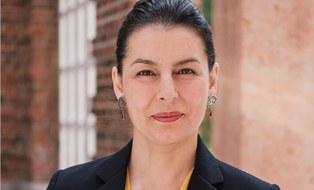 © Tine Jurtz
wissenschaftliche Mitarbeiterin
NameDr. Farahnaz Sadidi
Betreuung Praktikumsveranstaltungen, Seminar kritisches Denken
Professur für Didaktik der Physik
Professur für Didaktik der Physik
Sprechzeiten:
Sprechzeiten nach Vereinbarung per E-Mail
Für die Vorbereitungsphase der Messaufgaben der Teilchenphysik-Masterclasses an Schulen sollen entwickelt werden:
- Prototyp für die Visualisierung der Funktionsweise des ATLAS-Detektors für eine Aktivierungsphase im Rahmen einer Teilchenphysik-Masterclass
- Erstellung einer Animation zur Vermittlung des Konzepts des fehlenden transversalen Impulses
Kontakt:
 © Salome Flegr
Juniorprofessorin
NameJun.-Prof. Dr. Salome Flegr
Eine verschlüsselte E-Mail über das SecureMail-Portal versenden (nur für TUD-externe Personen).
Professur für Didaktik der Physik
Professur für Didaktik der Physik
Mitgestaltung und Weiterentwicklung des ATLAS Open Data Portal am CERN (http://opendata.cern.ch/) mit folgenden Aufgaben zur Auswahl:
- Mitarbeit und Aufbereitung der Dokumentation zum ATLAS Datensatz
- Implementierung neuer Inhalte im Open data Portal (nur für Programmier-Profis)
- Entwicklung neuer Ideen für die Darstellung von Lerninhalten auf dem Open Data Portal
Die Arbeit soll in Kooperation mit der Didaktik der Physik erstellt werden (Kontakt: Jun.-Prof. Flegr, ).
Kontakt:
© Salome Flegr
Juniorprofessorin
NameJun.-Prof. Dr. Salome Flegr
Eine verschlüsselte E-Mail über das SecureMail-Portal versenden (nur für TUD-externe Personen).
Professur für Didaktik der Physik
Professur für Didaktik der Physik
Im Netzwerk Teilchenwelt wurde umfangreiches Unterrichtsmaterial zur Teilchenphysik erstellt. Die Erkenntnisse des Standardmodells werden darin mithilfe des Konzepts von Ladungen und Wechselwirkungen beschrieben. Dieser Ansatz, der sich in der populärwissenschaftlichen Literatur und in Schulbüchern bislang kaum widerspiegelt, soll durch geeignete Arbeitsblätter ergänzt werden.
Diese Arbeit soll in Kooperation mit der Didaktik der Physik erstellt werden.
Kontakt:
© Salome Flegr
Juniorprofessorin
NameJun.-Prof. Dr. Salome Flegr
Eine verschlüsselte E-Mail über das SecureMail-Portal versenden (nur für TUD-externe Personen).
Professur für Didaktik der Physik
Professur für Didaktik der Physik