
Oct 23, 2026
The IKTP Honors Professor Kai Zuber on His Retirement
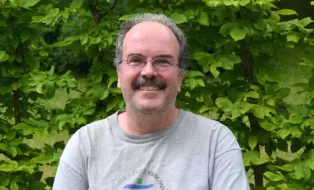
As of September 30, 2026, Prof. Dr. Kai Zuber, who held the Chair of Nuclear Physics for many years, has retired. The Institute of Nuclear and Particle Physics (IKTP) at TU Dresden honors an internationally recognized neutrino physicist who has had a significant impact on research and teaching at the institute since his appointment in June 2008. His work combines contributions to fundamental discoveries with the development of new research opportunities and the training of young physicists.
Kai Zuber’s academic career began at Heidelberg University. His master’s thesis on the GALLEX solar neutrino experiment and his doctoral dissertation, completed in 1992, on the Heidelberg-Moscow Experiment already addressed questions that would shape the rest of his career. After research stints in Heidelberg and Dortmund, a Heisenberg Fellowship from the German Research Foundation (DFG) took him to the University of Oxford. He subsequently taught and conducted research at the University of Sussex before taking up the Chair in Dresden.
Unraveling the Properties of Neutrinos
Neutrinos provide insight into processes occurring inside stars and, at the same time, challenge our understanding of the fundamental building blocks of nature. For decades, Kai Zuber has studied their properties and explored the question of what new physics can be uncovered through their investigation. His work bridges nuclear and particle physics with astrophysics and cosmology. He is the author of more than 600 scientific publications.
A particular focus of his research is the search for neutrinoless double beta decay. The detection of this as-yet-unobserved process would demonstrate that neutrinos are their own antiparticles. With the COBRA experiment, which he proposed in 2001, Kai Zuber developed an independent approach based on semiconductor detectors. In addition, he participated in the international GERDA and LEGEND experiments and established this field of research in Dresden.
His research activities also extended to the Sudbury Neutrino Observatory (SNO) in Canada and its follow-up experiment, SNO+. As a member of the SNO collaboration, he was among the researchers honored with the 2016 Breakthrough Prize in Fundamental Physics. This prize recognized the discovery and study of neutrino oscillations, which have fundamentally changed our understanding of these particles.
Through his participation in the Borexino experiment, Kai Zuber also contributed to research on energy production in the Sun. The Borexino collaboration was honored in 2021 with the Giuseppe and Vanna Cocconi Prize from the European Physical Society for its measurements of solar neutrinos from the proton-proton chain and the CNO cycle.
His particular expertise in above-ground measurements also led to groundbreaking research beyond neutrino physics, for example, to high-precision measurements of atomic nuclear masses at the ISOLTRAP experiment and to the establishment of German participation in the COMET experiment, where previously unobserved muon processes can be sought.
An Underground Laboratory for Dresden
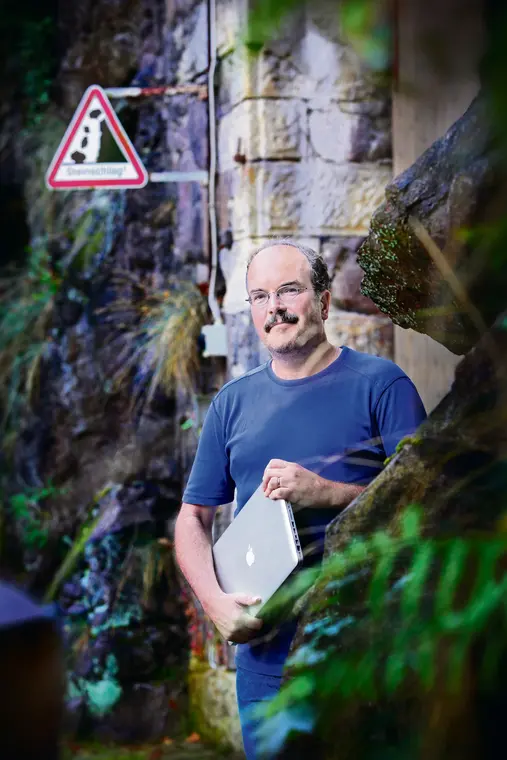
His commitment to Dresden as a research hub is particularly evident in the Felsenkeller. Following a joint initiative by Kai Zuber and Thomas Cowan, a collaboration was established in 2009 between TU Dresden, the former Dresden-Rossendorf Research Center, and the VKTA. This opened up access for scientists and students to the existing underground laboratory for research and training and became a prime example of the collaboration among Dresden’s research institutions that distinguishes Dresden as a center of science.
As scientific director, Kai Zuber shaped the further development of the Felsenkeller laboratory. Together with the Helmholtz-Zentrum Dresden-Rossendorf and in close collaboration with Daniel Bemmerer, a research infrastructure was established that combines studies of nuclear reactions in stars with highly sensitive measurements of rare decays. The underground accelerator, opened in 2019, and the measurement stations for trace levels of radioactivity create opportunities that draw researchers from Germany and abroad to Dresden. Thus, a long-term scientific vision has evolved into a venue for collaborative experiments and the training of early-career researchers.
Sharing Knowledge and Paving the Way for Science
As a university professor and author, Kai Zuber also made neutrino physics accessible. His textbook *Neutrino Physics*, which has been published in several editions—the third of which was released in 2020—guides readers from the fundamental principles of physics to the experiments and open questions in the field. It offers students and researchers a comprehensive introduction to a field that has undergone fundamental developments throughout his career.
Mentoring young scientists is also an integral part of his work. Kai Zuber supervised or co-supervised more than twenty doctoral dissertations as well as numerous diploma, master’s, and bachelor’s theses. In doing so, he gave young people the opportunity to collaborate on international experiments and pursue their own research questions. Among his former doctoral students are Belina von Krosigk, now a professor of experimental physics at Heidelberg University; Daniel Münstermann, now a professor at RheinMain University of Applied Sciences; and Henning Kiel, a professor of applied mathematics at Westphalian University of Applied Sciences. Their career paths exemplify the impact of his work beyond his own research group.
Internationally Connected
Kai Zuber’s scientific exchanges extended far beyond Dresden. His international collaborations and his presence at conferences made him a well-known figure in neutrino and astroparticle physics. Anyone who met him at a conference might run into him again on another continent just a short time later. Among his colleagues, this was jokingly summed up as: “Kai is like a wave function: everywhere at once—with the occasional collapse at a conference.”

Kai Zuber traf Arthur McDonald (rechts) auf dem Rückweg nach der Nobelpreiszeremonie zu einem gemeinsamen Abendessen in Oxford und durfte dabei auch einmal die Nobelpreismedaille in der Hand halten.
Particular highlights for Dresden as a research hub were the visits by Nobel Prize in Physics laureates Arthur B. McDonald in 2017 and Takaaki Kajita in 2019. Both also spoke about their research in public lectures at TU Dresden. McDonald, with whom Zuber was connected through SNO, delivered the keynote address at the topping-out ceremony for the Felsenkeller Accelerator Laboratory; Kajita participated in its grand opening two years later.
The IKTP extends its heartfelt thanks to Kai Zuber for his many years of dedication to research and teaching, for his contributions to the Institute’s development, and for guiding many scientists throughout their careers. We wish him all the best in this new chapter of his life and are delighted that he will remain closely connected to the Institute.