
Jul 06, 2026
The First Minutes of the Universe in the Lab – New Beamline for Nuclear Physics at TU Dresden
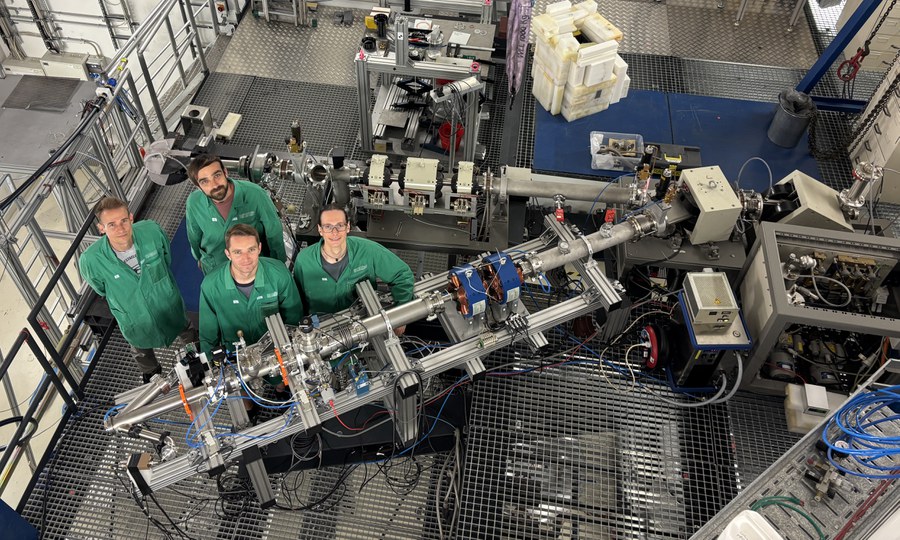
An der neuen Beamline des DT-Neutronengenerators: Toralf Döring, Steffen Turkat, Max Osswald, Frederik Uhlemann (v.l.n.r.)
The history of the universe began 13.8 billion years ago. However, some details of those first few minutes are still not fully understood. A new beamline has now been put into operation at the DT Neutron Generator of the Institute of Nuclear and Particle Physics (IKTP) at TU Dresden, which is intended to investigate precisely this early phase of cosmic evolution.
How did the first chemical elements in the universe form? This question has occupied astrophysicists for decades. The first atomic nuclei formed within the first few minutes after the Big Bang – a process known as primordial or Big Bang nucleosynthesis. This process primarily produced the light elements hydrogen and helium, which to this day make up the majority of visible matter in the universe. Despite the enormous contributions of stars, supernovae, and neutron star mergers to the formation of heavier elements, this ratio has hardly changed since then.
The theoretical models of Big Bang nucleosynthesis are astonishingly precise. Nevertheless, some of their results depend on nuclear reactions whose properties are not yet known with the necessary accuracy. This is precisely where a new research project at the Institute of Nuclear and Particle Physics comes in.
Measuring the Big Bang
The focus is on two nuclear reactions involving the hydrogen isotope deuterium. In one, two deuterium nuclei fuse to form helium-3 and a neutron; in the other, tritium (hydrogen-3) and a proton are produced. In nuclear physics, these processes are referred to as the 2H(2H,n)3He and 2H(2H,1H)3H reactions, respectively. These reactions played a key role in the formation of the first elements in the early universe. Their properties significantly determine the predicted abundance of deuterium and thus the accuracy with which the conditions during Big Bang nucleosynthesis can be reconstructed. At the same time, they provide important information about the baryonic matter density of the universe – that is, the amount of matter that makes up stars, planets, and ultimately ourselves.
A New Beamline for Astrophysics
For these investigations, a new beamline was installed at the DT Neutron Generator at TU Dresden over the past few months and successfully commissioned in early June. The beamline, developed specifically for astrophysical research, enables measurements in precisely the energy range relevant to the processes of Big Bang nucleosynthesis. An important milestone has already been reached: In mid-June, the first measurements of deuterium reactions on specially developed targets were successfully carried out. This lays the foundation for future precision measurements, which are expected to contribute to a significant improvement in the underlying nuclear physics data.
From Nuclear Physics to Cosmology
The project is based at the Chair of Nuclear Physics and led by Dr. Steffen Turkat. The team also includes Max Osswald (doctoral student) and Frederik Uhlemann (Master’s student). The construction and commissioning of the beamline were significantly supported by Toralf Döring (Technical Staff HZDR – AMS group Prof. Wallner).
The planned experiments are intended to significantly reduce the uncertainties in the reaction rates of deuterium fusion. More precise measurement data not only improve our understanding of the formation of the first elements but also provide important foundations for modern cosmological models. With this new infrastructure, the Dresden facility will have powerful capabilities for nuclear astrophysics research. Here, fundamental questions about the history of the universe are investigated—from the first seconds after the Big Bang to the question of just how much matter actually exists in the universe. After all, sometimes the search for the origins of the universe begins with a particle beam in a laboratory.
Further information:
 © IKTP
Mitarbeiter
NameMr Dr. Steffen Turkat
Kernphysik
Send encrypted email via the SecureMail portal (for TUD external users only).
Institute of Nuclear and Particle Physics
Visiting address:
Andreas-Schubert-Bau, EG, Raum 10 Zellescher Weg 19
01069 Dresden
Felsenkeller:
Am Eiswurmlager 12
01189 Dresden
Deutschland