
Sep 28, 2026
From a Fireball to the Felsenkeller Lab: Students Study Meteorites
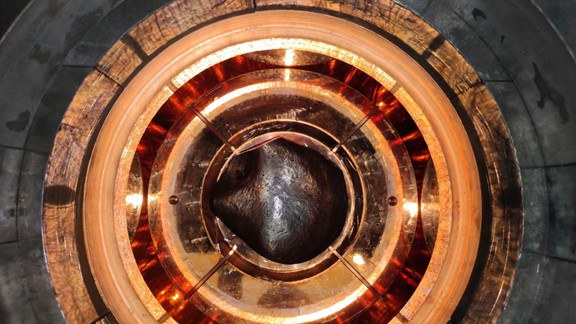
On March 8, 2026, a meteorite fell to Earth in Koblenz and crashed through the roof of a residential building. A few weeks later, a small fragment of it was found on a germanium detector at the Felsenkeller underground laboratory in Dresden. Freshly fallen meteorites are particularly interesting to researchers because they still contain radioactive traces of their journey through the solar system, which decay over time.
Cosmic radiation produces so-called cosmogenic radionuclides in meteorites. Sodium-22 and aluminum-26 are of particular interest. Sodium-22 has a half-life of about 2.6 years, while aluminum-26 has a half-life of about 717,000 years. The two nuclides therefore decay on very different timescales. Their activity levels and their ratio, together with models for production, shielding, and the meteorite’s size, can provide clues about its irradiation and fall history.
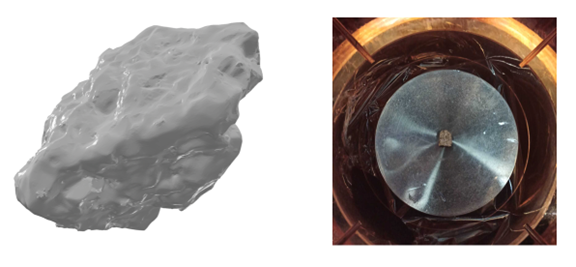
Das nur 1,279 Gramm schwere Bruchstück des Koblenz-Meteoriten im 3D-Scan (links) und auf der Endkappe des TU1 Detektor im Felsenkeller (rechts). Die reale Probengeometrie wird in der Monte-Carlo-Simulation berücksichtigt.
For such measurements, it is crucial to have as low a natural radiation background as possible. Dresden offers particularly good conditions in this regard: The TU1 measurement site is located approximately 45 meters below bedrock and additionally uses massive shielding made of copper and lead. This allows even extremely rare radioactive signals to become detectable. The Koblenz sample was analyzed both in the VKTA’s Felsenkeller underground laboratory and in the new Felsenkeller underground laboratory of TU Dresden and the HZDR. Measurements were taken at TU1 from April 9 to May 1, 2026. Calculated back to the day of the fall, this resulted in specific activities of 103 ± 15 decays per minute per kilogram for aluminum-26 and 86 ± 12 decays per minute per kilogram for sodium-22. In the entire sample, which weighed only 1.279 grams, this corresponds to an activity of only about two millibecquerels for each isotope.
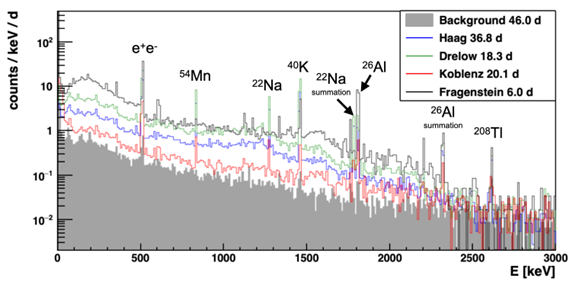
Gammaspektren der Meteoriten Haag, Drelów, Koblenz und Fragenstein im Vergleich zum Untergrund des TU1-Detektors. Die charakteristischen Peaks erlauben die Identifikation und Quantifizierung radioaktiver Nuklide.
The analysis of the Koblenz measurement was the subject of Konstantin Rummel’s bachelor’s thesis in the Nuclear Physics Group at the Institute of Nuclear and Particle Physics (IKTP). He ported the existing Geant4 simulation of the detector to the “remage” simulation environment—software specifically developed by the LEGEND collaboration for simulating germanium detectors. Konstantin examined systematic effects and modeled the actual geometry of the meteorites. To do this, the Koblenz sample was scanned in three dimensions at the SLUB Makerspace and imported into the Monte Carlo simulation as a highly detailed model. Konstantin Rummel successfully defended his bachelor’s thesis on September 7, 2026, and will be a co-author on the planned publication of the results.
The sample from Koblenz is not the first meteorite to be studied in the rock cellar. Since 2025, the team has measured several meteorite samples. Results regarding the Haag [link] and Drelów [link] meteorites have already been published in scientific journals. The various samples demonstrate how significantly size, shape, chemical composition, and the distribution of cosmogenic nuclides can influence quantitative analysis.
A particularly impressive new specimen is the recently discovered meteorite, which is expected to be named Fragenstein. In contrast to the Koblenz sample, which weighs only 1.279 grams, the Fragenstein specimen weighs approximately 3.743 kilograms – almost 3,000 times as much. Its high density of about 7.88 grams per cubic centimeter indicates that it is an iron-rich meteorite. Initial assessments suggest that it may have been on Earth for a very long time – on the order of one million years.
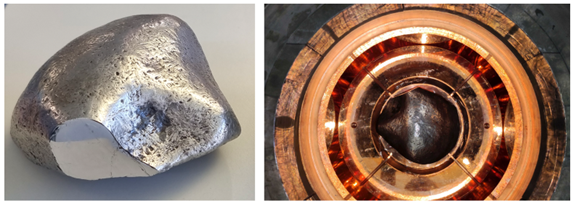
Der rund 3,74 Kilogramm schwere Fragenstein-Meteorit (links). Der Meteorit in der speziell angefertigten Low-Background-Halterung auf dem TU1 Germaniumdetektor (rechts).
To measure such a large specimen, a special mount had to be fabricated, as the meteorite could not simply be placed on the detector cap. Christoph Seibt, a doctoral student in the IKTP’s nuclear physics group, therefore designed a special mount made of high-purity copper. The material used introduces very little natural radioactivity into the measurement. Christoph is currently analyzing the data. The measurement is intended to help confirm the extraterrestrial origin of the specimen and lay the groundwork for its registration and naming in the international meteorite database.
The meteorite measurements thus combine several aspects of modern experimental physics: highly sensitive gamma spectrometry, Monte Carlo simulation, 3D modeling, and the interpretation of cosmogenic radionuclides. For students, they offer the opportunity to learn, using a manageable sample, methods that are also required in neutrino, dark matter, and astroparticle physics. In the future, additional highly sensitive, low-background detectors in the planned Low Seismic Lab at the German Center for Astrophysics are expected to further expand measurement capabilities in Saxony.
Contact and Supervision:
 © Björn Lehnert
Group leader
NameDr. Björn Lehnert
Nuclear physics
Send encrypted email via the SecureMail portal (for TUD external users only).
Institute of Nuclear and Particle Physics
Visiting address:
Andreas-Schubert-Bau, 4. Etage, Raum 420 Zellescher Weg 19
01069 Dresden