
Jun 29, 2026
Preparations for the “High-Luminosity” Era: Dresden’s ATLAS groups are preparing for the next step at CERN
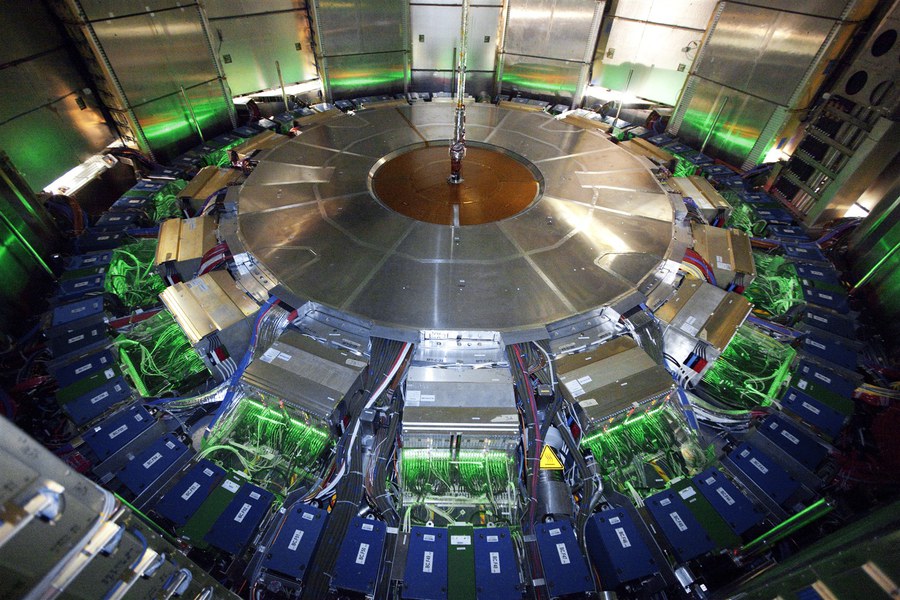
Last weekend, the final particle collisions – for the time being – took place at CERN’s Large Hadron Collider (LHC). This marks the end of the third operating cycle, known as Run 3, at the world’s largest particle accelerator. After four years of successful data collection, a new phase is now beginning: Through 2030, the accelerator and the major experiments will undergo extensive modernization and be prepared for the High-Luminosity LHC (HL-LHC). The two ATLAS groups at the Institute of Nuclear and Particle Physics at TU Dresden, led by Prof. Arno Straessner and Prof. Frank Siegert, are also playing a key role in this transition.
Starting in 2030, the High-Luminosity LHC will deliver approximately ten times more data than before. The significantly higher luminosity will make it possible to study extremely rare particle processes with unprecedented precision. At the same time, the demands on the detectors will increase considerably: At each beam crossing, approximately 200 proton-proton collisions will occur simultaneously.
Arno Straessner’s research group is developing new methods for the rapid and precise readout of signals from the ATLAS calorimeter. The goal is to precisely measure the energies of the produced particles even under the much more demanding conditions of the HL-LHC. Arno Straessner explains: “The upgrade is a prerequisite for being able to take advantage of the opportunities offered by the HL-LHC at all.” The new detector components are scheduled to be installed in the ATLAS experiment starting in 2027.
Frank Siegert’s research group will also benefit from this; they are investigating the properties of the Higgs mechanism using extremely rare scattering processes at the LHC. “The biggest challenge lies in the rarity of these events,” says Frank Siegert. That is why the significantly larger data volume from the HL-LHC is eagerly anticipated.
The end of Run 3 therefore by no means marks a break for the Dresden scientists. The coming years will be entirely devoted to preparations for the next expansion phase of the ATLAS experiment and, with it, new insights into the fundamental building blocks of our universe.
Contact:
Prof. Frank Siegert
Prof. Arno Straessner