
BNE-Workshops
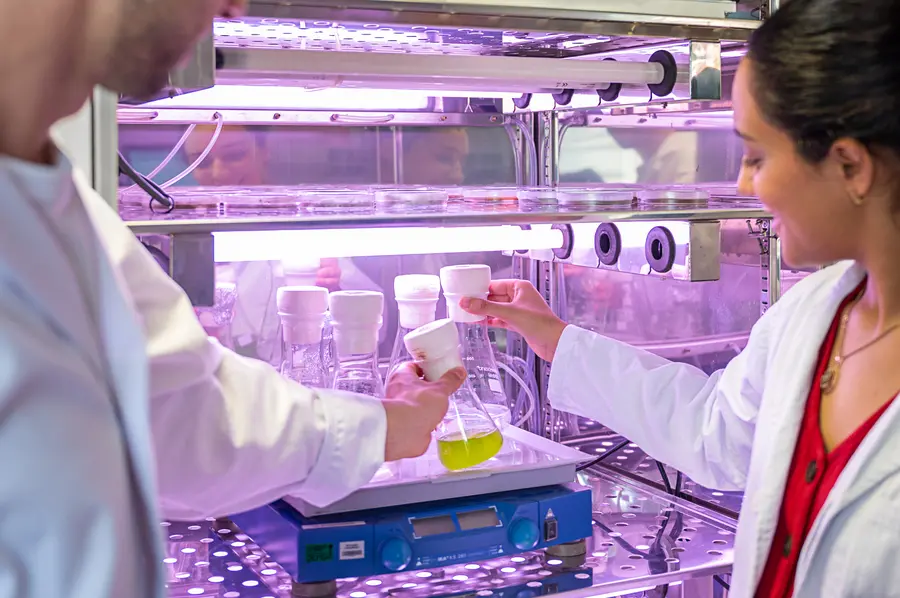
Wie hängen Umwelt, Wirtschaft, Gesellschaft und Technik zusammen? Die BNE-Angebote der TU Dresden greifen vielfältige Themen rund um nachhaltige Entwicklung auf – von Klimawandel und Ressourcennutzung über erneuerbare Energien bis hin zu Ernährung und gesellschaftlichen Entscheidungsprozessen. Die Workshops, Vorträge und Planspiele bieten Anknüpfungspunkte für den Profilunterricht, fächerverbindenden Unterricht und Projekttage. Je nach Thema und Klassenstufe ermöglichen sie Schülerinnen und Schülern, wissenschaftliche Perspektiven kennenzulernen, Zusammenhänge zu entdecken und eigene Lösungsansätze zu entwickeln.
Related Subjects: Biology | Chemistry | Physics | ESD
Key Topics: CO2 Transport Between the Earth and the Atmosphere
Format: Workshop
Every year, several hundred million metric tons of CO2 are released into the atmosphere in Germany. To prevent the concentration of CO2 in the atmosphere from rising further, it must be reabsorbed. Plants take in CO2 and can sequester carbon, but how much CO2 can a forest or a meadow actually absorb? We’ll examine how CO2 is transported between the atmosphere and the Earth’s surface and how this process can be measured.
| Participant Capacity | Age/Grade Level: | Duration: | Location: |
| 10–30 | 8th to 10th grade | 90 minutes | Measuring station in Tharandt |
- Also available as a mobile option (e.g., as an in-class activity)
Institution: Chair of Meteorology
Related Subjects: Physics | Chemistry | Geography | ESD
KeyTopics: Energy Transport | Radiation
Format: Workshop
Where does all this heat actually come from? Well, from the sun, of course—but why is this becoming more and more of a problem for us humans? We’ll delve into energy transport via radiation, discuss radiation balances and “radiative forcing,” and measure radiation fluxes from the sky as well as from natural and artificial surfaces at various wavelengths.
| Participant Capacity | Age/Grade Level: | Duration: | Location: |
| 10–20 | 8th–10th grade | 90 minutes | Flexible—outdoors or right in the classroom |
- Also available as a mobile option (e.g., as a format held directly in the classroom)
Institution: Chair of Meteorology
Related Subjects: Biology | Physics | Geography | ESD
KeyTopics: Water | Water Cycle | Landscape
Format: Workshop
How does water flow through a landscape? And what does this have to do with watersheds? In a short presentation and a hands-on activity, students explore the water cycle—using paper, a pen, and the Augmented Reality Sandbox.
| Participant Capacity | Age/Grade Level: | Duration: | Location: |
| 10–30 | 8th to 10th grade | 90 minutes | Classroom and at the Chair of Hydrology, Bergstrasse 66 |
- Also available as a mobile option (e.g., conducted directly in the classroom)
Institution: Chair of Hydrology
Related Subjects: Biology | Chemistry | Geography | ESD
KeyTopics: Water | Chemicals | Drinking Water
Format: Workshop
This presentation, which includes many interactive questions, focuses on water pollution caused by chemicals. Students discuss questions such as: Where do the chemicals come from? How do they get into the water? How can they be removed? Can I still drink tap water? What can I do myself to help reduce the amount of chemicals that end up in the water?
| Participant Capacity | Age/Grade Level: | Duration: | Location: |
| 10–30 | 8th to 10th grade | 90 minutes | Classroom and at the Chair of Hydrology, Bergstrasse 66 |
- Also available as a mobile option (e.g., conducted directly in the classroom)
Institution: Chair of Hydrochemistry and Water Technology
Subjects Covered: Physics | Biology | Chemistry | Geography | ESD
KeyTopics: Water | Chemicals | Drinking Water
Format: Workshop
The module consists of two parts: A lecture lasting up to 45 minutes on groundwater. Where and how is it found? How much of it is there? Where does it come from, and where does it flow? The second part of the module is hands-on and will introduce students to models and small experimental setups that illustrate how groundwater behaves underground. Students will get to try things out for themselves, and it might even get a little wet.
| Participant Capacity | Age/Grade Level: | Duration: | Location: |
| 10–30 | 8th to 10th grade | 90 minutes | Lecture in the classroom or at TUD. Hands-on portion at the technical center. |
- Also available as a mobile option (e.g., conducted directly in the classroom)
Institution: Chair of Groundwater Systems
Subjects Covered: Physics | Biology | Chemistry | Geography | ESD
KeyTopics: Waste | Recycling | Circular Economy
Format: Workshop
This presentation covers the fundamentals of waste management. Basic technical processes involved in waste treatment are explained and clearly illustrated. The pathways our waste takes are illustrated. During an on-site visit, participants can tour processing units, pilot plants, the laboratories, and the “VERENA” waste-to-energy plant.
| Participant Capacity | Age/Grade Level: | Duration: | Location: |
| 10–30 | 5th through 7th grade | 90 minutes | Lecture in the classroom or at TUD. Practical component (if desired) at TUD (Pirna branch) |
- Also available as an on-site session (e.g., directly in the classroom)
Institution: Chair of Waste Management and Circular Economy
Related Subjects: Biology | Chemistry | Geography | ESD
KeyTopics: Water | Drinking Water | Wastewater
Format: Lecture & Guided Tour
The lecture covers the basics of waste management. Fundamental technical processes involved in waste treatment are explained and clearly illustrated. The journey of our waste is illustrated. During an on-site visit, participants can tour treatment units, pilot plants, the laboratories, and the “VERENA” waste-to-energy plant.
| Participant Capacity | Age/Grade Level: | Duration: | Location: |
| 10–20 | Elementary school (ages 6–10) | Short programs (under 30 minutes) are available, as well as 90-minute and 120-minute or longer programs (morning or afternoon sessions) | Classrooms and at the Institute of Urban and Industrial Water Management, Bergstrasse 66 |
- Also available as a mobile program (e.g., conducted directly in the classroom)
Institution: Chair of Process Engineering in Hydro Systems
Related Subjects: Biology | Geography | ESD
KeyTopics: Water | Water Resources | Climate Change
Format: Workshop
This presentation, which includes many interactive questions, focuses on the importance of water for life, the (anthropogenic) water cycle and climate change, virtual water and the water footprint, drinking water use, and the Dresden Waterworks. Information about careers in the water sector can also be provided as an option.
| Participant Capacity | Age/Grade Level: | Duration: | Location: |
| 30 people | 8th through 10th grade (ages 14–16) | 90 to 120 minutes | Classroom and at the Institute of Urban and Industrial Water Management, Bergstrasse 66 |
- Also available as a mobile program (e.g., conducted directly in the classroom)
Institution: Chair of Process Engineering in Hydro Systems
Subjects Covered: Biology | Chemistry | Geography | ESD
KeyTopics: Water | Water Resources | Water Quality
Format: Workshop (conducted in English)
The workshop provides insight into water scarcity in terms of quantity and quality, as well as the challenges arising from conflicts of interest and limited resources for action. Following a thematic introduction, students will play the serious game “MoRe Water.” They will plan monitoring campaigns to identify land uses and will be presented with a specific scenario requiring action. This will challenge them to identify the causes and responsible parties in order to secure the scarce resource of water.
| Participant Capacity | Age/Grade Level: | Duration: | Location: |
| 20–30 participants | 11th through 13th grade or until after high school graduation (ages 16 and up) | Longer than 120 minutes (morning or afternoon program) | Institute of Hydrobiology, Drudebau, Zellescher Weg 40 |
- Also available as a mobile program (e.g., conducted directly in the classroom)
Institution: Institute of Hydrobiology
Related Subjects: Social Studies | Economics & Law | Geography | ESD
Key Topics: Climate Protection | Resources | Emissions
Format: Workshop
Through a simulation game, students learn about the effects of using pollution rights (emissions) and how limiting these rights as a constraining factor changes established ways of thinking. Within the game, each participant is an emitter and can decide for themselves how to manage resources and influence their interactions—including with other players. The learning objective is to understand the difficulties involved in reaching a global agreement on climate protection and the challenges that exist in this context.
| Participant Capacity | Age/Grade Level: | Duration: | Location: |
| 10–20 people | Grades 8 through 13 or through high school graduation | Short program available (under 30 minutes) & longer than 120 minutes (morning or afternoon program) |
Directly in the classroom or at TUD |
- Also available as a mobile program (e.g., held directly in the classroom)
- Online
Institution: Professur für Energiewirtschaft
Related Subjects: | Economics & Law | Geography | Biology | ESD
KeyTopics: Sustainability | Resources | Economics
Format: Workshop
Through a simulation game, students learn about the impacts of using pollution rights (emissions) and how limiting these rights as a constraining factor changes established ways of thinking. Within the game, each participant acts as an emitter and can decide for themselves how to manage resources and influence their interactions—including with other players. The learning objective is to understand the difficulties involved in reaching a global agreement, such as on climate protection, and to recognize the challenges that exist in this context.
| Participant Capacity | Age/Grade Level: | Duration: | Location: |
| 20–30 participants | 5th through 7th grade (ages 11–13) | 90 min | Directly in the classroom or at TUD |
- Also available as a mobile program (e.g., conducted directly in the classroom)
Institution: Chair of International Economic Relations
Related Subjects: | Economics | Social Studies | Geography | ESD
KeyTopics: Climate Protection | Economics | Public Goods
Format: Workshop
Through a simulation game, students learn about the impacts of using pollution permits (emissions) and how limiting these permits as a constraining factor changes established perspectives. Within the game, each participant acts as an emitter and can decide for themselves how to manage resources and influence their interactions—including with other players. The learning objective is to understand the difficulties involved in reaching a global agreement on climate protection and to identify the challenges that exist in this context.
| Participant Capacity | Age/Grade Level: | Duration: | Location: |
| 20–30 participants | 5th through 7th grade (ages 11–13) | 90 min | Directly in the classroom or at TUD |
- Also available as a mobile program (e.g., conducted directly in the classroom)
Institution: Chair of International Economic Relations
Subjects Covered: | Economics | Chemistry | Biology | ESD
Key Topics: Circular Economy | Sustainability | Recycling
Format: Workshop
What is the circular economy? The presentation focuses on a positive vision (Cradle to Cradle) for the future, in which humans become beneficial organisms. However, it also addresses the current state of affairs and the challenges on the path toward a circular economy. The workshop is about getting creative and developing a product design that meets all the criteria of a circular economy.
| Participant Capacity | Age/Grade Level: | Duration: | Location: |
| 20 or more participants – over 30 participants | 5th through 7th grade (ages 11–13) | 45–90 min | Right in the classroom |
- Also available as a mobile program (e.g., conducted directly in the classroom)
- Online
Institution: Institute of Waste Management and Circular Economy
Related Subjects: Biology | Chemistry | Geography | ESD
KeyTopics: Plastic | Microplastics | Marine Pollution
Format: Lecture
How does plastic waste end up in the ocean, and what effect does it have on the animals and plants there? We’re hearing more and more about plastic islands in the ocean and microplastics in our food. But how did they get there, and what can science tell us about the risks? These and other questions will be answered in this lecture.
| Participant Capacity | Age/Grade Level: | Duration: | Location: |
| 10–over 30 people | Elementary school (ages 6–10) | 45–60 min | Right in the classroom |
- Also available as a mobile program (e.g., conducted directly in the classroom)
- Online
Institution: Institute of Waste Management and Circular Economy
Related Subjects: Biology | Physics | ESD
Key Topics: Materials, Wood, Sustainability, Environmental Protection
Format: Workshop
Workshop featuring a short introductory presentation on the development of bio-based oil absorbents that, in combination with bacteria, can clean up oil spills at sea, along the coast, or in inland waters (with video clips from field trials in the Baltic Sea); Hands-on experiments to measure the oil absorption of wood-based oil binders, both in dry conditions and from the water surface of an aquarium; a competition featuring several teams in oil binder distance and target throwing, with small prizes
| Participant Capacity | Age/Grade Level: | Duration: | Location: |
| (5–30) | 8th–10th grade | 30–60 min | MAR 32 / Marschnerstrasse |
- Also available as a mobile option (e.g., as a format held directly in the classroom)
Institution: Chair of Wood Technology and Wood-Based Bioeconomy
Inquire now
Related Subjects: Chemistry, Physics, Biology, ESD
Key topics: Sustainability, environmental technology, resource conservation
Format: Lecture
In the “Environmental Protection” course, participants receive a thorough introduction to the fundamentals and global challenges of environmental protection. Topics such as energy, ethics, environmental law, and the economics of environmental protection are covered, as are technical approaches to air, water, and waste management. Other key areas include material and product cycles, noise control, as well as contaminated site remediation and soil protection. The program is supplemented by an analysis of the effects of pollutants, radiation, and noise, as well as strategies for risk minimization and plant safety. Thanks to the diversity of topics, current developments are addressed and explored in depth with participants in a dialogue-oriented format.
| Participant Capacity | Age/Grade Level: | Duration: | Location: |
| 20 or more participants | Starting in 8th grade | 90 min | Mollier Building, George-Bähr-Str. 3, 01069 Dresden, Room 213 (MOL/213/H) |
Institution: Chair of Energy Process Engineering
Subjects Covered: Mathematics | Physics | Chemistry | ESD
Key Topics:Paper, Sustainability, Circular Economy, Packaging, Recycling
Format: Workshop
Workshop featuring a brief introductory presentation on the circular economy in general and the recycling of paper and paper products. Group work to determine how different types of packaging should be disposed of in Germany to ensure recycling. Selection of paper packaging and conducting simple recycling tests in the lab. (Optional: conducting experiments on ink removal during recycling).
| Participant Capacity | Age/Grade Level: | Duration: | Location: |
| (5–10) | Starting in 8th grade | Longer than 120 minutes (morning or afternoon program) | Marschnerstraße 39, 01307 Dresden |
Institution: Chair of Wood Technology and Wood-Based Bioeconomy
Inquire now
Subjects Covered: Mathematics | Physics | Chemistry | BNE
Key Topics: Paper , Sustainability, Circular Economy, Packaging, Recycling, Product Development
Format: Workshop
Workshop featuring a brief introductory lecture on paper in general, packaging trends, and packaging functions. Overview of how to calculate insulation materials. Presentation of projects focused on developing paper-based insulation packaging. Group work to calculate packaging specifications (determining thickness) for specific insulation requirements. Demonstration of the recyclability of the developed paper packaging in the lab, including independent completion of lab reports (under supervision).
| Participant Capacity | Age/Grade Level: | Duration: | Location: |
| (5–10) | Starting in 8th grade | 120 min | Marschnerstraße 39, 01307 Dresden |
Institution: Chair of Wood Technology and Wood-Based Bioeconomy
Inquire now
Related Subjects: Mathematics | Physics | Chemistry | Biology | ESD
KeyTopics: Climate and Environment, Circular Economy
Format: Workshop
This workshop provides students with hands-on insight into process engineering and its significance for current transformation processes in our society. The focus is particularly on topics such as sustainability, the circular economy, and climate and environmental protection.
After a brief introduction to process engineering, participants explore typical fields of application at various stations—ranging from chemistry and food technology to raw material processing. They have the opportunity to conduct experiments themselves and examine various demonstration objects. At the same time, they gain initial insights into practical laboratory work.
The workshop thus provides an overview of the diverse applications of process engineering and offers guidance for participants’ own academic and career planning.
| Participant Capacity | Age/Grade Level: | Duration: | Location: |
| (5–30) | Starting in 8th grade | 120 min | TU Campus / Merkelbau and VVT Hall |
Institution: Institute of Process Engineering and Environmental Technology
Related Subjects: Physics | Biology | Mathematics |Social Studies | Political Science | ESD
KeyTopics: Mobility , Transportation Planning, Ecology
Format: Guided tour/lab visit
Climate-friendly, safe, inclusive: How should urban transportation be designed in the future? In this workshop, students learn to develop their own perspectives on their transportation behavior and can devise creative solutions for the mobility of the future.
| Participant Capacity | Age/Grade Level: | Duration: | Location: |
| (5–20) | Grades 1 through 7 | 45 to 90 min | Gerhart-Potthoff-Bau, Hettnerstr. 1-3, Seminar Room, 01069 Dresden |
- Also available as a mobile option (e.g., conducted directly in the classroom)
Institution: Chair of Transport Ecology
Related Subjects: Biology | Physics | Chemistry | ESD
KeyTopics: Sustainability , Nutrition, Food, Technology, Process Engineering
Format: Workshop & Guided Tour
Eating habits and food preparation methods are changing. A growing global population and climate change also require resource-efficient food production technologies. So, what products and processes are currently being researched? How is food quality tested, and what is food sensory analysis? Together, we’ll produce selected foods in the pilot plant and analyze the products using both instrumental and sensory methods. These examples highlight the engineering challenges, provide insight into the Food Technology department within the Process Engineering and Natural Materials Technology degree program at TU Dresden, and showcase the career prospects for food technologists.
| Participant Capacity | Age/Grade Level: | Duration: | Location: |
| (5–20) | Grade 8 and up | 90 minutes or more | ZIN, Bergstraße 120 |
- Also available as a mobile program (e.g., conducted directly in the classroom)
Institution: Chair of Food Engineering
Related Subjects: Physics | Chemistry | BNE
Key Topics: Sustainability , lightweight construction, circular economy, product design, plastics
Format: Workshop
In this workshop, students will learn the basics of plastics and fiber-reinforced composites, including their chemical structure, manufacturing, design (construction), applications and use, disposal, and recycling options. Special emphasis is placed on the sustainable and resource-efficient use of plastics and fiber-reinforced composites. Through a series of hands-on stations, students will explore the advantages and disadvantages of using plastics in components and discover ways to collect, sort, and process plastics into new products. During these activities, students will discuss fundamental approaches that are preferable to traditional recycling. As part of the workshop, students can take home a unique component they made themselves from recycled plastics as a souvenir.
| Participant Capacity | Age/Grade Level: | Duration: | Location: |
| (5–20) | From 8th grade through high school graduation | Available in sessions of 45 minutes or longer, up to 120 minutes (morning or afternoon program) | Institute of Lightweight Engineering and Polymer Technology, Holbeinstraße 3, 01307 Dresden |
- Also available as an on-site program (e.g., conducted directly in the classroom)
Institution: Institute of Lightweight Engineering and Polymer Technology
Related Subjects: Physics | Geography | ESD
KeyTopics: ESD , Sustainability, Energy
Format: Workshop
How can you actually charge your cell phone using solar energy? You definitely need a solar cell—that much is clear. But that alone isn’t enough, because the voltage of the solar cell doesn’t match the cell phone’s voltage. That’s why you also need an electrical circuit to adjust this voltage. You’ll build and solder a power electronics version of this circuit on your own, then test it with a cell phone and—weather permitting—with a solar cell as well.
The project day is jointly offered by the Chair of Power Electronics and the Education Center of aha – anders handeln e.V., and brings together technology with Education for Sustainable Development (ESD). It consists of three parts: First, there is a general introduction to the topic of Education for Sustainable Development (ESD); then, the students solder a circuit to charge a cell phone using a solar module; and finally, the students design a sustainable cell phone charging station that they can use to charge their cell phones at their school.
| Participant Capacity | Age/Grade Level: | Duration: | Location: |
| (20–30) | Starting in 8th grade | Full day | Görgesbau, Helmholtzstraße 9, 01069 Dresden |
- For entire school classes; duration of the program is approximately 6 hours, including a one-hour lunch break
Institution: Chair of Power Electronics
Related Subjects: Physics | BNE
Key Topics: Sustainability, Technology, Packaging, Food, Mechanical Engineering, Process Engineering
Format: Workshop
Ensuring food security for a steadily growing global population and achieving sustainable production are challenges facing society as a whole, requiring technological solutions for resource-efficient food production and packaging. But how can agricultural raw materials be utilized to the highest possible quality and as completely as possible? How can key characteristics, such as taste and texture, be achieved in vegan products? And how can sensitive foods be packaged in a way that conserves resources while ensuring safety? Can novel packaging materials also be processed to meet quality standards? We are conducting research on these and other questions at the Chair of Food Engineering and the Chair of Processing Machines/ Processing Technology. We’ll give you an exciting look at our latest developments and opportunities to conserve valuable resources in food production and packaging. A short presentation will be followed by a hands-on tour of the pilot plant, where you can see and try out technological solutions for yourself.
| Participant Capacity | Age/Grade Level: | Duration: | Location: |
| (5–16) | Starting in 8th grade | 90 minutes or more (also suitable as a morning or afternoon program) | Institute of Natural Materials Technology, Room ZIN 120, Bergstraße 120, 01069 Dresden |
Institution: Chair of Processing Machines/ Processing Technology and Chair of Food Engineering
Related Subjects: Mathematics | Physics | Computer Science | ESD
Key Topics: Materials, Wood, Sustainability, Environmental Protection
Format: Workshop
How exactly does flying work, and how can it be made more environmentally friendly? We’ll answer these and many other exciting questions about aviation and the study of aerospace engineering in our program for students in grades 9 through 12. Aviation faces major challenges—let’s explore the latest developments and how they’re connected in an interactive way. Are you ready to take off and broaden your horizons? Join us and be part of the journey into the future of aviation!
| Participant Capacity | Age/Grade Level: | Duration: | Location: |
| (5–30) | Starting in 9th grade | 90 minutes or more | Marschnerstraße 32, 01307 Dresden |
- Also available as a mobile program (e.g., conducted directly in the classroom)
- Also available as a full-day program (with multiple learning stations and a closing forum)
Institution: Chair of Aircraft Engineering
Inquire now
Related Subjects: Physics | Computer Science | Biology | ESD
Key Topics: Sense of smell · Sensory perception · Digitalization
Format: Workshop
Electronic counterparts already exist for some of our senses. A camera for the eye—a microphone for the ear. But can we also build an artificial nose, and why would we need one? Human body odor is influenced by factors such as diet, current inflammatory processes, and hormonal balance; consequently, changes in body odor can provide clues about diseases. An electronic nose could provide valuable information that has so far been largely untapped in medicine. Electronic noses can also help people in their daily lives, as body odors play a crucial role in many social situations. They influence our attraction to a partner, create a sense of belonging within the family, and allow us to infer emotions. For this reason, the inability to perceive one’s own and others’ body odors is described as one of the most severe impairments for people with olfactory disorders. The workshop will explain how the digitization of the sense of smell works and, at the same time, introduce various sensors. Students will work together to set up an experiment in which such a sensor is connected and a measurement is taken. A short quiz in which students must identify odors is part of the workshop.
| Participant Capacity | Age/Grade Level: | Duration: | Location: |
| (5–20) | Starting in 8th grade | Up to 120 min |
Hallwachsstraße 3 (HAL), 01069 Dresden |
Institution: Chair of Materials Science and Nanotechnology
Related Subjects: ESD | Economics | Geography | Social Studies
KeyTopics: Sustainability , Resources, Public Goods, Climate Policy
Format: Workshop
|
We conduct an economic experiment (classroom game) with the students, either on the management of renewable resources or on the provision of public goods. This is accompanied by an overview of the field of Business Administration and Economics. a. Management of renewable resources. Through this activity, students can actively and playfully experience firsthand why problems such as overfishing or deforestation arise. And, of course, we discuss potential solutions. An overview of the field of Business Administration and Economics is provided free of charge. b. Provision of public goods Private goods (cars, smartphones, etc.) can be provided very effectively through the market. The environment, however, is a public good—and that’s not so straightforward. Students learn in a playful way about the coordination problems that also play a central role in climate policy. |
| Participant Capacity | Age/Grade Level: | Duration: | Location: |
| (5–30) | Starting in 6th grade | Duration: 90 min | TU Dresden or directly in the classroom |
- Also available as a mobile option (e.g., as a format held directly in the classroom)
Institution: Faculty of Business and Economics
Related Subjects: ESD | Geography | Biology | Civics / Social Studies
KeyTopics: Climate Change · Biodiversity · Sustainability
Format: Workshop
“The most dangerous of all worldviews is the worldview of people who have never looked at the world.” (Alexander von Humboldt). A 60- to 90-minute journey [customizable] to the tips of the icebergs that represent the major challenges of our time: biodiversity loss, climate change, and how scientific facts and new perspectives can contribute to a societal and economic shift in thinking.
| Participant Capacity | Age/Grade Level: | Duration: | Location: |
| (5–30) | Starting in 10th grade | Duration: 60 to 90 minutes | TU Dresden or directly in the classroom |
- Also available as a mobile option (e.g., as a format held directly in the classroom)
Institution: School of Civil and Environmental Engineering