
May 28, 2026
What if robots could smell? Interactive science exhibition “The future of smelling“ shows research on the electronic nose
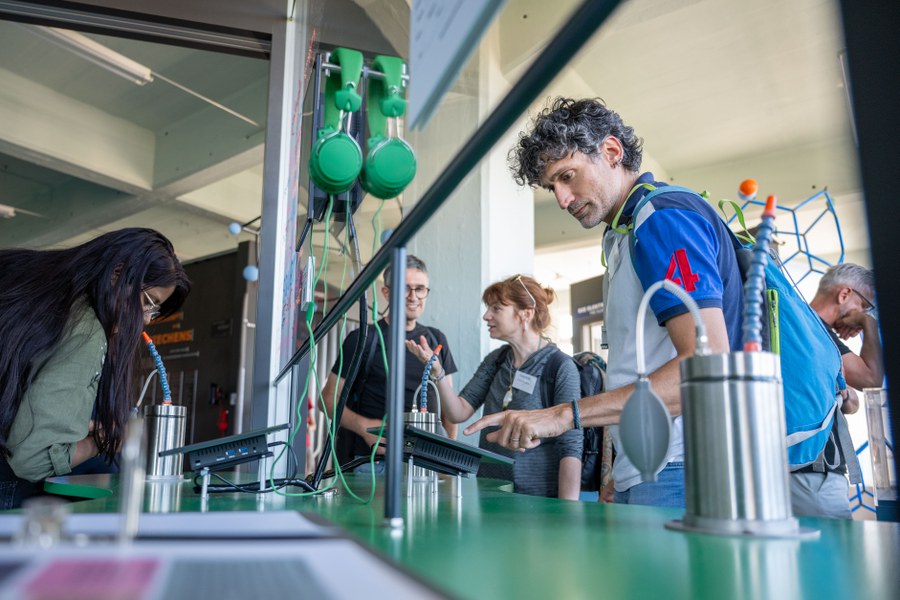
Visitors to the exhibition “The Future of Smell – From the Nose to Smelling Machines.”
Starting today and running through November 1, 2026, the Technische Sammlungen Dresden are presenting the special exhibition “The Future of Smelling – From the Nose to Smelling Machines.” For the first time, the exhibition makes the research of the Technical University of Dresden (TUD), Dresden University Hospital, and Friedrich Schiller University Jena visible and tangible to a broad public, allowing visitors to experience it firsthand. The exhibition was commissioned by the TUD.
The sense of smell: The underestimated superpower
The sense of smell is a powerful, invisible navigator that in everyday life often gets overlooked. Compared to the sense of smell of many animals, however, that of humans is underdeveloped—in the animal kingdom, we find true champions of smell: They can detect food sources from kilometers away, analyze emotions in extraordinary detail, and even identify serious illnesses through body odor or before symptoms appear. Mastering a olfactory technology capable of harnessing these extraordinary natural abilities for humans would mark a major milestone in civilization.
Olfactory perceptronics: When machines learn to smell
But how can a highly complex natural phenomenon like the sense of smell be translated into hardware and software? The answer lies in a new field of research: perceptronics. Perceptronics enables machine to perceive, to form memories, to acquire knowledge, and ultimately to think. It is a scientific discipline made possible by advances in sensor technology and, above all, the development of artificial intelligence.
Dresden, a hub for science and technology, is one of the world’s leading centers for microelectronics. It offers ideal conditions for researching and testing future technologies. In the unique collaborative project “Olfactorial Perceptronics,” funded by the Volkswagen Foundation, three leading research institutions in Central Germany are exploring the future of the electronic nose. In addition to TUD Dresden University of Technology, the University Hospital Dresden and the Friedrich Schiller University Jena are also participating in this project, which is led by Prof. Gianaurelio Cuniberti, Chair of Materials Science and Nanotechnology.
The project partners rank among the global leaders in their respective fields. In close cooperation, they are working towards an ambitious goal: developing smelling machines more powerful than even the most astute noses in the animal kingdom.
The interactive science exhibition
The exhibition conveys knowledge through interactive hands-on objects, experimental models, and media and software installations. Exhibits cover topics including medicine, biology, chemistry, psychology, history, nanotechnology, and materials science.
Beginning May 28, 2026, the exhibition guides visitors through three thematic areas:
- The biological nose
- The cosmos of scents
- The electronic nose
Each portal features video interviews with young female researchers and leading international experts from Central German top-tier research institutions.
The exhibition is funded by the Volkswagen Foundation through the program “Additional funding for science communication” and was designed by Paul Bauer, Interaktive Medien Potsdam, Studio Klarheit Filmproduktion Dresden, Jörg-Peter Bauer, Detlef Schweiger, Henry Puchert, and Atelier Tobias Ehlich.
Contact:
Prof. Gianaurelio Cuniberti
Chair of Materials Science and Nanotechnology
+49 351 463-31420
Press contact:
Stefanie Düring-Schmidt
Public relations
Technische Sammlungen Dresden
+49 351-4887254
Text: Paul Bauer - Interaktive Medien GbR