
Jul 15, 2026
Participation in Northern European Regional Meeting (NERM) of the International Forestry Students' Association
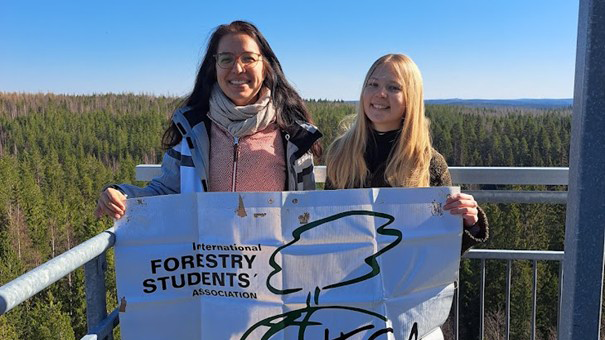
The GFF made it possible for us—Yasmin Hess and Miriam Hausl—to participate in the Northern European Regional Meeting (NERM) of the International Forestry Students’ Association (IFSA).
IFSA is an international, student-led organization that addresses issues related to the world’s forests and brings together forestry students from around the globe to collaboratively find solutions to current forest-related problems. At the TU Dresden branch campus in Tharandt, where forestry degree programs are offered, there is also an IFSA student chapter that organizes local field trips and events on forest-related topics and maintains international contact with forestry students from around the world.
This year’s regional meeting of all IFSA groups from Northern Europe took place from April 13 to 17 in Finland and was organized by local students. The program focused on topics relevant to the future, such as the use of wood products as an alternative to plastics, promoting biodiversity in forest management, and political framework conditions for forestry and environmental protection.
We were particularly impressed by the visit to a forestry research station in Hyytiälä, where climate data has been studied since 1905. Among other things, the measurements provide information about the forest’s carbon balance and the reasons for its fluctuations. The tour of the Äänekoski Bioproduct Mill was also impressive, as this modern wood processing facility allowed us to explore numerous applications of wood as a raw material that will become increasingly important in the future—for example, as fibers for producing plastic-free clothing and packaging, or as oxidized lignin to reduce the use of water and cement in the construction industry.
Furthermore, we had the opportunity to present two research projects from TU Dresden in which we were involved at the NERM: Yasmin Hess reported on the implementation of the UNESCO Man and the Biosphere Program in the Mata Atlântica Biosphere Reserve in Brazil, and Miriam Hausl provided participants with insight into the results of a Germany-wide survey that compared the focus areas of forestry degree programs in Germany, and measured satisfaction with them.
Furthermore, the exchange with other students from 15 different countries was, of course, an important opportunity for us to gain an authentic understanding of the challenges currently facing the forestry sector across Europe, as well as where the opportunities lie and what we, as future experts, can do.
Thanks to the support of the GFF, we were able not only to learn a great deal about the forestry sector in Finland at NERM 2026, but also to actively contribute. We would like to express our sincere thanks for this.
Miriam Hausl and Yasmin Hess