
Oct 28, 2026
Forest.Knowledge.Change – Interactive Learning in the Marteloskop - A Project of the DLL Fund
A report by Prof. Dr. Marieke van der Maaten-Theunissen, Chair of Forest Growth and Dendrosciences, and Erik Nestler, Chair of Soil Resources and Land Use
What was it about?
How can one make sound forestry decisions when ecological and economic goals compete with one another? The “Wald.Wissen.Wandel” project allows forestry students to experience this question firsthand—in a real forest and with digital support.
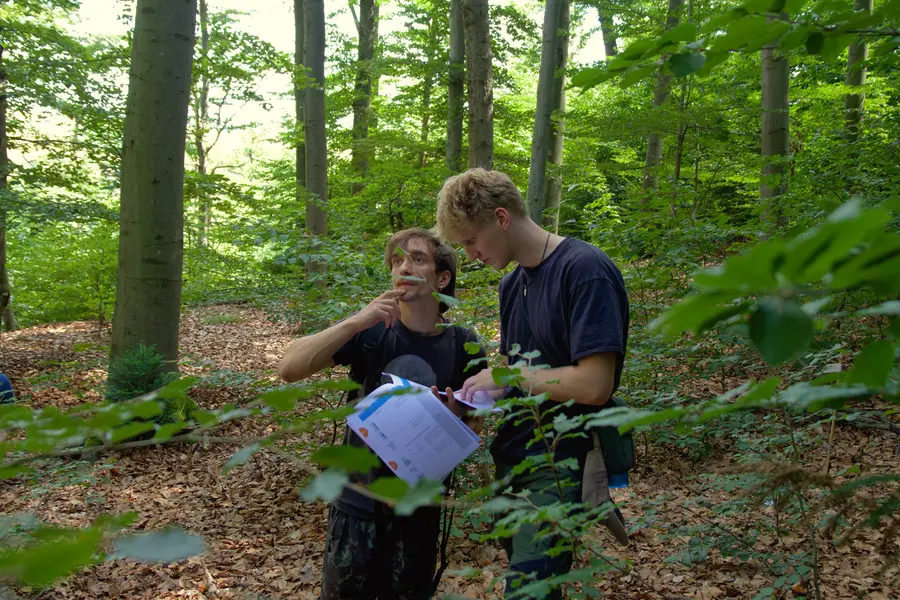
At the heart of the project are so-called Martel plots: rectangular forest areas ranging from 0.5 to 1 hectare, in which all trees are measured and additionally assessed for their ecological and economic value. Using the European Forest Institute’s I+ app, students can simulate virtual thinning operations there and immediately see the consequences of their tree selection on the stand, biodiversity, and timber revenue—presented as tables and diagrams that can be discussed right on site.
Three new Marteloscope plots were established and digitized in the Tharandt Forest; the data is now available in the I+ app. To enable students to use the plots independently, a teaching concept was developed in parallel that builds the exercises step by step: from the initial exploration of a stand through individual skills—such as identifying microhabitats or assessing wood quality—to tree selection in realistic scenarios like “forest conversion.” To this end, an introductory video, lesson plans for instructors, and worksheets and answer keys for self-assessment were created. The concept has so far been tested with 113 students in four courses—ranging from the ANW University Days to the “Forest Measurement” lab. The feedback: The combination of digital preparation, hands-on practice, and group reflection significantly boosts motivation and understanding.
The project was proposed by Prof. Dr. Marieke van der Maaten-Theunissen (Chair of Forest Growth and Dendrosciences) and Erik Nestler (Chair of Soil Resources and Land Use).
How were the grant funds used?
The funds were primarily used to pay Student Assistants and Research Assistants, as well as to cover consumables for establishing the three Marteloscope plots—that is, for the labor-intensive measurement and assessment of each individual tree, which forms the basis for the digital simulation.
What are the plans for the future?
The three plots will remain permanently available for use and will be regularly incorporated into courses and field trips organized by the ANW university group. The range of exercises is set to expand: Skills previously practiced individually will be integrated into scenarios such as “biotope forest” and “commercial forest,” in which students apply their knowledge to make concrete decisions. In the long term, exercise results will be consolidated into a personal competency profile via OPAL; in addition, the publication of teaching materials as Open Educational Resources is underway.
At the same time, the sites have become a focal point for research: several theses are addressing them, a master’s thesis will evaluate the teaching concept, and since spring 2026, daily drone flights have been recording how the forest changes over the course of the year. Since the concept has a modular structure, it can be adapted to Marteloscopes at other locations in Saxony, Germany, and Europe.
 © Marieke van der Maaten
Professor in Forest Growth
NameProf. Dr. Marieke van der Maaten-Theunissen
Send encrypted email via the SecureMail portal (for TUD external users only).
Chair of Forest Growth and Dendrosciences
Visiting address:
Hauptgebäude (HAU) Pienner Straße 8
01737 Tharandt
 © D.Henzen
Erik Nestler M.Sc.
Send encrypted email via the SecureMail portal (for TUD external users only).
Institute of Soil Science and Site Ecology
Institute of Soil Science and Site Ecology
Visiting address:
Judeich-Bau, 2.26 Pienner Straße 19
01737 Tharandt
The Digital Learning and Teaching Fund provides the Center for Interdisciplinary Learning and Teaching with a tool for the (further) development of digital teaching and learning scenarios. In this way, we are contributing to the sustainable improvement of teaching quality at TUD.
During the 2025–2026 funding period, we were able to support and guide five exciting projects from various academic disciplines. As part of a series of news articles, we’d like to introduce the individual projects on our website over the next few weeks and show how they will continue to influence teaching at TUD after the projects conclude. Stay tuned!