
During college
Table of contents
Welcome to your studies
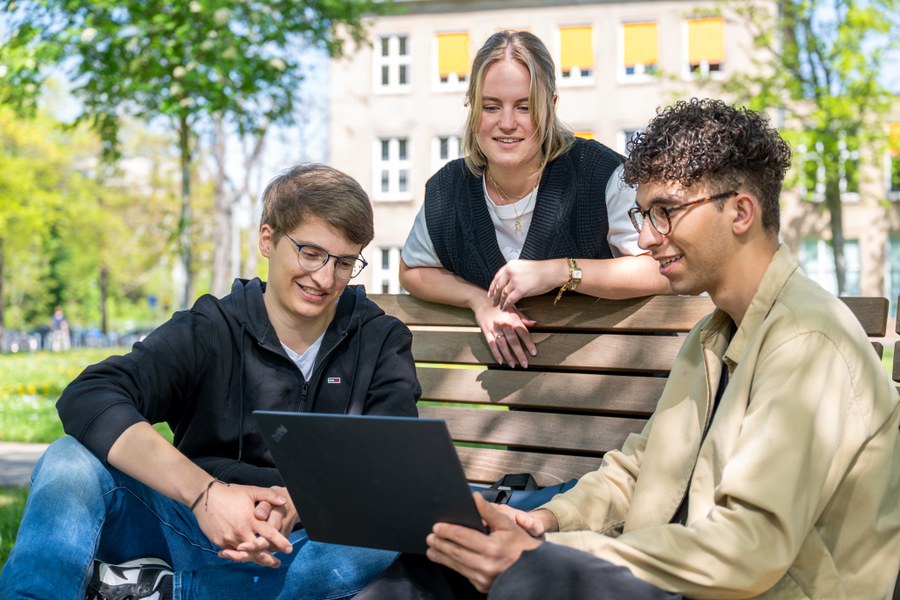
Whether it’s study regulations, timetables, exams or advisory and support services – this is where students can find the most important information and points of contact for their studies.
An overview of key topics


Information on the Degree Programs
Information will follow shortly
General Information about the Studies
Organization of Studies
Here you will find detailed information about course, core examination and lecture-free periods.
Key
Times of day
Courses are held in 90-minute double sessions (DS):
1. DS: 07:30 am – 09:00 am
2. DS: 09:20 am – 10:50 am
3. DS: 11:10 am – 12:40 pm
4. DS: 1:00 pm – 2:30 pm
5. DS: 2:50 pm – 4:20 pm
6. DS: 4:40 pm – 6:10 pm
7. DS: 6:30 pm – 8:00 pm
Weeks
Some courses are held only every two weeks. In the timetable, a distinction is made between odd calendar weeks and even calendar weeks:
1st week: odd week, e.g. calendar week 41.
2nd week: even week, e.g. calendar week 42.
This web page lists the current calendar week.
Abbreviations
The letters in front of the course title indicate the type of course and its position in the curriculum:
V lecture, Ü exercise, S seminar, P lab course, SP language course, T tutorial
SWS semester periods per week, PVL prerequisite for examination, PL examination, Kl. written exam, Mdl. oral exam, LP credit points
O obligatory (compulsory module),
W optional (one of several courses must be chosen).
Compulsory and Elective Modules
- Compulsory modules = all students in a study program must attend the modules
- Elective modules = all students are able to select modules from a catalogue according to their field of study and focus, which are then treated as compulsory modules.
OPAL—the online platformfor academic teaching and learning —is the learning platform of TU Dresden and other universities in Saxony. It can be used by all associate members of TU Dresden with a valid ZIH login, as well as by guests. OPAL enables learning and working anytime, anywhere—both individually and in groups.
What can I find on OPAL?
- Lecture notes and teaching materials
- Assignments and quizzes
- Course registrations
- Study and work groups
How do I log in?
-
To use OPAL, you need a valid login from the Computer Center (ZIH).
Upon enrollment, you will receive a coupon ID via email. You can use this to activate your login through the TU Dresden Self-Service Portal. - Then go to tu-dresden.de/opal. Select “TU Dresden” and click “Login.”
- Then enter your username (login ID) and your new password. Click “Log In.”
Where can I find more information?
If you have questions about specific content in OPAL, please contact the instructors for the respective course. If you encounter technical issues with the learning platform, E-Learning Support at the Service Desk can assist you.
You can find additional instructions and tips for getting started with OPAL, as well as our FAQs, in the OPAL information section “E-Learning at TU Dresden.”
CampusNavigator of the TU Dresden

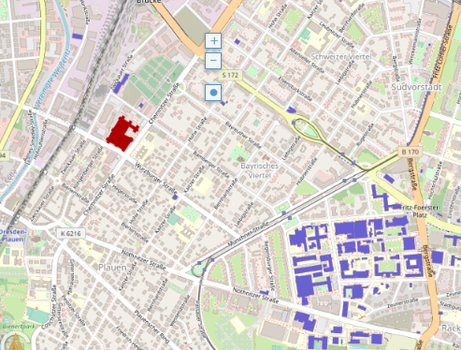
© CampusNavigator

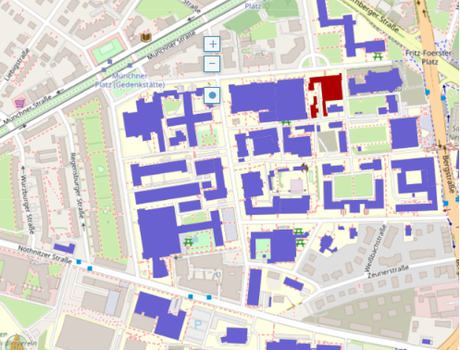
© CampusNavigator

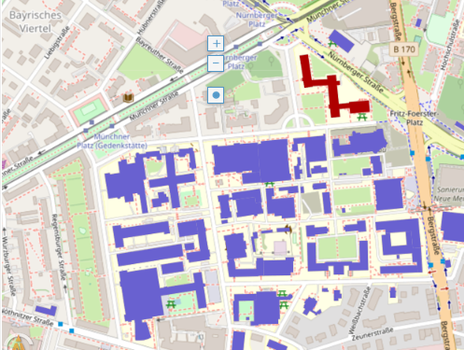
© CampusNavigator

ECTS credit points (LP) document the average workload of students as well as their individual study progress.
One credit point corresponds to a workload of 30 hours. As a rule, 60 credit points are awarded per academic year, i.e. 30 per semester.
The total workload for the course of study corresponds to 300 credit points and comprises the forms of teaching and learning specified in the module descriptions in terms of type and scope, the course and examination work, as well as the diploma thesis and the colloquium. The module descriptions indicate how many credit points can be earned in each module. Credit points are acquired if the module examination has been passed.

In order to ensure the quality of courses, to create transparency, to generate insights, and provide meaningful feedback to instructors, our faculty takes great care to evaluate courses on a regular basis.
Therefore, you will be asked to fill out an online questionnaire in some courses towards the end of the semester. Your participation is very important - you can not only anonymously and confidentially share your perspective on teaching, but you will help to optimize teaching at the faculty with your honest and constructive feedback.
Several methods are used at the faculty:
Completion of examinations
- Difference between examinations and preliminary examinations:
no grading for PVL (only pass/fail), PVLs can be repeated as often as you like,
maximum of 3 attempts for a PL. - A module examination usually consists of several examinations which are specified in the module descriptions.
- The examination modalities are determined by the teacher and announced at the beginning of the semester.
- The following examination performances are offered:
Written examinations, oral examinations, homework, complex performances, portfolios, scientific-practical performances, language examinations (only in language courses).
- For information on the examination dates and enrollment, please visit the website of the Examination Office.
- The examination period is the first 4 weeks of the lecture-free period.
- Selma enrollment for exams is necessary: enrollment in module and in exam.
- Stepping back is possible up to 3 working days before the examination date (civil law: without Sat and Sun) .
- In case of illness, accident, etc. (non-attendance of exams), please see website of the Examination office.
- Save/print overview of "Registered exams" for verification/ print/ keep ready at exam time.
- Exam results are available in selma, please save proof as PDF and archive (digitally)
- Repeat exams: The first repetition must be taken after one year, the second at the next possible time. (The enrollment for the second repetition counts as an application for the same).
- Free attempt: this means taking an exam ahead of time, the cancellation of the result is possible, but always related to the module exam! It is best to get information at the examination office!
Students with disabilities or chronic illnesses can apply for compensation, e.g. an extended exam time, or the use of aids. A medical certificate is required and the application must be submitted to the examination board in good time before the examination period.
You can find more information here.
Additional Offers

Each student can take a total of 10 SWS (Bachelor/Diplom) or 4 SWS (Master) of foreign language training free of charge. Language training at TU Dresden is provided by TUDIAS GmbH.

In order to take advantage of the rich and interesting possibilities of the University Library, you can register online as a user here.
Sächsische Landesbibliothek – Staats- und Universitätsbibliothek Dresden (SLUB) © Sächsischen Bibliotheksgesellschaft
For example, you can borrow books and media, reserve work spaces and equipment in the SLUB-Makerspace, conduct research in the database and register for events and advisory services.
After you finish your studies, your SLUB user status will change and the Campuscard will no longer be valid for use as a library card. However, you can then receive a new SLUB card free of charge, allowing you to benefit from all the same SLUB services.
TUD Counseling and Support Services
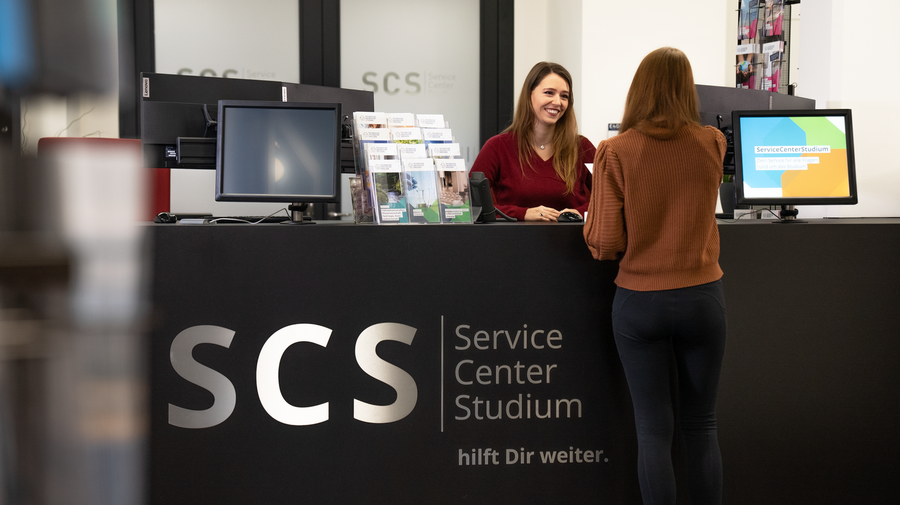
TU Dresden offers a wide range of counseling and support services to meet various needs both before and during your studies.
The ServiceCenterStudies at TU Dresden © TU Dresden
If you are concerned with any questions about studying, the ServiceCenterStudies can help you or guide to the right counseling center for your concerns. It accompanies you throughout your sudies, from choosing a degree program to graduation.

Mentoring and Buddy Programmes at TU Dresden © TU Dresden
Among other things, the SCS offers mentoring and buddy programs that are designed for various target groups in order to give you the opportunity to discover and dicuss the wide-ranging possibilities and perspectives of studying. An overview of the current offerings can be found here.
The TU Dresden implemented the Passt?!-Program as an early warning system for students in order to adequately react to challenging situations during your studies as needed. The participation is free, voluntary, and open to anyone.
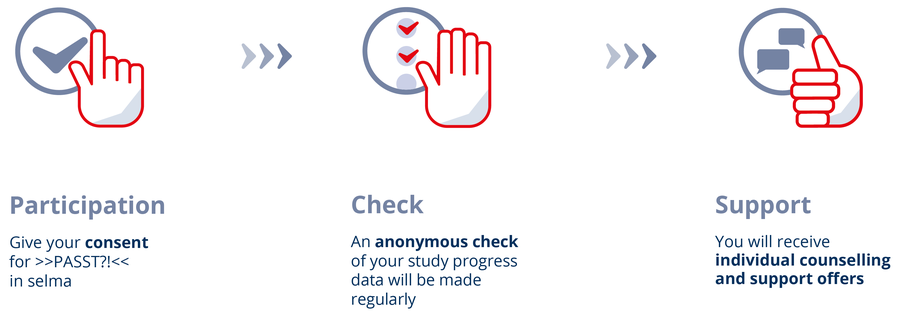
Workflow PASST?! Participation
The goal is to timely identify challenges and offer customized support and counseling to students.
Participation
You can log in and out of PASST?! at any time in the selma portal:
- Log in to the selma portal with your ZIH-Login and your password.
- In the menu to the left click 'Account'.
- Scroll down to the section 'Additional personal details'.
- Here you will find your current PASST?! participation status (Registration for the PASST?! program). Click ‘Edit’ on the right side in order to change your status.
- Using the drop-down menu, choose ‘Ich nehme teil.’ (I take part.) if you wish to participate in the program. Choose ‘Ich nehme nicht teil.’ (I do not take part.) if you do not wish to participate or you wish to withdraw. Once you have done so, click ‘Save’.
- After the status change, there is no further confirmation.
Further informationen can be attained here.
If you have questions about studying with disability and/or chronic illness, you will be supported by the relevant representatives with deciding on and applying for a course of study, organizing and completing your studies, receiving individual advice on compensating for disadvantages in studying as well as in examination performance, digital and structural accessibility as well as support options in everyday situations.
You can find further information here.
Financial Aid
If you study at TU Dresden, you are able to apply for financial aid (BAföG). The Studentenwerk Dresden will help you with the application. For further information, please follow this link.
Student Halls
Are you wondering how to submit an online application for a dorm room? What are the chances of getting one in the first place? How extensive is the waiting list? Find out on the Studentenwerk's website in order to find your Student Hall!
Living in a hall of residence? That's how it's done! © Studentenwerk Dresden
Canteens
All over the TU Dresden campus there are canteens and cafeterias to provide you with the nutrition you need to go about your busy day. The Studentenwerk feeds up to 20.00 guests everyday. You can purchase their dishes at fair and transparent prices. The current menu can be found here.
Studying together makes it easier! Want to prepare for your exam over the long term? Make progress on your seminar paper, course paper, or thesis? Stay on track with your studies?
Additional advice and support services can be found under “Counseling and Services.”
Traffic Culture in Dresden and at the Faculty
Does transportation run through your veins? Then you’ve come to the right place. Not only will you find plenty to enjoy at our faculty with its many student organizations focused on transportation, but Dresden also offers a few hidden gems in this area.
Transport Museum Dresden
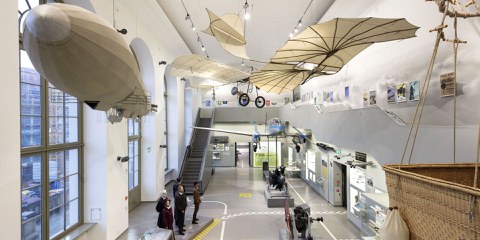
Since the opening of the museum in the city center of Dresden in 1956, a vast number of exhibitions and exhibits on the history of railroads, seafaring, air and road transport have been displayed on more than 5.000m2. The group 'Forum Mobilität Dresden' organizes regular panel discussion and presentations on interesting transport-related topics.
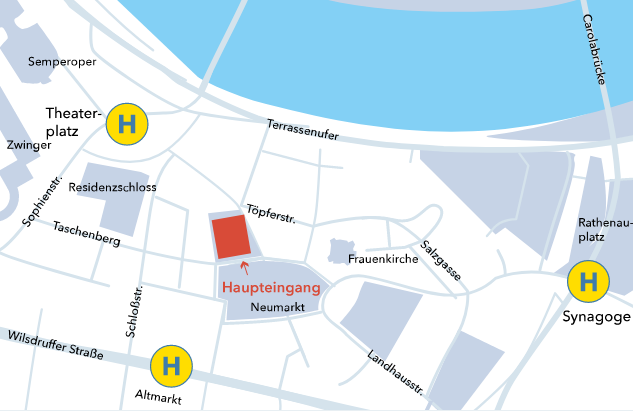
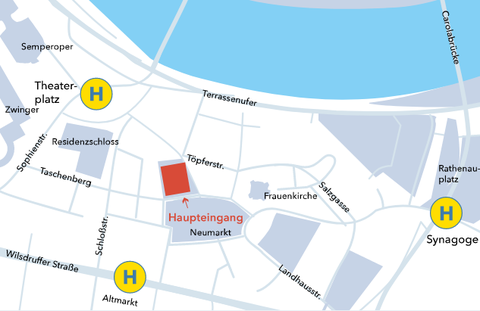
© Dresdner Verkehrsmuseum
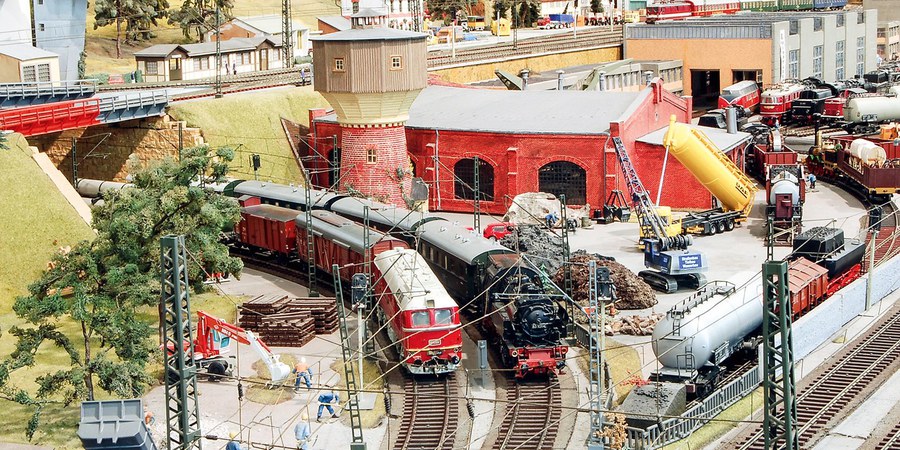
© Dresdner Verkehrsmuseum
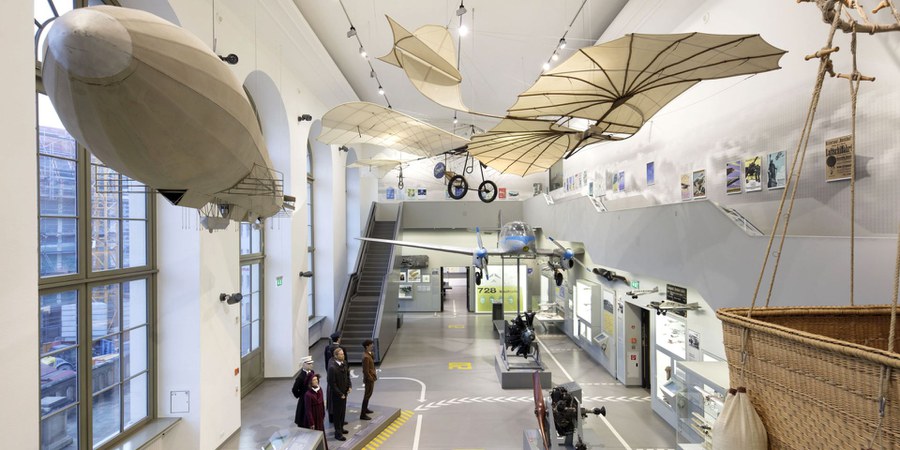
© Dresdner Verkehrsmuseum
Dresden Railway Museum
Verein des Eisenbahnmuseums
The association 'IG Bahnbetriebswerk Dresden-Altstadt e.V.' was founded in 1999 in order to preserve the traditions and history of the German railroad, especially from the sixties and seventees of the last century. In addition to maintaining and repairing of technical installations and various diesel, steam, and electric locomotives as well as carriages, a number of events are held at the museum: e.g. the Steam Engine Festival in the spring, children's festivals as well as the Dresden Museum Night take place annually.
Dresden Tram Museum
Straßenbahnmuseum auf dem Betriebshof Trachenberge
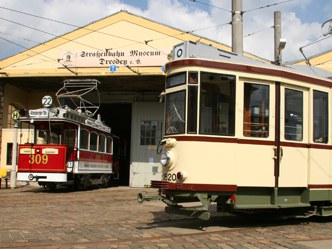
Where the horses for the horse-drawn streetcars were once housed, you will now find a historic depot. The Trachenberge depot not only accommodates historic rail vehicles but the residing museum also shows the everyday life of work of transport companies in the past. During guided tours you can marvel at 38 vehicles. Next to the Tram Museum you can find the association 'Historische Kraftfahrzeuge des Dresdner Nahverkehrs' that concern themselves with the preservation of, among other things, historic busses.
Dresden Airport
At Dresden Airport you can not only travel comfortably within Germany and Europe but also enjoy guided tours.
Imagefilm Dresdner Flughafen © DresdenAirport
Expeditions with the DVB
Streifzug 1 der DVB
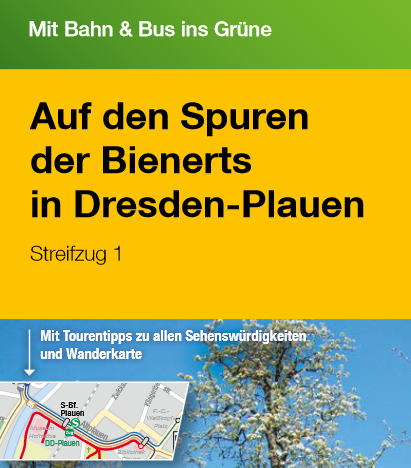
With the semester ticket you not only easily get to the university or the cinema but also to the countryside! The DVB has compiled great recommendations for hiking, walking, and little adventures in well- and lesser known parts of the city - and the best thing: you can comfortable reach the starting points by bus and tram.
The student council is the student representation of the "Friedrich List" Faculty. Beside the council, there are various student groups that are also calles "listige" associations.
DVWG e.V.

The Deutsche Verkehrswissenschaftliche Gesellschaft takes up, discusses, and published current perspectives and issues in the field of transportation and mobility. The 'Junge Forum' of the association is aimed at trainees, students, young researchers, and young professionals in the trantsportation sector.
Spätverkehr e.V.

In 2006, the faculty's graduates' association was founded in order to support the students and faculty in forming networks and promoting exchange with partners in the industry. For example, they organize an annual job fair 'KontaktMesse' and the attendant faculty ball.
Verkehrte Welt e.V.
Verkehrte Welt e.V. was founded in 2003 to promote international communication between students in the field of transportation. They organize lectures, excursions, and conferences for enthusiastic students who love what they do.
EUROAVIA Dresden e.V.

This association brings together aerospace students from 42 universities from several countries. EUROVIA aims to bridge the gaps between universities, their students, and the industry. The Dresden chapter was founded in 1990 and has since been recognized as an official university group of the TU Dresden.
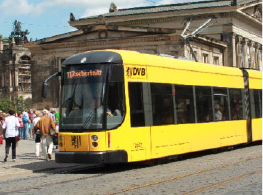
Every year, Dresdner Verkehrsbetriebe AG recruits students to work as part-time students driving trams.
Those interested can find further information on the DVB’s careers portal.
Contact
 © Pexels/Pixabay
Serviceteam Verkehr studieren
for questions about the transport studies at TU Dresden
Send encrypted email via the SecureMail portal (for TUD external users only).