
Jul 19, 2026
Promotion of early-career researchers begins even before college: A successful thesis on learning in virtual reality
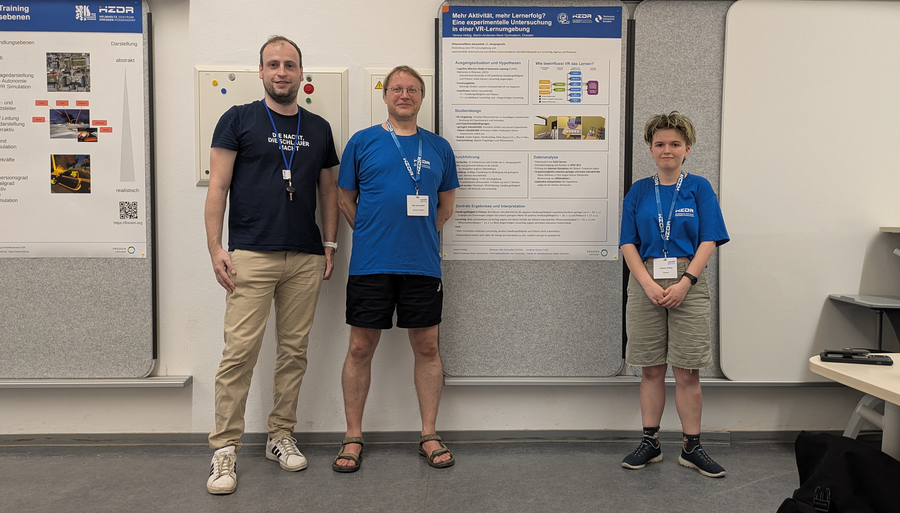
Verena Helbig (right) presents the results of her annual research project at the Dresden Science Night 2026 (with her advisors Jonathan Dyrna, left, and Nils Schmeißer)
Promotion of Early-Career Researchers Begins Even Before College: Successful Senior Thesis on Learning in Virtual Reality
At the“Communities in Virtual Learning Spaces”research group at the Center for Interdisciplinary Digital Sciences (CIDS) at TU Dresden, the promotion of early-career researchers doesn’t begin when students start college—it begins as early as high school. One example of this is the research project by Verena Helbig, an 11th-grade student at the Martin-Andersen-Nexö-Gymnasium in Dresden, which was supervised by Jonathan Dyrna (CODIP) in collaboration with Nils Schmeißer (Helmholtz-Zentrum Dresden-Rossendorf). In her project titled “The Influence of Interaction in Virtual Environments on Learning Outcomes,” Verena investigated how different levels of interactivity in a virtual reality (VR) learning environment affect learning outcomes, action-taking capacity, and presence. To this end, she developed her own VR learning environment on the basics of ionizing radiation, designed an experimental study with two experimental conditions, conducted the study with 6th-grade students, and performed a statistical analysis of the collected data.
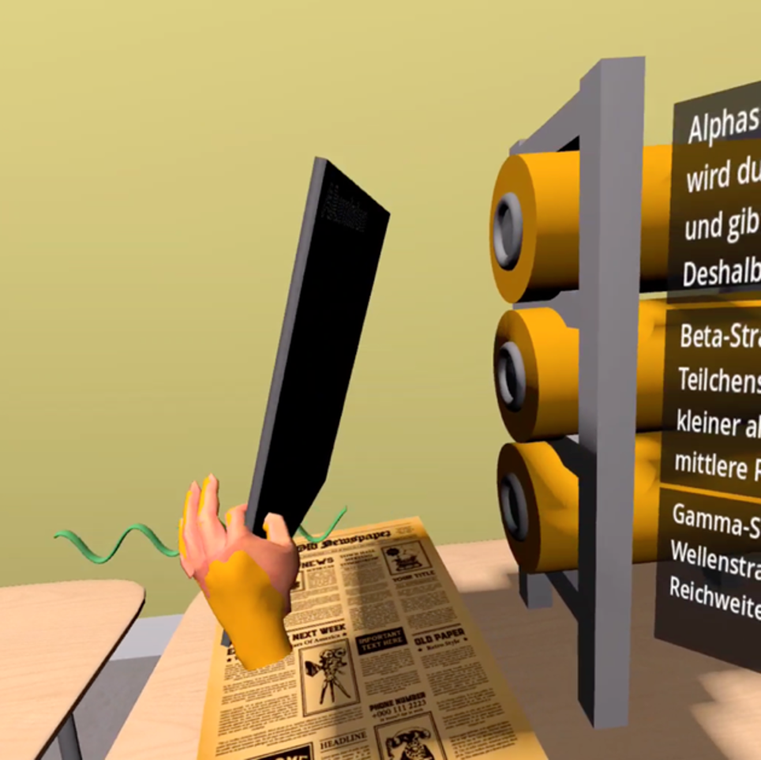
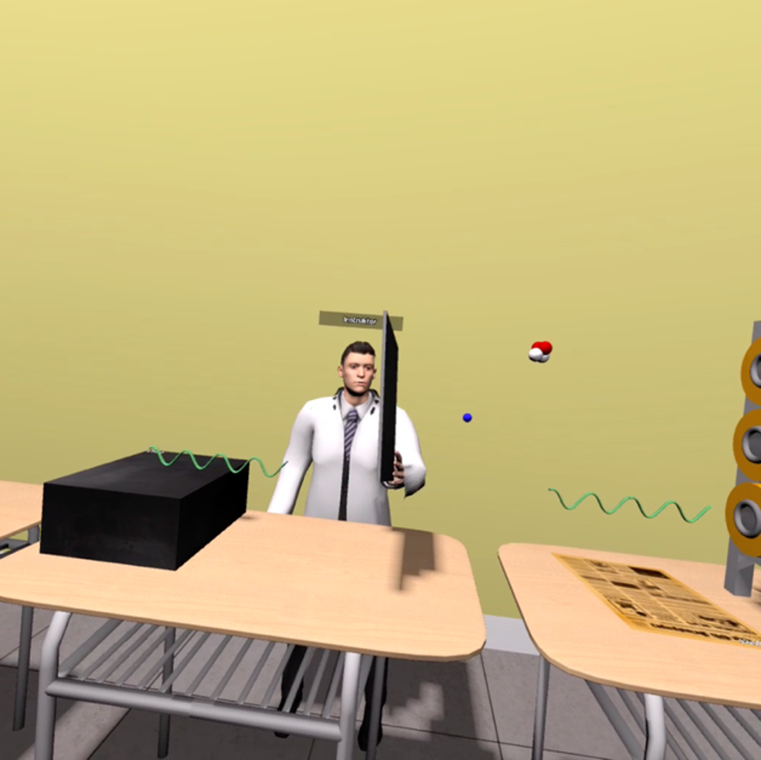
In der VR-Lernumgebung führten die Schülerinnen und Schüler Experimente zur ionisierenden Strahlung entweder selbst durch (Versuchsbedingung mit höherer Interaktivität) oder beobachteten deren Demonstration durch eine Lehrperson (Versuchsbedingung mit geringerer Interaktivität).
On June 29, 2026, Verena successfully defended her annual research project before a panel of five teachers and achieved an outstanding result, earning the second-highest possible score. Just a few days earlier, on June 26, 2026, she presented her project as part of the Dresden Science Night at HTW Dresden. In the “Fascination with Energy” section of the Helmholtz-Zentrum Dresden-Rossendorf, she presented her findings using a scientific poster and gave interested visitors the opportunity to try out the VR learning environment she had developed for themselves. In the same exhibition area, “VR-Based Training for Firefighters and in Schools,” her advisor, Nils Schmeißer, also presented additional VR training scenarios for education and instruction that he had developed together with colleagues.
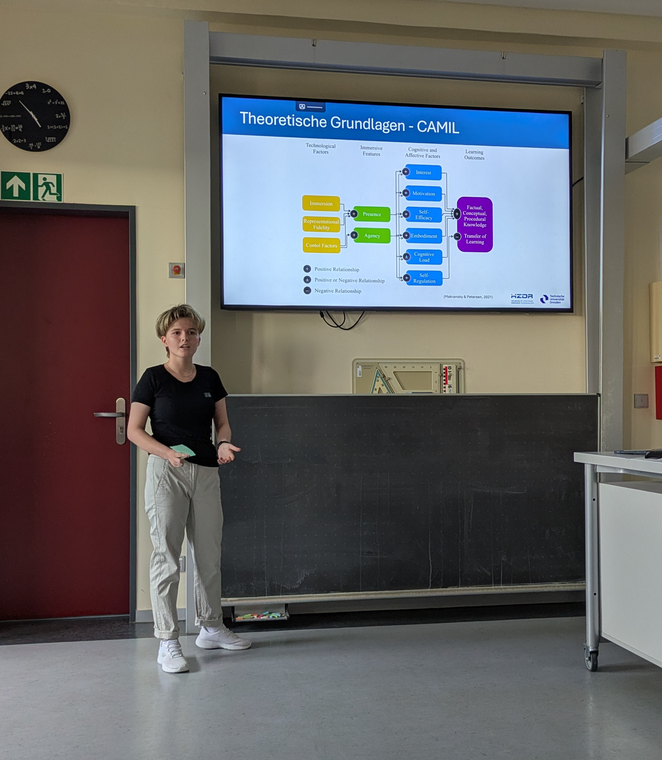
Verena Helbig bei der Verteidigung ihrer wissenschaftlichen Jahresarbeit am Martin-Andersen-Nexö-Gymnasium Dresden
CODIP warmly congratulates Verena on her outstanding achievement! Her work impressively demonstrates how students can independently tackle scientific questions while still in school and, through collaboration between schools, universities, and non-university research institutions, gain valuable insights into current fields of research.