
The JoDDiD podcast

WHY A PODCAST?
A new study has been published. Did you come across it (by chance)? Great. Okay, now all that’s left is to read through the often several hundred pages, identify the specific sections that are relevant to you, make sense of the new findings, and possibly discuss them with colleagues. It’s no small task. That can easily take up a full 40-hour workweek. Since we know that many people active in extracurricular education hardly have that kind of time—let alone the ability to work through scientific texts that are sometimes complex and difficult to understand—that’s why we created the JoDDiD podcast. After all, we’ve set out to address precisely this: the communication between academia and practice. And we want to facilitate a transfer of knowledge that involves both sides. This means that in this format, we’ll present studies, concepts, and theories, but we’ll also feature exciting practical reports and case studies.
WHAT WILL IT BE ABOUT?
What will be the common thread? In our specific case, it’s not a thread,
but a pair of glasses—the JoDDiD glasses. In this podcast discussion format, members of the JoDDiD team put on their political education glasses and ask questions of the expert they’re speaking with. This format isn’t just about presenting information—it’s primarily about discussing and reflecting together! The goal is to formulate insights, tasks, and questions for the field of political youth and adult education.
WHO SPEAKS ON THE PODCAST?
The podcast typically features two people, at least one of whom is a JoDDiD representative (viewing the topic through the lens of political education). Guests can come from a wide variety of backgrounds: researchers, practitioners, and funding providers.
AND WHERE CAN I FIND THE PODCAST?
The JoDDiD podcast can be found on all major podcast platforms by searching for “JoDDiD Podcast” or directly here in our podcast library:
_______________________________________________________________________________________________________
ALL PODCAST EPISODES AT A GLANCE
Teaser:
Listen to see what it’s all about.
Episode 1: Civic Education at the Stadium

A JoDDiD discussion about the study on “The Stadium as a Place of Learning,” covering special locations, community ties, exclusion, real-life topics, and much more—all, of course, against the backdrop of (out-of-school) political education. But just listen for yourself and feel free to give us feedback.
Episode 1 - Civic Education at the Stadium
Episode 2: Civic Education in the 16th Report on Children and Youth
In this JoDDiD podcast episode, we speak with Prof. Anja Besand, one of the 14 experts and a co-author of the 16th Report on Children and Youth. This conversation provides background information, anecdotes, implications for political education, and insights into the over 600-page report for stakeholders involved in out-of-school political education.
Episode 2 on the 16th Report on Children and Youth
Episode 3: The End of the Simulation

Our 3rd JoDDiD PODCAST EPISODE is online. In this JoDDiD podcast episode, Dr. Götz Nordbruch from ufuq.de joined us at JoDDiD to share practical experience and describe specific challenges. This practical discussion centers on the question of how anti-racist political education can succeed today. Together with Götz Nordbruch, we talk and think aloud—for listeners to hear—about topics such as collateral learning, emotions in political education, and the dilemma of inclusion, among others.
A podcast episode in cooperation with ufuq.de.
Episode 3 – The End of Simulation
Episode 4: Political Education in Reactionary Times
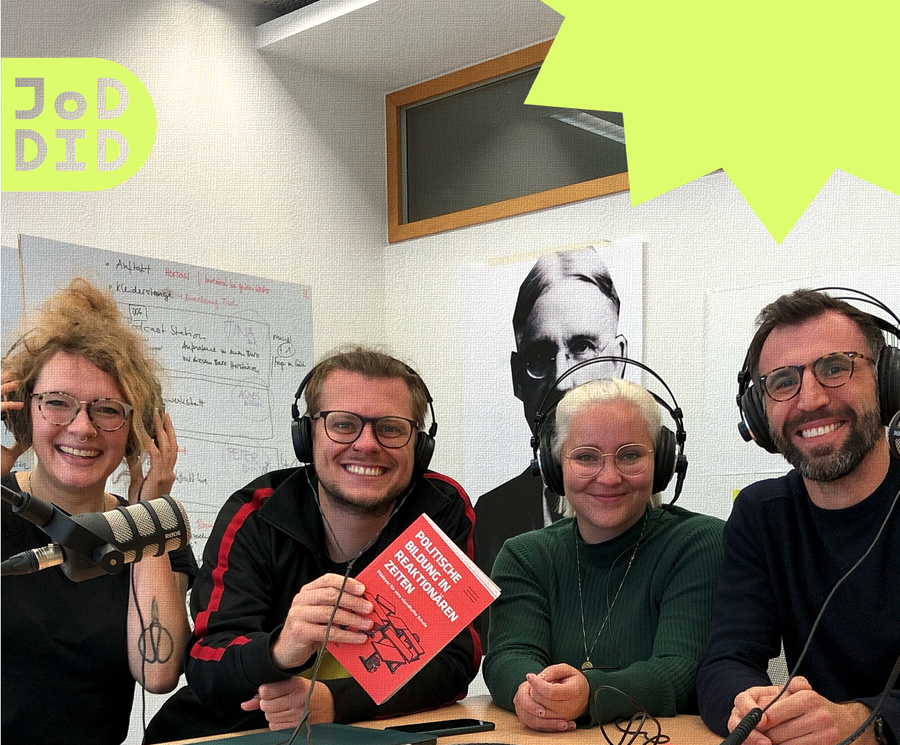
In this new JoDDiD podcast episode, Elisa Moser and Tina Hölzel from JoDDiD had the exclusive opportunity to speak with two authors of the book *Political Education in Reactionary Times* (Wochenschauverlag 2021) to discuss the challenges that group-focused hostility poses for political education. Prof. Dr. Rico Behrens and Stefan Breuer provide background insights into the case studies and key concepts and ideas of the book.
Episode 4 – Political Education in Reactionary Times
Episode 5: Political Education in the Face of War
Now available online as an audio recording—our digital discussion roundtable from February 28, 2022, featuring many fascinating guests, questions, and insights on the challenging topic of war.
Participants included, among others:
Özcan Karadeniz (Association of Binational Families and Partnerships Leipzig e.V.)
Norbert Hanisch (Saxony Association for Children and Youth [KJRS])
Heidi Bischof (Network for Democratic Culture e.V. [NDK])
Anja Besand (JoDDiD)
Episode 5 (JoDDiD Special)—Political Education in the Face of War
Episode 6: Civil Society Engagement in Saxony

Volunteering in Saxony?! From soccer clubs to election workers—what does the landscape of civic engagement in Saxony look like, and what does that mean for political education?
Today, as part of the new JoDDiD podcast series, we’re talking with Friedemann Brause, an Advisor at the Saxon State Agency for Political Education (@slpb_dd ). In early 2021, the SLpB published its study “Engagement in Saxony—What People Are Committed To and What Framework Is Needed.” As always, you can listen to the episode on all the usual podcast platforms, on our website, or via this link.
Episode 6 – Civic Engagement in Saxony
Episode 7: Political Education in the Ore Mountains
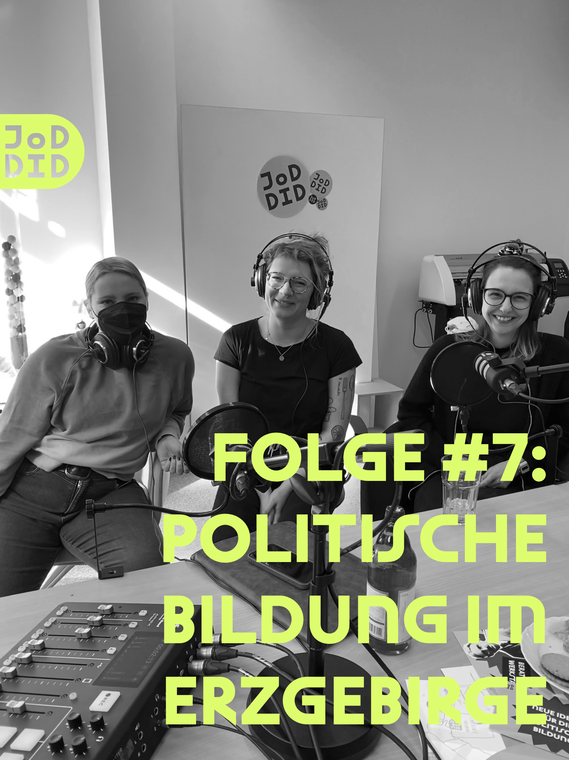
JoDDiD PODCAST EPISODE #7: Political Education in the Ore Mountains. In this practical discussion, we talk with Alina Gündel from Agenda Alternativ e.V. in the Ore Mountains about political education in rural areas. Drawing on over 10 years of practical experience in political education, we learn about the potential and challenges in the Erzgebirge, how structures and administration function, which local stakeholders are active, and how political education in the Erzgebirge can be conceived and implemented—both in terms of subject matter and format. But just listen for yourself! As always, you can find this and other JoDDiD PODCAST EPISODES on all the usual podcast platforms, our website, or via this link: Episode 7—Political Education in the Ore Mountains
DOUBLE EPISODE 8.1 AND 8.2: Political Education and the NSU Complex & Political Education at the Documentation Center on the NSU Complex

This double episode of the JoDDiD podcast focuses on political education in Saxony and the NSU Complex. Tina Hölzel and Paul Hübler from JoDDiD join Hannah Zimmermann from the “Offener Prozess” project for a discussion. In the first part of our conversation, we focus on the relationship between political education and the NSU complex in Saxony. We discuss the struggle to come to terms with the past and the concept of “unlearning” in political education, ask ourselves what remembrance should look like, and attempt to outline the challenges facing political education in Saxony. Hannah brings along the “Open Process” methodology handbook, which we examine together with her.In the second part of our podcast with Hannah Zimmermann, we then turn our attention to the planning processes for the documentation center on the NSU complex. In doing so, we gain insight into a process with many questions still up for discussion. What should a documentation center achieve? What are the wishes of the victims’ families? How does the planning process actually work? Should the documentation center be centrally or decentralized? How do we address the fact that authorities have destroyed important documents related to the NSU complex or have made them inaccessible? At the end, Hannah tells us what the documentation center looks like in her dreams. We’re really looking forward to it!
Episode 8.1: Political Education and the NSU Complex
Episode 8.2: Political Education at the Documentation Center on the NSU Complex
Episode 9: Political Education in the Theater

In this exciting conversation, we talk with Nicole Dietz and Andra Born from the TJG about the Theater Academy’s production project “POWER.” Drawing on the experience of this theatrical work on “power structures and gang formation” with young girls, we reflect on political education in the theater, explore common themes, moments that political education can learn from cultural education, and explain what a revolt and a rolling pin have to do with this politically educational project at the TJG.
Episode 9: Political Education in Theater
Episode 10: Political Education in the Podcast

It’s crazy how time flies—the JoDDiD podcast “Put on Your Glasses, We Need to Talk” has been around for a year now. We took this as an opportunity to, as a small audio team, "JoDDiD auf’s Ohr" to look back together, compile unreleased material, give you insights into the birth of the JoDDiD podcast, reminisce about our experiences and memories, and also share stories of challenging moments. Maybe you’d like to try your hand at a podcast on political education? Want to get to know the people behind the JoDDiD podcast in a whole new way or hear some unreleased outtakes? Then this episode might be especially exciting for you!
Episode 10: Political Education on the Podcast
Episode 11: Political Education in Saxony: A Discussion with the BpB

In this episode of the JoDDiD podcast, Tina Hölzel, Elisa Moser, and Prof. Anja Besand sit down for a conversation with Daniel Kraft. Daniel Kraft is the Head of Communications and Press Officer for the Federal Agency for Civic Education (BpB). To mark the BpB’s 70th anniversary, he and his colleagues are touring Germany with the BpB Infomobil. Dresden, home to JoDDiD, is the first stop on the tour, so we took the opportunity to record a podcast right there. We discuss political education in Saxony and eastern Germany with Daniel Kraft. We explore what can be learned from an old hand like the BpB, examine the challenges facing the field, and reflect together on the role of knowledge transfer and communication in political education.
EPISODE 11: Discussing Political Education in Saxony with the BpB
Episode 12: Political Education Needs Takeaways!

The year is drawing to a close. In the final episode of the JoDDiD podcast for 2022, Anton and Paul summarize the key takeaways from all episodes for you in a single episode. This gives you a concise recap of all the podcast episodes we’ve recorded so far. So enjoy listening to our first year-in-review episode! To help you navigate, we’ve added chapter markers. This way, you can jump between the key takeaways as needed or find the topics that are particularly relevant to your work. We thank you for your loyal listening, wish you a relaxing holiday season, and look forward to a new podcast year in 2023 with exciting new topics and guests.
EPISODE 12: Political Education Needs Takeaways
Episode 13: Civic Education at Institutions

Political Learning at Institutions—from the police to garbage collection and the courts to the state legislature—a practical discussion with Franz Werner and Rico Lewerenz.
In this new JoDDiD podcast episode, we speak with two practitioners about a classic topic in political education: learning within institutions.
Our focus is on taking a critical look, but also on the potential for on-site learning.
EPISODE 13: Civic Education at Institutions
Episode 14: Political Education as a Non-Formal Program

In this new podcast episode, we had the particularly exciting opportunity to speak with the highly experienced Dr. Helle Becker from the Center for Political Education. Not only does she possess an incredibly broad range of expertise in the field of out-of-school political education, but she also provides a very informed overview of the Center and the entire field of out-of-school and non-formal political education in Germany. But just listen for yourself.
EPISODE 14: Political Education as a Nonformal Program
Episode 15: JoDDiD Mini-Report on the ECR Conference in Bocholt

We attended the conference of the Society for Political Didactics and Political Youth and Adult Education (GPJE for short) on the topic of “Extracurricular Political Education—Science and Practice”!
For us, this was the perfect opportunity to try out a new format—the JoDDiD mini-reports. The idea behind them is to take you along to a wide variety of events in diverse situations so you can gain situational insights into the practice and scholarship of political education.
EPISODE 15: Mini-Report on the ECR Conference, GPJE Bocholt
Episode 16: Political Education on the Go—Mini-Report on the GPJE Conference “Emotions and Political Education” in Hildesheim
We attended the Early-Career Researchers’ Conference as well as the main conference of the Society for Political Didactics and Political Youth and Adult Education (GPJE for short) on the topic of “Emotions and Political Education” at the University of Hildesheim!
We attended the 2023 GPJE main conference in Hildesheim, which focused on “Emotions and Political Education”—a highly topical and central issue in the field of political education.
EPISODE 16: Political Education on the Go – Mini-Report on GPJE Hildesheim
Episode 17: Political Education in Saxony
JoDDiD conducted an online survey among practitioners in the field of extracurricular political education in Saxony, with the aim of learning more about their current challenges and aspirations, as well as their personal backgrounds, circumstances, and understanding of their work. The results were published in the form of a field study and a strategy paper.
In this podcast episode, we speak with two authors, David Jugel and Rico Lewerenz, from the research department at JoDDiD, about the key findings of the field study.
Click here for the exploratory study: https://tu-dresden.de/gsw/phil/powi/joddid/forschung-transfer/forschung-1/wie-gehts-der-ausserschulischen-politischen-bildung-in-sachsen
If you’d like to learn more, check out the press conference on the study on our JoDDiD YouTube channel: https://www.youtube.com/watch?v=5s7uW3utzSc&t=21s
EPISODE 17: Civic Education in Saxony
Episode 18: Political Education and Education for Sustainable Development
In this podcast episode, we speak with Anna-Maria Kümritz and René Michalsky from Trafo e.V.
We discuss Education for Sustainable Development (ESD), which is currently on everyone’s lips and a highly sought-after approach. What exactly is ESD? How does the ESD approach relate to political education? How can ESD be successfully implemented? What similarities and differences can be identified with political education? And what does ESD actually have to do with educational work in companies?
EPISODE 18: Civic Education and Education for Sustainable Development
Episode 19: Political Education and Elections
This podcast episode focuses on a classic topic in political education: elections.
In 2024, state elections will take place in many eastern German states. In Saxony, political educators are even facing a “super election year” that will bring three elections at once. What exactly political education has to do with elections, what goals are pursued in this context, what formats might be suitable, and what fears and concerns political educators have when addressing the topic—you’ll learn all of this in this episode.
Our guests were Johanna Probst from the Political Children’s and Youth Association of Saxony, Sabine Kirst from the Saxon State Center for Political Education, and Franz Werner from Aktion Zivilcourage.
EPISODE 19: Political Education and Elections
Episode 20: Political Education and Cultural Education – Mini-Report on the “GPJE-ECR” Conference in Bremen
This podcast episode is a JoDDiD mini-report on the conference of the Society for Political Didactics and Political Youth and Adult Education in Bremen.
We attended the Early-Career Researchers’ Conference of the Society for Political Didactics and Political Youth and Adult Education (GPJE for short) on the topic “Connecting Perspectives—Overlaps, Synergies, and Boundaries Between Political and Cultural Education” at the University of Bremen!
For anyone interested—and for those who perhaps couldn’t attend the conference—we’ve once again recorded a mini-report. We took you along to a wide variety of situations so you can gain a contextual insight into the practice and scholarship of political education.
What are the intersections, synergies, and distinctions between political and cultural education? Is it possible to move beyond the instrumentalization of cultural education as a method of political education?
And what generally happens at a conference like this, and how does academic exchange work? Who do we meet there, and what do they have to say? What are our impressions, and what do we take back to our daily work? We’ll try to illustrate this by taking you along to Bremen through our mini-report.
Episode 21: Ethical Foundations of Political Education—Mini-Report on the 2024 GPJE Annual Conference in Potsdam
Every June, the Society for Political Didactics and Political Youth and Adult Education (GPJE for short) convenes for its annual conference. This time, we traveled to Potsdam’s idyllic Griebnitzsee campus to discuss the conference theme: “Ethical Foundations of Political Education.”
Of course, we packed our microphones once again to capture a variety of impressions and thoughts from the conference for you. We hope to provide those working in the field who are unable to attend a conference with insights into the practice and scholarship of political education, including its current issues and controversies.
Episode 22: Political Education in Saxony Examined Through New Studies
Examining Funding Conditions and Rural Areas
Listen up—the JoDDiD podcast has a new episode for you! In this one, we’ll take a look at two new JoDDiD studies published this year.
First, we’ll examine the study “Democratic Education in the Funding Maze,” published in August by Rico Lewerenz and Celina M. Hertel, published in August, and examine Saxony’s funding structures, the current areas of tension and challenges, as well as the solutions proposed by the authors.
While funding issues are usually a focal point, the challenges in rural areas are quite unique. This is precisely what the second JoDDiD study, “Democratic Education in Rural Areas” by Celina M. Hertel and David Jugel, addresses. It was published back in April.
Together with the authors, Celina M. Hertel and David Jugel, today’s hosts, Paul Hübler and Nathalie Bock, examine the studies, look for common ground between them, and highlight for the field of extracurricular political education where the problems lie and what needs to be done.
EPISODE 22: Political Education in Saxony Examined Through New Studies
Episode 23: Evaluation in Political Education
How can we ensure that our educational work is successful? Are we truly reaching the people we want to reach? Are we using the right methods, and are we applying them in the right contexts?
We encounter these and many other questions time and again in our consulting work as a research institution with providers of extracurricular political education in Saxony. Often, the desire to critically examine and further develop one’s own work arises from personal motivation. At the same time, funding agencies are increasingly requiring evaluation to demonstrate quality and impact. But how can educational practice be meaningfully evaluated—and what options are there for utilizing scientific insights and feedback?
In this internal JoDDiD podcast episode, Tina Hölzel, Prof. Anja Besand, David Jugel, and Agnes Scharnetzky discuss the opportunities and challenges of evaluation in out-of-school political education. They explore how organizations can reflect on their work, improve it, and make it transparent to the outside world.
EPISODE 23: Evaluation in Political Education
Episode 24: Civic Education Meets Sociopolitical Studies
This podcast episode explores what attitude studies can tell us about effective political education.
How can democracy education succeed in times of social tension? What challenges—but also opportunities—do current attitude studies reveal for political education work? And how does political education position itself in an increasingly polarized discourse?
In this episode, we combine impressions from the 2025 Early Career Researchers Conference in Hanover with an in-depth discussion of key study findings—including the 2023 Mitte Study, the 2024 Leipzig Authoritarianism Study, the Saxony Monitor, and the 2024 Shell Youth Study.
As hosts of the episode, Tina Hölzel-Chokarash and Nathalie Bock discuss with their guests—Prof. Sabine Achour, Prof. Steve Kenner, and Dr. Christian Demuth—the following topics:
- societal trends and democratic attitudes,
- targeting specific audiences under difficult conditions,
- political education under pressure from the right,
- the tension between expectations of impact and critical practice,
- and new venues, formats, and perspectives for principled democratic education work.
The episode is complemented by insights from early-career researchers—recorded at the ECR conference—on the question: How can current studies be meaningfully integrated into the practice and research of political education?
Featuring Luisa Schmidt, Martin Bücher, Dr. Sascha Regier, and Richard Heise.
An episode for everyone who not only thinks about political education but also further develops and implements it in practice—critically, effectively, and with a commitment to democracy.
EPISODE 24: Political Education Meets Sociopolitical Studies
Episode 25: Futures (in) Political Education
This podcast episode is a “report” on the ECR and GPJE conference in Giessen in 2025. Every June, the Society for Political Didactics and Political Youth and Adult Education (GPJE for short) convenes for its annual conference and the preceding Early Career Researchers’ Conference. This time, we made the trip to Giessen under the conference theme “Futures (in) Political Education.”
Of course, we packed our microphones again to capture a variety of impressions and thoughts from the conference for you. We hope to provide those working in the field who are unable to attend a conference with insights into the practice and scholarship of political education, including current issues and controversies surrounding the topic of “Futures.”
EPISODE 25: Futures (in) Political Education
Episode 26: JoDDiD and PolBNT+ in Conversation
JProf. Dr. Steve Kenner was our guest here at JoDDiD with his podcast “PolBNT+ in Conversation with…” and spoke with Prof. Dr. Anja Besand and Tina Hölzel-Chokharash.
Among other topics, the three discuss education and transformation in the context of democracy and authoritarian temptations, a supposed requirement for neutrality, and why more political education is needed—even in unusual places.
EPISODE 26: JoDDiD and PolBNT+ in Conversation
Episode 27: anGEDACHT—A Political Education Perspective on … Sexualized Violence
Political Education Through Current Events: Gisèle Pelicot and the Epstein Files
Content Warning: This episode addresses sexualized violence, child sexual abuse, and systematic sexual abuse. These topics may trigger negative reactions in some people. Please be mindful if this applies to you and consider not listening to this episode alone.
Helpline for violence against women: 116 016
Welcome to a new JoDDiD podcast episode and a brand-new format!
We’ve taken your feedback and requests seriously and are expanding our scope. Lately, many political educators have reached out to us with questions about current sociopolitical events. We want to better meet this demand for timeliness and engaging content.
One thing is clear: even we don’t always have answers right after an event. But we often have many questions and thoughts that might inspire you. That’s why, going forward, we’ll be getting together for fairly spontaneous internal discussions to exchange ideas on current events. We’ll let you listen in and take the plunge to provide you with quicker insights into pressing questions during challenging times—and to offer an unfiltered glimpse into our thinking on political education.
In this episode, we’ll discuss two very recent examples from current media coverage of sexualized violence: the Epstein Files and the Gisèle Pelicot case.
How can political education actually address such cases? What questions regarding political education arise? What do we need to keep in mind? Which fundamental didactic principles are being challenged? What is particularly important when addressing these topics, and how can we in political education learn to deal with such current cases—and what pitfalls should we be mindful of?
This internal podcast episode features Tina Hölzel-Chokarash, Nathalie Bock, Elisa Moser, Corinna Drexler, and Prof. Anja Besand.
EPISODE 27: anGEDACHT – A Political Education Perspective on ... Sexualized Violence