
ElViS
Development and testing of ultralight composite structures with integrated electrical storage function (Subproject: Design development, fabrication and experimental characterisation)
Electric flight has the potential to transform urban mobility in a sustainable and environmentally friendly way. Lightweight construction and energy storage play a particularly important role in this context, as the high additional weight of current energy storage systems means that only limited ranges or transport capacities can be achieved. In smaller aircraft or air transport systems (drones, multicopters) in particular, heavy, compact batteries can lead to space-related challenges and unfavourable weight distributions. However, a breakthrough in electric or hybrid-electric propulsion systems based on current battery system technology has yet to materialise. To achieve significant progress in the field of electric flight, two key development approaches have been identified. On the one hand, storage systems can be improved by increasing the gravimetric energy density of the individual storage cells. On the other hand, the structural weight can be reduced through the targeted multifunctionalisation of the materials used (material substitution to avoid redundant properties and functions). With the development of so-called structurally load-bearing energy storage devices, mechanical protective housings can be eliminated and/or existing fibre-reinforced composite structures replaced in order to provide additional electrical energy per unit of mass. The aim of the ElViS joint project was to develop mechanically load-bearing composite structures with an integrated electrical storage function, to analyse them experimentally and to evaluate their suitability for aircraft.
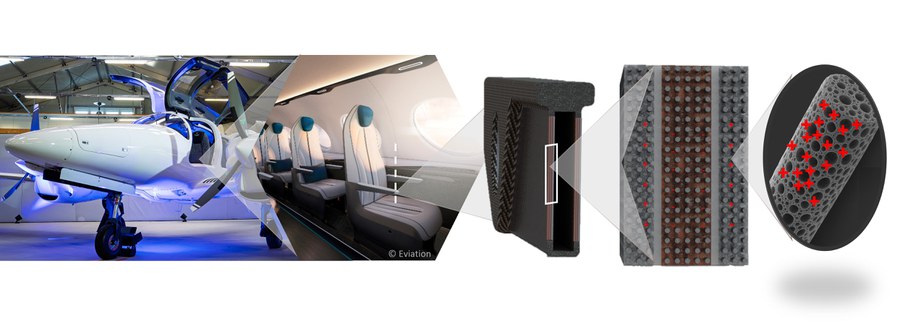
Fig. 01: Possible use-case of structural batteries with multifunctional porous carbon fibres.
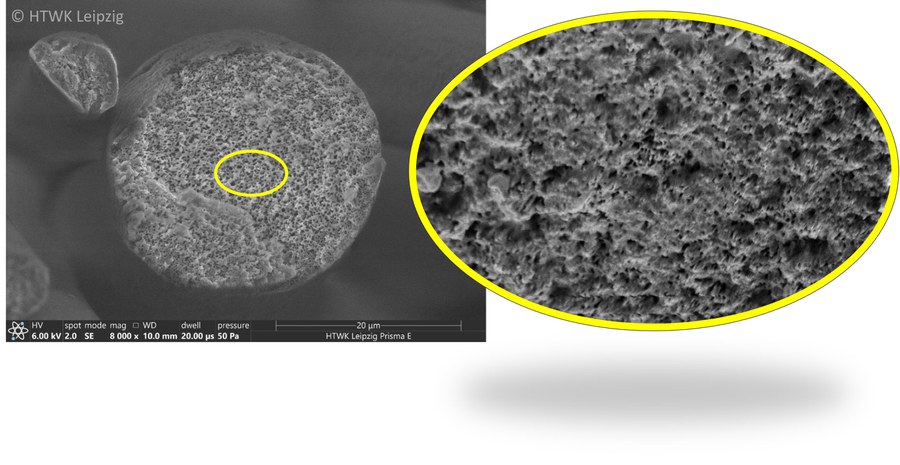
Fig. 01: Porous carbon fibre with key properties high conductivity and large surface area.
01.05.2022–31.08.2025
- Professorship of Lightweight Structures and Composite Materials at Leipzig University of Applied Sciences (HTWK)
- Chair of Inorganic Chemistry II (AC) at TU Dresden
Associated partners

 © TUD/ILK
Chair of Lightweight Systems Engineering and MultiMaterial Design
NameProf. Dr.-Ing. habil. Maik Gude
Send encrypted email via the SecureMail portal (for TUD external users only).
Institute of Lightweight Engineering and Polymer Technology
Visitors Address:
DÜR, Floor 0, Room 71 Holbeinstr. 3
01307 Dresden
Deutschland
- Thomas Behnisch (Novel Materials and Special Processes)
Publikationen Thomas Behnisch | TU Dresden