
RoSI
Investigation of the damage and modal behavior of fast rotating geometrically complex structures using in-situ measurement systems
Composite materials offer excellent properties for the use in modern high-performance rotors due to their high specific stiffness and strength and their adjustable progressive damage behaviour. The heterogeneity and anisotropy of the material require novel numerical models for the design and description of the load-bearing behaviour of damaged rotors and, in particular, the damage-induced shift in their natural frequencies. In order to validate such models, in-situ measurement techniques are essential for determining the damage state and modal behaviour as a function of complex load conditions. As part of the project, a measurement method using diffraction grating sensors applied to the rotor and the evaluation of its far field was investigated and used to validate the numerical model. The decisive advantage of this method over other image-based methods such as digital image correlation is the suppression of motion blur. A variety of measures were investigated and implemented to reduce systematic measurement uncertainties, including the evaluation of multiple diffraction orders, spatially resolved calibration of the grating frequency, the use of matrix cameras, and the application of gratings using direct laser interference patterning. This made it possible for the first time to measure strains, damage and vibrations (Fig. 1) in a speed-dependent and spatially resolved manner at speeds > 260 m/s.
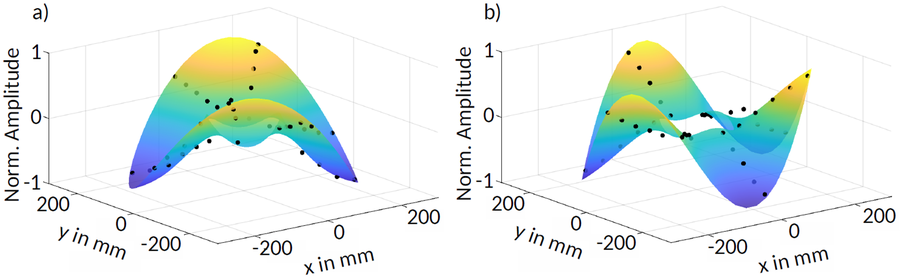
Fig. 01: Measured mode shapes with two (a) and three (b) nodal diameters at a rotational speed of 3,600 rpm using diffraction grating sensors.
Using optical coherence tomography (OCT), the internal structure and damage-induced changes in the material structure were visualised and examined in three dimensions in quasi-static loading scenarios. Using the functional extension of polarisation-sensitive OCT (PS-OCT), stress changes, inter-fibre failures and the deformation field of the samples were recorded simultaneously, enabling quantitative measurement of spatially resolved strain and stress. An ultra-fast OCT system was developed to visualise the complete three-dimensional structure and damage behaviour of GRP rotors under rotational load, even at high speeds > 300 m/s (Fig. 2). The method allows in-situ investigation of both the development of cracks and delaminations within the rotors and their deformation in any direction. As a result, a validated numerical model has been developed that can predict the structural dynamic behaviour of rotating composite structures as a function of rotational speed, temperature field and damage state.
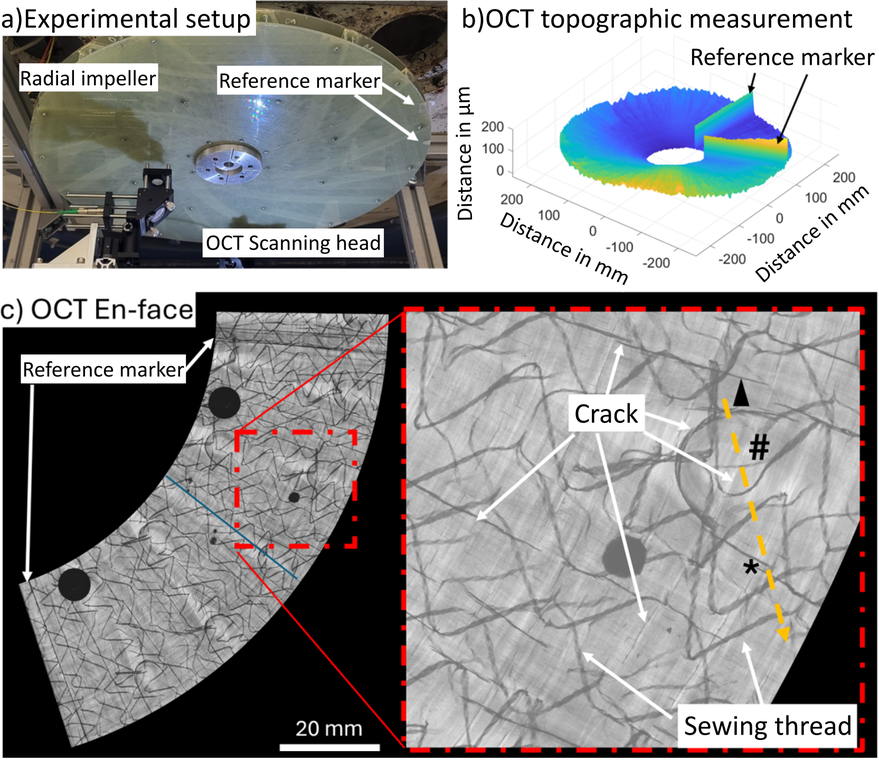
Fig. 02: OCT measurement on a radial impeller with rotational speeds of up to 12,000 rpm with the experimental setup (a) and the results of the OCT topography measurement (b) as well as detailed images of a segment scan at 600 rpm (c).
01.06.2017–30.09.2025
-
Research group Clinical Sensoring and Monitoring (KSM) at the Carl Gustav Carus Faculty of Medicine at the TU Dresden
- Chair of Measurement and Sensor System Technique (MST) at the TU Dresden

German Research Foundation (DFG)
Project number: 336228110
Funding Program: Individual Research Grants
 © Saskia Trute
Chair of Lightweight Systems Engineering and MultiMaterial Design
NameProf. Dr.-Ing. habil. Maik Gude
Send encrypted email via the SecureMail portal (for TUD external users only).
Institute of Lightweight Engineering and Polymer Technology
Visitors Address:
DÜR, Floor 0, Room 71 Holbeinstr. 3
01307 Dresden
Deutschland
- Dr. Tino Wollmann (Calculation Methods and Simulation)
Publications Tino Wollmann | TU Dresden