
Profile
Agile research, teaching & collaboration unit in Design
Our team comprises approximately 30 researchers from a broad spectrum of disciplines – Design, Biomedicine, Engineering, Psychology, Business Administration, Economics, Computer Science, Physics, and the Social Sciences. We embed applied research projects directly into our curricula and co‑investigate emerging research topics with students, thereby fostering a genuine learning‑by‑doing environment. From the outset we practice co‑creation, partnering with an expanding network of industry, healthcare, and societal stakeholders.
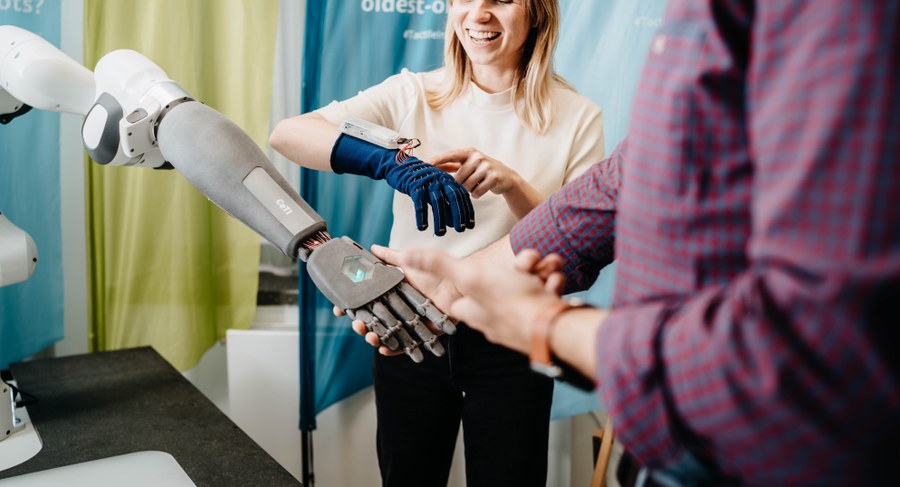
Human-Centered Technical Design with a Holistic System Perspective
Our research is grounded in a human‑centered approach that guides the development of technical solutions and service environments across the product‑to‑system spectrum. By integrating ecological, social and economic considerations, we create responsible, sustainable systems that enable users to act responsibly in everyday contexts. All of our insights are generated through systematic empirical research, combining quantitative measurements with qualitative user studies.
Design as a bridgig discipline
Design translates concepts into visual, material or digital artefacts that can be perceived and interpreted by diverse stakeholder groups. By deliberately making these artefacts accessible, we foster a collaborative environment in which engineers, social scientists, users and policymakers can co‑create. Our practice integrates expertise from the technical to the social sciences, which enables hybrid prototyping, the simultaneous development of physical prototypes and their accompanying service or business models, and strong knowledge‑transfer capabilities. In response to the increasing emphasis on impact‑oriented research, technology transfer, and public engagement, we employ iterative, adaptive methods that explicitly acknowledge systemic complexity. A core professional competence is a tolerance for ambiguity: rather than fearing uncertainty, we view it as a generative resource that fuels creativity. We apply this competence both in our own research programmes and when we initiate or support collaborative projects for external partners.
Why we stand out:
integrating design and engineering
The Chair of Industrial Design Engineering at TU Dresden is one of the largest academic design‑research units in Germany, embedded within an engineering‑focused environment. Design’s unique ability to visualise innovative solutions makes the chair a core contributor to TU Dresden’s engineering ecosystem and to the collaborative projects of the DRESDEN‑Concept alliance.
Active in shifting roles – a multi‑institutional perspective
Within our interdisciplinary ecosystem we fulfil a range of complementary roles – as researchers, project initiators, teachers, learners, catalysts, system‑thinkers, problem‑solvers and discoverers. By moving fluidly among these positions we systematically enlarge the mediating role of design between technology, users and organisational contexts. A number of our team members also hold appointments at partner organisations of the DRESDEN‑Concept alliance, which gives them – and the chair – a genuinely multi‑institutional outlook.


