
TUD Lectures+
↵

TUD Lectures PLUS
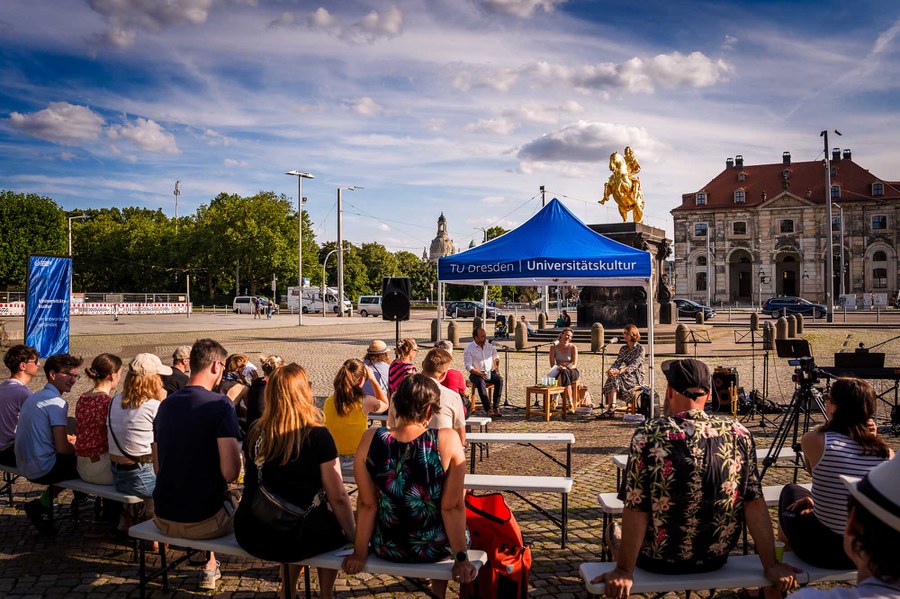
TUD Lectures+ ist eine Veranstaltungsreihe des Sachgebiets Universität und Gesellschaft, die aktuelle gesellschaftliche, wissenschaftliche und technologische Fragen in den Mittelpunkt stellt. Sie bringt Menschen aus Wissenschaft, Wirtschaft, Politik, Kultur und Gesellschaft zusammen und schafft Raum für neue Perspektiven, kontroverse Diskussionen und inspirierende Impulse. Aus dem 2021 gegründetem Videoformat, wurde ein Vortragsformat an ungewöhnlichen Orten. Mittlerweile sind die TUD Lectures+ eine Talkrunde, die als Podcast aufgezeichnet wird und dort stattfindet, wo man "hineinstolpert" - das können Biergärten, Einkaufsstraßen, Kneipen, Friedhöfe oder Bibliotheken sein.
Im Zentrum stehen Themen, die unsere Gegenwart prägen und unsere Zukunft gestalten: von technologischen Innovationen und nachhaltiger Entwicklung über gesellschaftlichen Wandel bis hin zu den großen Herausforderungen unserer Zeit. Renommierte Expertinnen und Experten teilen ihr Wissen, ordnen Entwicklungen ein und geben Denkanstöße, die über den Abend hinaus wirken. Im Mittelpunkt stehen dabei aber die Fragen der Anwesenden, die mittels Fragekarten eingereicht werden. Ab Oktober 2026 strartet die neue Reihe "Demokratie unter Druck".
Hier gibt es einer Übersicht aller TUD Lectures Plus der vergangenen Jahre. Thematisch lassen sich die Lectures einteilen in:
Inhaltsverzeichnis
Demokratie unter Druck (2026/2027)
Die Demokratie ist ein Grundpfeiler unserer Gesellschaft – doch sie steht zunehmend unter Druck. Polarisierung, Desinformation, der Verlust des Vertrauens in Institutionen sowie antidemokratische Tendenzen stellen sie vor immense Herausforderungen. Mit der TUD Lectures-Reihe „Demokratie unter Druck“, die im Oktober 2026 startet, soll ein interdisziplinärer Dialog angestoßen werden, um diese Entwicklungen zu beleuchten. Die TUD Lectures, die gemeinsam von der Arbeitsgruppe „Gemeinsam für Demokratie“ der Fakultät Psychologie, dem Centrum für Demographie und Diversität (CDD) sowie dem Dezernat Universitätskultur und dem Podcastformat YOU ASK we explain organisiert wird, bringt Expert:innen aus verschiedensten Disziplinen wie Psychologie, Politikwissenschaft, Soziologie, Kommunikationswissenschaft und anderen Disziplinen zusammen.
Mit welchem Gefühl geben wir unsere Stimme ab? Mit Enttäuschung? Mit dem Gefühl, nicht gehört oder nicht gesehen zu werden? Oder mit der Hoffnung, etwas verändern zu können? Entscheidend: Gefühle!
Gefühle beeinflussen, was wir wahrnehmen, wem wir vertrauen und welche Botschaften uns erreichen. Rechtsextreme Parteien sprechen gezielt Emotionen wie Wut, Angst, Abgrenzung und Zugehörigkeit an. Psychologische Mechanismen spielen dabei eine wichtige Rolle. Sie prägen unsere Wahrnehmung und beeinflussen, wie wir politische Botschaften bewerten – und letztlich auch, für wen wir uns entscheiden. Wie können wir es dennoch schaffen im Gespräch zu bleiben, wenn Meinungen zunehmend auseinanderdriften?
Wann:
07.10.2026, 18:00 Uhr
Wo:
Robotron Kantine Dresden
Im Rahmen der TUD Lectures+ darf die Ausstellung „WAS TUN WIR. Bilder in Zeiten zerfallender Gewissheiten.“ bereits ab 17:00 Uhr kostenlos besucht werden.
Unsere Redner:innen
Prof.in Dr. Eva Walther, Sozialpsychologie, Universität Trier
PD Steffen Kailitz, Hannah-Arendt-Institut für Totalitarismusforschung
Robert Ritter, Arbeitsgruppe „Demokratie unter Druck“
Moderation:
Friedemann Brause, Sächsische Landeszentrale für politische Bildung
Wann: 14.10.2026, ab 18 Uh18:00 Uhr
Wo: Galerie Brüderstraße (9), Görlitz
Die Wahlergebnisse aus Sachsen-Anhalt zeigen, dass die liberale Demokratie bröckelt. Was bleibt, wenn liberale Demokratien ins Wanken geraten? Wie darf/ sollte/ kann sich überhaupt ein Unternehmen, eine Forschungseinrichtung positionieren und einbringen, um liberale Demokratie zu leben? Welches Vorgehen ist laut Verfassung möglich oder gar geboten? Was bedeutet politische Stabilität für Investitionen, Innovation, Fachkräfte und Forschung?
Bei den interaktiven TUD Lectures+ werden Antworten auf diese und weitere Fragen gesucht und gemeinsam mit dem Publikum besprochen.Nach kurzen Eingangsstatements diskutiert das Podium sowohl untereinander als auch mit den Besucherinnen und Besuchern der Veranstaltung, wie Unternehmen und Forschungseinrichtungen Verantwortung übernehmen können, wo Engagement gefragt ist und welche Handlungsmöglichkeiten jede Einzelne hat.
Unsere Redner:innen
Prof. Markus Scholz, Professur für Betriebswirtschaftslehre, insb. Responsible Management am Internationalen Hochschulinstitut Zittau (IHI) der TU Dresden
Sylvia Pfefferkorn, Welcome to Saxony
Prof. Thomas D. Kühne, Direktor des CASUS
Moderation:
Franziska Stölzel, Wissenschaftlerin für den Sozialen Wandel
Mit Levke Burfeind von HateAID und Prof. Philipp Lorenz-Spreen, Professor für Computational Social Science am Institut für Kommunikationswissenschaft und dem Center Synergy of Systems (SynoSys) der TU Dresden
Moderation:
Stefanie Gerstenberger, Tu Dresden
Frauenrechte und Generationen (2025)
Unsere Podcastreihe YOU ASK we explain - Berührungsängste mit der Wissenschaft widmet sich in unserer 40. Folge dem Austausch zwischen Dresden und Coventry
Dresden und Coventry verbindet ein Bild, das sich unauslöschlich in das kollektive Gedächtnis beider Städte eingeschrieben hat: das Bild der Zerstörung. Und doch stehen diese Zerstörungen nicht einfach nebeneinander. Sie markieren zwei historische Ereignisse, die in einem ursächlichen Zusammenhang stehen – das eine ist ohne das andere nicht zu verstehen.
Die Luftangriffe auf Coventry im November 1940, deren 85. Jahrestag sich Ende des vergangenen Jahres jährte, waren ein Wendepunkt im Zweiten Weltkrieg. Sie veränderten nicht nur das Gesicht der Stadt, sondern prägten auch ihre Haltung gegenüber der eigenen Geschichte. Dresden ereilte wenige Jahre später ein ähnliches Schicksal – mit anderen Voraussetzungen, anderen Nachwirkungen und einer anderen Erinnerungskultur.
Bis heute wird in beiden Städten jährlich der Opfer gedacht. In Coventry jedoch ist dieses Gedenken untrennbar mit einem besonderen Vermächtnis verbunden: dem bewussten Akt der Vergebung. Die neu errichtete Kathedrale steht nicht nur als architektonisches Zeichen des Wiederaufbaus, sondern als Ort einer Haltung, die auf Versöhnung zielt. Wer diesen Raum betritt, spürt schnell, dass Vergebung hier nicht eingefordert, sondern angeboten wird – und dass es an uns liegt, dieses Angebot anzunehmen.
Der Podcast in der Reihe TU Lectures Plus greift diese gemeinsame, zugleich gegensätzliche Geschichte auf. Im Format You ask – we explain werden historische Linien, persönliche Perspektiven und gegenwärtige Fragen miteinander verknüpft. Im Zentrum steht dabei der Austausch: Wie wirken diese Erfahrungen bis heute nach? Welche Verantwortung tragen nachfolgende Generationen? Und was entsteht, wenn unterschiedliche Perspektiven ineinander übergehen?
Gerade in diesem Dialog liegt der Wert des Dresden–Coventry-Austauschs: nicht im Vergleich von Leid, sondern im gemeinsamen Nachdenken über Erinnerung, Verantwortung und Zukunft.
Wann: 12.02.2026, 19.00–20.15 Uhr
Wo: Raskolnikoff, Böhmische Straße 34, 01099 Dresden
Unsere Referent:innen:
-
Tine & Günter Starke - Fotograf:innen (Link)
-
Nikolai Press - Alumnibotschafter:in für Coventry (Link)
-
Sabine Coady Schaebitz - Coventry University, Autorin des Buchs "Heritage and Democracy - Introductory Thoughts" (Link)
-
Rainer Barczaitis - Coventry coordinator, Übersetzer (Link)
-
Johannes Schütz - TU Dresden, DFG-Projekt „Polyphonie der Heimat“
Fotohinweis
Während dieser Veranstaltung wird fotografiert und Videos aufgenommen. Die Fotos werden für die Presse- und Öffentlichkeitsarbeit der TUD sowie der anderen Beteiligten genutzt. Im Rahmen der Berichterstattung werden Fotos bei Bedarf auch an Dritte weitergegeben. Mit Ihrer Teilnahme an der Veranstaltung willigen Sie ein, dass gegebenenfalls Fotos von Ihnen für Veröffentlichungen in Print- und Online-Medien inkl. Social Media genutzt werden.
Dieses Vorhaben wird gefördert vom Bundesministerium für Forschung, Technologie und Raumfahrt (BMFTR) und dem Freistaat Sachsen im Rahmen der Exzellenzstrategie von Bund und Ländern.
Inhalt
Familien sind vielleicht die kleinsten demokratischen Zellen unserer Gesellschaft. Zwischen Frühstückstisch und Gute-Nacht-Geschichte lernen wir jeden Tag, was Gemeinschaft bedeutet: zuzuhören, Fragen zu stellen, auszuhalten, anderer Meinung zu sein – und trotzdem zusammenzugehören. In Familien erfahren wir, wie wichtig es ist, Wünsche zu äußern, Verantwortung zu übernehmen und gemeinsam Lösungen zu finden. All das prägt uns ein Leben lang.
Anlässlich des Podcastfestivals in der Bibliothek Neustadt möchten wir – angelehnt an die Kinderfragenshow in der Zentralbibliothek – mit euch weiter darüber nachdenken, wie wir als Familien zusammenkommen und wie wir als Generationen miteinander leben. Welche Herausforderungen entstehen dabei? Welche Chancen stecken in den kleinen Momenten des Alltags? Und was können wir voneinander lernen?
Gemeinsam mit dem Podcastformat „YOU ASK we explain“ der TU Dresden sammelt Jana Forkel – bekannt aus der Sendung mit der Maus und neuneinhalb – eure Fragen rund um Familie, Zusammenleben und Generationen. Live vor Ort werden sie von der Autorin Gerda Raidt sowie Wissenschaftler:innen der TU Dresden aufgegriffen und beantwortet. So entsteht ein Gespräch, das zeigt: Jede Frage zählt. Und jede Perspektive hilft uns, unser Miteinander besser zu verstehen.
Kommt vorbei, denkt mit – und fragt, was ihr euch schon immer gefragt habt!
Für Familien und Kinder ab 6 Jahren.
Wann:
06. Dezember 2025, 16:00
Wo:
Bibliothek Neustadt, Königsbrücker Straße 26, 01099 Dresden
Referent:innen:
- Jana Forkel – bekannt aus der Sendung mit der Maus und neuneinhalb
- Gerda Raidt, Autorin
Fotohinweis:
Während dieser Veranstaltung wird fotografiert und Videos aufgenommen. Die Fotos werden für die Presse- und Öffentlichkeitsarbeit der TUD sowie der anderen Beteiligten genutzt. Im Rahmen der Berichterstattung werden Fotos bei Bedarf auch an Dritte weitergegeben. Mit Ihrer Teilnahme an der Veranstaltung willigen Sie ein, dass gegebenenfalls Fotos von Ihnen für Veröffentlichungen in Print- und Online-Medien inkl. Social Media genutzt werden.
Dieses Vorhaben wird gefördert vom Bundesministerium für Forschung, Technologie und Raumfahrt (BMFTR) und dem Freistaat Sachsen im Rahmen der Exzellenzstrategie von Bund und Ländern.
Inhalt
Mutterschaft – ein Wort, das so heimelig klingt und doch ganze Weltordnungen in Bewegung setzt. Zwischen tradierten Rollenbildern und modernen Lebensentwürfen spannt sich ein Feld, das weit über die Familie hinausreicht. Mütter jonglieren Termine, tragen die unsichtbare Verantwortung und sind zugleich politisches Subjekt, feministische Kämpferinnen, Kunstinteressierte und Mitgestalterinnen der Gesellschaft.
Während sich Rollen wandeln, werden Mütter immer noch stilisiert, bewertet, interpretiert – und gleichzeitig ist ihnen eine "zweite Halbzeit" zugestanden. In diesem Spannungsfeld entfaltet sich der Live-Podcast. Dabei wird aus Mutterschaft ein öffentliches Thema - nicht privat, sondern auch politisch.
Sein Sie live dabei und stellen Sie uns Ihre anonymen Fragen. Wir freuen uns auf Ihre Teilnahme und einen bereichernden Austausch!
Wann:
12. November 2025, 17:30
Wo:
Zentralbibliothek im Kulturpalast, Foyer 2. OG - Schloßstraße 2, 01067 Dresden
Unsere Referent:innen:
- Cordula Weimann, Omas for Future
- Steffi Palm, Projekt Leihomas vom Frauenförderwerk e. V.
- Maik Spreer, "Mama, denk an mich" - Netzwerk für Drogenprävention in der Schwangerschaft
- Eugenie Gehring/Carla Lopez, Projekt Stadtteilmütter vom Frauenförderwerk e. V.
Moderation:
-
Henriette Mehn, Städtische Bibliotheken Dresden
Fotohinweis
Während dieser Veranstaltung wird fotografiert und Videos aufgenommen. Die Fotos werden für die Presse- und Öffentlichkeitsarbeit der TUD sowie der anderen Beteiligten genutzt. Im Rahmen der Berichterstattung werden Fotos bei Bedarf auch an Dritte weitergegeben. Mit Ihrer Teilnahme an der Veranstaltung willigen Sie ein, dass gegebenenfalls Fotos von Ihnen für Veröffentlichungen in Print- und Online-Medien inkl. Social Media genutzt werden.
Dieses Vorhaben wird gefördert vom Bundesministerium für Bildung und Forschung (BMBF) und dem Freistaat Sachsen im Rahmen der Exzellenzstrategie von Bund und Ländern.
Inhalt
Einen Tag vor dem Weltfriedenstag lädt die Künstlerin Svea Duwe gemeinsam mit dem Podcastformat „YOU ASK we explain“ der TU-Dresden zum Denkmal der Roten Armee am Olbrichtplatz. Herzstück der Skulpturalen Situation ist die Präsentation eines invertierten Gedenkkranzes, in dessen Wurzeln Begriffe eingewachsen sind, die sich auf die russische Inschrift am Denkmal beziehen. Flankiert wird diese Präsentation durch eine offene Gesprächsrunde über die Frage „Wie ist Weltfrieden denkbar?“ mit Prof. Dr. Dominik Steiger, Prof. Dr. Stephanie Herold, Katja Protte und Svea Duwe, moderiert von Gwendolin Kremer. Den Abschluss bildet die Performance „Europas Hemd“ von Svea Duwe, interpretiert von Caroline Beach. Die Veranstaltung wird im Podcastformat „YOU ASK we explain“ der TU-Dresden aufgezeichnet.
Sein Sie live dabei und stellen Sie uns Ihre anonymen Fragen. Wir freuen uns auf Ihre Teilnahme und einen bereichernden Austausch!
Wann:
20. September 2025, 15 Uhr
Wo:
Hans-Oster-Straße, Denkmal
Unsere Referent:innen:
-
Prof. Dr. Dominik Steiger - Inhaber des Lehrstuhls für Völkerrecht, TU-Dresden
-
Prof. Dr. Stephanie Herold - Denkmalpflege und urbanes Kulturerbe, TU-Berlin
-
Katja Protte - Kuratorin Kunst + Militär, Militärhistorisches Museum Dresden
-
Svea Duwe - Bildhauerin
Moderation:
-
Gwendolin Kremer - Kunsthistorikerin, Kustodie TU-Dresden, Mitglied der Kommission für Kunst im Öffentlichen Raum Dresden
Fotohinweis
Während dieser Veranstaltung wird fotografiert und Videos aufgenommen. Die Fotos werden für die Presse- und Öffentlichkeitsarbeit der TUD sowie der anderen Beteiligten genutzt. Im Rahmen der Berichterstattung werden Fotos bei Bedarf auch an Dritte weitergegeben. Mit Ihrer Teilnahme an der Veranstaltung willigen Sie ein, dass gegebenenfalls Fotos von Ihnen für Veröffentlichungen in Print- und Online-Medien inkl. Social Media genutzt werden.
Dieses Vorhaben wird gefördert vom Bundesministerium für Bildung und Forschung (BMBF) und dem Freistaat Sachsen im Rahmen der Exzellenzstrategie von Bund und Ländern.
Inhalt
Die Technische Universität Dresden lädt in Kooperation mit den Städtischen Bibliotheken Dresden, dem *sowieso* e.V. und dem Frauenstadtarchiv e.V. zu der Wanderausstellung „Gemeinsam sind wir unerträglich – Die unabhängige Frauenbewegung in der DDR“ ein.
Zum Auftakt der Ausstellung diskutieren Gäste aus Wissenschaft und Aktivismus in einer öffentlichen Podcast-Aufzeichnung über die unabhängige Frauenbewegung der DDR, ihre Bedeutung damals – und ihre Relevanz heute.
In den 1980er Jahren gründeten sich in der DDR unabhängige Frauengruppen, die sich nicht mit staatlichen Parolen zufriedengaben. Sie engagierten sich für Frieden, Demokratie und Menschenrechte – und stellten die offizielle Erzählung von Gleichstellung infrage. Sie protestierten gegen das Wettrüsten, prangerten die Diskriminierung von Lesben an und forderten reale Gleichberechtigung. Trotz Überwachung, Repression und gesellschaftlicher Ablehnung hielten sie unbeirrt an ihrem Engagement fest. Aus diesen Gruppen entwickelte sich eine landesweite Bewegung. 1989/90 wurden sie Teil der friedlichen Revolution, nahmen an den Runden Tischen Platz und kämpften für Frauenhäuser, gleiche berufliche Chancen, soziale Absicherung und eine kritische Auseinandersetzung mit bestehenden Machtverhältnissen.
Die Ausstellung „Gemeinsam sind wir unerträglich“ bringt ihre Geschichten nach Dresden. Dokumente, Fotografien und bewegende Interviews zeigen, wie Frauen damals für ihre Rechte kämpften – und warum ihr Engagement noch lange nicht beendet ist.
Ihr Ringen ist noch heute aktuell: Denn wie gleichberechtigt ist unsere Gesellschaft wirklich? Wirtschaftliche Ungleichheit, Bildungszugänge, Wohnraumpolitik und Umweltkrisen sind nach wie vor Herausforderungen für die soziale Gerechtigkeit. Die Ausstellung lädt dazu ein, diese Fragen weiterzudenken – und den Dialog fortzusetzen.
Ausstellungszeitraum:
📅 21. Juli – 20. August 2025
Wo:
📍Foyer 2. OG, Zentralbibliothek im Kultupalast Dresden
Gäste:
- Grit Lemke, Autorin (u.a. „Kinder von Hoy. Freiheit, Glück und Terror“, 2021) und Filmkuratorin („Gundermann Revier“, 2019 und „Sorbische Filmlandschaften. Serbske filmowe krajiny“, 2024),
- Judith Geffert von der Rosa Luxemburg Stiftung und Co-Kuratorin der Ausstellung
Informationen:
- Sprache: deutsch
- eine Anmeldung ist nicht erforderlich
- Barrierefreiheit: Bei Bedarfen der Barrierefreiheit, freuen wir uns über Ihre Nachricht an .
Bustouren
Rebellinnen auf Achse – mit dem Bus durch die Geschichte der Dresdner Frauenbewegung
Im Rahmen der Ausstellung lädt eine Bustour zu einer historischen Spurensuche ein. Besucht werden zentrale Orte der Frauenbewegung in Dresden in der späten DDR und Wendezeit – wie das Frauenstadtarchiv e.V und das *sowieso*. Zeitzeug:innen und Expert:innen berichten unterwegs von damaligen Kämpfen und aktuellen Perspektiven.
Wann:
Montag, 28. Juli & Samstag, 2. August 2025, 16 – 19 Uhr
weitere Informationen:
- Eintritt frei
- Anmeldung erforderlich unter: tud.de/ddr-frauenbewegung
Inhalt:
Die Vergangenheit verstehen, um die Gegenwart bewusster zu gestalten – unter diesem Leitgedanken startet unsere 33. Podcastfolge: Vergangenheit, Verantwortung, Vision, produziert als TUD Lectures+. Mit Analysen und ethischen Fragestellungen beleuchten wir die dunklen Kapitel der Medizingeschichte im Nationalsozialismus und schlagen Brücken zur Gegenwart.
Ausgangspunkt für diesen Podcast ist die Ausstellung „Im Gedenken der Kinder“, die an die mehr als 5.000 Kinder erinnert, die in sogenannten „Kinderfachabteilungen“ gequält und ermordet wurden. Diese grausamen Verbrechen geschahen unter Beteiligung niedergelassener Ärzte, staatlicher Ämter, Krankenhäuser und wissenschaftlicher Institutionen. Unser Podcast widmet sich diesen erschütternden Kapiteln der Geschichte und diskutiert ihre Bedeutung für die heutige Gesellschaft.
Wann:
16. April 2025, 18:00 Uhr
Wo:
Kunstverein Dresden, Neustädter Markt 8, 01097 Dresden
Unsere Referent:innen:
Unsere Gäste sind Wissenschaftler:innen, die sich seit Jahren intensiv mit der NS- und Medizinvergangenheit und ihren Folgen beschäftigen:
- Prof. Dr. phil. Beate Mitzscherlich – Professorin für Pädagogische Psychologie und Ethik im Gesundheitswesen an der Westsächsischen Hochschule Zwickau. Sie forscht seit vielen Jahren zu den Verbrechen der NS-Medizin und insbesondere zur Rolle der Gesundheitsämter. Ihre Arbeit zeigt auf, wie systematisch Menschen, die nicht in das völkische Gesellschaftsbild passten, erfasst, entrechtet und ermordet wurden. Ihre Erkenntnisse werfen ein erschreckendes Licht auf die ethische Skrupellosigkeit der Täter:innen und machen deutlich, wie zentral das Thema Datensicherheit auch in der heutigen Zeit ist.
- Prof. Dr. Florian Bruns – Professor für Ethik und Geschichte der Medizin und Zahnmedizin sowie Direktor des Instituts für Geschichte der Medizin an der TU Dresden. Als Kurator der Ausstellung „Im Gedenken der Kinder. Die Kinderärzte und die Verbrechen an Kindern in der NS-Zeit“ hat er sich intensiv mit der Beteiligung von Mediziner:innen an der systematischen Ermordung von Kindern befasst. Seine Forschung gibt tiefgehende Einblicke in die Mechanismen der Tätergesellschaft und die moralischen Dilemmata, die sich bis heute stellen.
- Dr. Hagen Schönrich – Wissenschaftlicher Koordinator des Forschungsprojekts „Die Technische Hochschule Dresden im Nationalsozialismus“. Er forscht zur Geschichte der Hochschulen während des Dritten Reiches und beleuchtet, wie Wissenschaft und Ideologie miteinander verflochten waren. Seine Arbeit zeigt, wie Hochschulen als Instrumente zur Durchsetzung politischer Agenden genutzt wurden und welchen Einfluss dies auf die Forschung und Lehre hatte.
Moderation:
-
Linda Fleck, Promotionsstipendiatin im Graduiertenkolleg „Die Technische Hochschule Dresden im Nationalsozialismus“. Ihre Forschung beschäftigt sich mit der Ideologisierung der Lehrer:innenausbildung und untersucht, wie Bildung gezielt als Machtinstrument zur Verbreitung nationalsozialistischer Ideologie genutzt wurde. Mit journalistischem Gespür und wissenschaftlicher Neugierde stellt sie die zentralen Fragen: Welche Verantwortung haben Wissenschaft und Gesellschaft aus der Vergangenheit heraus? Wie gehen wir heute mit ethischen Grauzonen in der Medizin um? Und welche Lehren können wir für die Zukunft ziehen?
Unser Podcast ist eine Einladung zum Nachdenken, Erinnerung ist der erste Schritt zur Verantwortung. Sein Sie live dabei und stellen Sie uns Ihre anonymen Fragen. Wir freuen uns auf Ihre Teilnahme und einen bereichernden Austausch
Fotohinweis
Während dieser Veranstaltung wird fotografiert und Videos aufgenommen. Die Fotos werden für die Presse- und Öffentlichkeitsarbeit der TUD sowie der anderen Beteiligten genutzt. Im Rahmen der Berichterstattung werden Fotos bei Bedarf auch an Dritte weitergegeben. Mit Ihrer Teilnahme an der Veranstaltung willigen Sie ein, dass gegebenenfalls Fotos von Ihnen für Veröffentlichungen in Print- und Online-Medien inkl. Social Media genutzt werden.
Dieses Vorhaben wird gefördert vom Bundesministerium für Bildung und Forschung (BMBF) und dem Freistaat Sachsen im Rahmen der Exzellenzstrategie von Bund und Ländern.
Inhalt:
Sexualität – sie flüstert, sie schreit, sie formt Identität. Sie ist Begehren und Barriere, Ekstase und Enigma. Ein Ort der Freiheit – und doch oft gefangen in Normen, Mythen, Missverständnissen.
Wir reden über Sex. Aber oft im falschen Licht. Zu verkürzt, zu normativ, zu verlegen.
Die Debatten kreisen um Identitäten und Kategorien, während die eigentlichen Fragen unausgesprochen bleiben. Denn Sexualität ist kein starres Konzept, sondern ein gelebter Prozess – wandelbar, individuell, widersprüchlich.
Nicht jeder fühlt Begehren, nicht jede Lust ist gleich. Asexualität ist kein Defizit, sondern eine Realität, die Raum braucht. Und Verlangen ist keine Konstante, sondern eine Dynamik, die von psychischen, gesellschaftlichen und körperlichen Faktoren geprägt wird. Wenn die Libido nachlässt, wenn das Körpergefühl sich verändert, wenn Sex plötzlich mehr Druck als Lust bedeutet – dann sind das keine Randphänomene, sondern Themen, über die wir sprechen müssen.
Sex ist politisch. Er ist kulturell verankert und sozial verhandelt. Normen schreiben vor, was als normal gilt, was begehrenswert erscheint, was als funktionierend betrachtet wird. Doch wer entscheidet, was richtig oder falsch, gesund oder gestört ist? Zwischen Scham und Selbstbestimmung, zwischen Erwartung und Erfüllung, zwischen Norm und gelebter Erfahrung verläuft ein schmaler Grat.
Gäste
Tina Hölzel-Chokharash, Paul Flemming und Rebekka Schwesig – bringen Wissenschaft, Praxis und Klartext auf die Bühne. Sie sprechen über Lust, Identität, Dysfunktion und gesellschaftliche Zwänge. Über Sex als Spiegel der Gesellschaft – und über das, was endlich gesagt werden muss.
Moderation:
Amelie Schleich
Wo:
Laika Bar, Kamenzer Straße 20, 01099 Dresden
Wann:
Beginn: 05.03.2025, 19:00 Uhr
Weitere Infos & Podcast-Links:
- https://tu-dresden.de/med/mf/idl/dasinstitut/carl/you-ask-we-explain/podcasts/folge-32
- https://open.spotify.com/show/6JifjjK1bpRWxADvX0qOtr
Fotohinweis:
Während dieser Veranstaltung wird fotografiert und Videos aufgenommen. Die Fotos werden für die Presse- und Öffentlichkeitsarbeit der TUD sowie der anderen Beteiligten genutzt. Im Rahmen der Berichterstattung werden Fotos bei Bedarf auch an Dritte weitergegeben. Mit Ihrer Teilnahme an der Veranstaltung willigen Sie ein, dass gegebenenfalls Fotos von Ihnen für Veröffentlichungen in Print- und Online-Medien inkl. Social Media genutzt werden.
Dieses Vorhaben wird gefördert vom Bundesministerium für Bildung und Forschung (BMBF) und dem Freistaat Sachsen im Rahmen der Exzellenzstrategie von Bund und Ländern
Gesellschaftlicher Zusammenhalt (2024)
Inhalt:
Wenn gespart wird, trifft es oft diejenigen mit der schwächsten Lobby.
Soziale Arbeit, insbesondere Schulsozialarbeit als ein Teil der Jugendhilfelandschaft in Sachsen, ist wesentlich für ein gelingendes Aufwachsen von Kindern und Jugendlichen. Sie leistet einen entscheidenden Beitrag dazu, Kinder und Jugendliche direkt am Lern- und Lebensort Schule in einer Lebensphase zu unterstützen, die von emotionalen, sozialen und akademischen Herausforderungen geprägt ist. Doch was passiert, wenn diese Unterstützung gekürzt oder gar eingestellt wird?
Die Folgen solcher Einschnitte sind vielfältig und tiefgreifend. Teenager stehen unter enormem Druck: Prüfungsangst, Konflikte mit Eltern, Lehrkräften oder Mitschüler:innen, Mobbing, die Suche nach Zugehörigkeit, soziale Unsicherheiten oder gar der Einstieg in problematische Verhaltensmuster wie Drogenkonsum. Solche Herausforderungen verlangen nach professioneller Begleitung – und genau hier setzt die Schulsozialarbeit an.
Vertrauen, das Jahre braucht – und in Sekunden verloren geht
Ein funktionierendes System der Schulsozialarbeit basiert auf einem langfristigen Vertrauensverhältnis zwischen Sozialarbeiter:innen und Schüler:innen. Dieses Vertrauen ist oft der Schlüssel, um junge Menschen zu erreichen und ihnen in schwierigen Momenten eine Perspektive zu bieten. Doch dieses fragile Gleichgewicht ist gefährdet: Kürzungen und Einsparungen zerstören gewachsene Strukturen und erschweren den Aufbau solcher Beziehungen nachhaltig.
Gesellschaftliche und generationenübergreifende Auswirkungen
Die gesellschaftlichen Konsequenzen eines Rückzugs der Schulsozialarbeit sind schwer abzusehen, doch sie reichen weit über den Schulalltag hinaus. Soziale Ungleichheiten könnten sich vertiefen, Konflikte verstärken und Chancen auf Bildung und Integration reduziert werden. Diese Entwicklungen könnten ganze Generationen prägen und die sozialen Herausforderungen unserer Gesellschaft deutlich verschärfen.
Ein Dialog für die Zukunft
Im Rahmen unseres Podcasts „Leise Stimmen, laute Folgen“ möchten wir diesen Themen Raum geben und eine Plattform für den Austausch schaffen. Ziel ist es, nicht nur die aktuellen Herausforderungen und die Bedeutung der Schulsozialarbeit zu beleuchten, sondern auch langfristige Perspektiven zu diskutieren.
Wir planen die Aufzeichnung an einem öffentlichen Ort, um das Thema einem breiteren Publikum zugänglich zu machen. Ein integraler Bestandteil der Veranstaltung ist der Dialog: Wir möchten nicht nur Expert:innen und Betroffene zu Wort kommen lassen, sondern auch die Öffentlichkeit einbeziehen und insbesondere Eltern die Möglichkeit geben, ihre Perspektiven und Fragen einzubringen.
Einladung zur Reflexion und Mitgestaltung
Unsere Veranstaltung richtet sich an alle, denen das Wohl junger Menschen und die Zukunft unserer Gesellschaft am Herzen liegt. Gemeinsam wollen wir nach Wegen suchen, wie der Stellenwert der Schulsozialarbeit gestärkt und ihre unverzichtbare Rolle für Schüler:innen, Lehrkräfte und Familien gesichert werden kann.
Wann:
22.01.2025, 18:00 Uhr
Wo:
Aula des Gymnasium Bürgerwiese, Parkstraße 4 (Lennéplatz), Dresden
Unsere Referent:innen:
- Paula Bormann - Geschäftsführende Bildungsreferentin an der LAG Schulsozialarbeit Sachsen e.V.
- Tobias Gaub - stv. Geschäftsführung beim Landesverband Soziokultur Sachsen
- Wieland Köhler - Schulsozialarbeiter am Gymnasium Bürgerwiese
- Amy Kirchhoff - Landesvorstand des Landesschülerrates Sachsen
- Anke Voigt - Leitung Kliniksozialdienst an der Klinik und Poliklinik für Kinder- und Jugendpsychiatrie und -psychotherapie des Universitätsklinikum Dresden
- Constanze Berndt - Professorin für Soziale Arbeit und Schule an der Evangelischen Hochschule Dresden
Moderation:
-
Dominique Schwarze - SHK an der Lernwerkstatt der Professur für Gesundheit und Pflege/Berufliche Didaktik, TU Dresden
Fotohinweis:
Während dieser Veranstaltung wird fotografiert und Videos aufgenommen. Die Fotos werden für die Presse- und Öffentlichkeitsarbeit der TUD sowie der anderen Beteiligten genutzt. Im Rahmen der Berichterstattung werden Fotos bei Bedarf auch an Dritte weitergegeben. Mit Ihrer Teilnahme an der Veranstaltung willigen Sie ein, dass gegebenenfalls Fotos von Ihnen für Veröffentlichungen in Print- und Online-Medien inkl. Social Media genutzt werden.
Dieses Vorhaben wird gefördert vom Bundesministerium für Bildung und Forschung (BMBF) und dem Freistaat Sachsen im Rahmen der Exzellenzstrategie von Bund und Ländern.
Welche Rechte haben Kinder im Umgang mit Onlineinhalten? Wie können Eltern ihre Kinder auf Plattformen wie TikTok schützen? Was bedeutet es, wenn Eltern Bilder ihrer Kinder online teilen ("Sharenting"), und wie sollten dabei die Wünsche der Kinder berücksichtigt werden oder sind diese gar nicht zu berücksichtigen? Hat ein Kind das Recht darauf selbst zu entscheiden? Wo fehlt es an Regulierungen, wo wird überreguliert und wer sollte handeln. Werden hierdurch auch politische Inhalte zensiert, die es gar nicht werden sollten? Wo ist eine Grenze zu ziehen?
Ein Blick in die Praxis und in die Forschung zeigen bei dieser Lectures Herausforderungen und Lösungen auf. Diskutieren Sie mit, denn es geht um Ihre Erfahrung und um Ihre Kinder.
Wann
25. September 2024 um 18:00 Uhr
Wo
Kinderschutzbund Dresden, Lili-Elbe-Straße 7, Dresden - Johannstadt
Unsere Referent:innen
- JProf. Dr. jur. Katharina Kaesling, LL.M. (College of Europe), Juniorprofessorin für Bürgerliches Recht, Geistiges Eigentum, insbesondere Patentrecht, sowie Rechtsfragen der Künstlichen Intelligenz, Institut für Internationales Recht, Geistiges Eigentum und Technikrecht (IRGET) an der Philosophischen Fakultät der TU Dresden
- Carolin Arnold, Fachberaterin und Referentin für Kinderschutz beim Kinderschutzbund Dresden, Beratung auch als Kinderschutzfachkraft etwa in Kindergärten, Schulen und Horten
Musik
Jo Aldinger und Patrick Neumann
Ländliche Regionen stehen vor Herausforderungen: Abwanderung, fehlende Treffpunkte und zunehmende Spaltung durch soziale Medien. Politische Bildung kann helfen, indem sie Menschen ermutigt, eigene politische Ansichten zu entwickeln und respektvoll zu diskutieren. Die Frage Was tun? Wie kann dieser Raum revitalisiert werden? Welche Rolle spielt politische Bildung in diesem Prozess?
Erfahren Sie bei den TUD Lectures+ wie Projekte wie der „Erzgebirge Atlas“, das „JoDDiD“ und der Landeszentrale für politische Bildung den Austausch fördern und was das für die Zukunft des ländlichen Raums bedeutet.
„Das wird man ja wohl noch sagen dürfen?!“ - nicht nur eine rhetorische Frage, sondern eine Einladung. Mit Kulinarik des Bahnwärterhäuschens Tharandt und Musik von Jo Aldinger und Patrick Neumann.
Wann
11. September 2024, 18:00 Uhr
Wo
bei Regen im Bistro der Tharandter Spezialitätenmanufaktur: Roßmäßler Str. 21
Unsere Referent:innen
- David Jugel, Wissenschaftlicher Mitarbeiter an der John-Dewey-Forschungsstelle für die Didaktik der Demokratie (kurz: JoDDiD)
- Dipl.-Ing Gudrun Deppe, Wissenschaftliche Mitarbeiterin an der Professur für Urbanismus & Entwerfen und Projektmitarbeiterin im Erzgebirge Atlas
- Heike Nothnagel, Koordination Schule in der Sächsischen Landeszentrale für politische Bildung
- Katrin Kräcker, Hausärztliche Versorgung in Borna
Musik
Jo Aldinger und Patrick Neumann
Die europäische Migrationspolitik steht zunehmend im Zentrum gesellschaftlicher und politischer Debatten. Wie wirkt sich der Spagat zwischen humanitärer Verantwortung und strikten Grenzkontrollen auf den sozialen Zusammenhalt und die Integration von Geflüchteten in den neuen Heimaten aus?
Können wir weiterhin zusehen wie Menschen an den Außengrenzen oder im Heimatland aufgrund von europäischen Einreisebestimmungen oder Nichthandelns der Wertegemeinschaft misshandelt, gefoltert und vergessen werden? Wie gehen wir mit Migration vor dem Hintergrund einer sich zunehmend zuspitzenden politischen und gesellschaftlichen Debatte innerhalb Sachsens und Dresdens um? Ist der Ruf Dresdens und Sachsens wirklich so schlecht oder lässt sich gerade in der Medizin ein Funke Hoffnung und Solidarität finden?
Es verspricht eine spannende Diskussion über Dresden, Europa und die Welt zu werden in der nächsten TUD Lectures+.
Wann
Datum 29. August 2024 um 18:00 Uhr
Wo
Goldenen Reiter, Neustädter Markt
Unsere Referent:innen
- Hanaa Hakiki, vom European Center for Constitutional and Human Rights (dt: Europäisches Zentrum für Verfassungs- und Menschenrechte)
- Dr.med. Martin Bortz, Global Health Aktivist vom Fachbereich Allgemeinmedizin der Medizinischen Fakultät Dresden und Mitarbeiter bei "Ärzte ohne Grenzen" (MSF)
Moderation
Prof.in Nicole Vögele, Professur für Bewegtbild an der Hochschule für bildende Künste Dresden und Investigativjournalistin u.a. für den Spiegel
Musik
Banda Comunale
„Da ist man zuhause, wo die Heimat ist." Für viele in Sachsen lebende Menschen hat sich der Begriff Heimat und damit auch sein Empfinden in den letzten Jahrzehnten mehrfach verändert. In der DDR-Zeit bedeutete Heimat sowohl lokale und regionale Verbundenheit, als auch staatliche Kontrolle und Reiseunfreiheit. Nach der Wende gewann Heimat als Rückzugsort an Bedeutung. Seit 2000 festigte sich die neue ostdeutsche Identität, wobei Unterschiede zwischen Ost und West weiterhin bestehen und zu Spannungen führen. Gleichzeitig setzte sich eine Bewegung für eine offene und pluralistische Heimatdefinition ein, andererseits werden die Begriffe Heimat und Identität immer stärker von rechtsnationalen Parteien und Gruppierungen umgedeutet und vereinnahmt.
Ist die Gesellschaft durch diese Ereignisse zusammengewachsen oder driftet sie weiter auseinander? Was macht Heimat für uns in Sachsen und in Deutschland heute aus? Die Antwort auf diese Frage hat tiefgreifende Implikationen für die psychische Gesundheit und das Wohlbefinden aller Altersgruppen und fordert uns heraus, darüber nachzudenken, wie wir eine inklusive und unterstützende Heimat für alle schaffen können.
Wann
15. August 2024, 18:00 Uhr
Wo
Unsere Referent:innen
- Dr. Johannes Schütz, Professur für Neuere und Neueste Geschichte
- Prof. Anna-Lena Zietlow, Professur für Klinische Kinder- und Jugendpsychologie
- Dr. Lucas von Ramin, Institut für Philosophie
Moderation
Stephan Wiegand
Musik
Was macht Glück für uns aus? Woran messen wir unser Glück? Welche Faktoren spielen dabei eine Rolle? Welchen gesellschaftlichen Rahmen benötigen wir, um Glück zu fördern? Welche wirtschaftlichen Aspekte beeinflussen unser Glück?
Wann
01. August 2024, 18:00 Uhr
Wo
Hofladen Pirna, Kirchgasse 1, 01796 Pirna
Unsere Referent:innen
- Univ.-Prof. Dr. Johan Wölber - Professur für Parodontologie, Poliklinik für Zahnerhaltung, UniversitätsZahnMedizin Dresden
- Christoph Rothhaupt - Landwirt, der über seine Depression spricht
- Dr. med. Cäcilia Strehle - Fachärztin für Psychiatrie und Psychotherapie in Freital
Moderation:
Jonas Steinhäuser - Arzt in Weiterbildung
Musik
Patrick Neumann und Jo Aldinger
Hören Sie sich unseren Podcast einfach in Kürze von unterwegs an - bei Spotify Apple Music oder Deezer.
"Dresden bleibt bunt" – so lautet das Motto zahlreicher Plakate, die bei Demonstrationen zu sehen sind. Doch leben wir diese bunte Vielfalt wirklich und spiegelt sich das auch in Bereichen wie Sprache, Technikgestaltung oder Medizin wider? Berücksichtigt man in Forschung und Entwicklung die Vielfältigkeit unserer modernen Gesellschaft und nimmt Rücksicht auf die Bedürfnisse von Menschen in ihrer Unterschiedlichkeit?
Wann
18. Juli 2024, 18:00 Uhr
Wo
Neustädter Mark (Open Air)
Unsere Referent:innen:
- Prof.in Roswitha Böhm, Prorektorin Universitätskultur, Professorin für Französische Literatur- und Kulturwissenschaft / Institut für Romanistik und Mitglied der GenderConceptGroup der TU Dresden
- Prof. Alexander Lasch, Professur für germanistische Linguistik und Sprachgeschichte
Moderation:
-
Prof.in Nicole Vögele von der Hochschule für bildende Künste Dresden
Musik
Sie hatten keine Zeit dabei zu sein? Kein Problem: Hören Sie sich unseren Podcast einfach von unterwegs an - bei Spotify, Apple Music oder Deezer.
Der Klimawandel stellt eine der größten Herausforderungen für den gesellschaftlichen Zusammenhalt dar und kann gleichzeitig als verbindendes Element wirken, da wir alle von seinen Auswirkungen betroffen sind. Was versteckt sich hinter dem Begriff „Klimawandel“ und wie können wir uns ihm wissenschaftlich nähern? Wie beeinflusst der Klimawandel unser Leben und unsere Gesundheit? Warum wird dieses Thema auf politische Agenden gesetzt oder wirkt manchmal polarisierend. Kann die aktuelle Debatte eine Chance sein, zusammenzukommen? Wie kann das gelingen?
Diesen und vielen anderen Fragen wollen wir im Rahmen der TUD Lectures PLUS „Gesellschaftlicher Zusammenhalt“ nachgehen.
Wann
4. Juli 2024 um 18:00 Uhr
Wo
Hauptmarkt Bautzen mit der Kurkapelle Sonnendeck ("Entflieht der alltäglichen Tristesse und nehmt ein Soundbad im handgemachten Klangrausch der “Kurkapelle Sonnendeck”. Ein heißer Aufguss technoider Beats, der euch ins Schwitzen bringt. Seidig-organische Synth-Sounds schmiegen sich an euch wie der beste Morgenmantel. Wellen erdiger Bassfrequenzen bringen euch in Ekstase, während Saxophon und Trompete euch ein warmes Gefühl in kalten Farben ins Gesicht föhnen. Ihr wisst nicht, wie euch geschieht und werdet Teil der bebenden Masse. Eine übersinnliche Verschmelzung aus Techno und Jazz, House und Minimal.
Rein in Pantoffeln und ab auf die Tanzfläche - die “Kurkapelle Sonnendeck” spielt auf.")
Unsere Referent:innen
- Prof. Matthias Mauder, Professor für Meteorologie,
- Dr. Manès Weisskircher ist Leiter der BMBF-Nachwuchsgruppe REXKLIMA (Rechtsextremismus versus Klimaschutz?) am Institut für Politikwissenschaft, TU Dresden
- Dr. rer. medic. Alice Freiberg, Leiterin des Forschungsbereich Arbeits-/Sozial-/Umweltepidemiologie. Sie arbeitet am Institut und der Poliklinik für Arbeits- und Sozialmedizin TU Dresden.
Moderation
Jun.-Prof. Dr. Moritz Ingwersen, Juniorprofessur für Literatur Nordamerikas mit Schwerpunkt Future Studies und Shaleen Paschke
-
Sie hatten keine Zeit dabei zu sein? Kein Problem: Hören Sie sich den Podcast einfach in Kürze von unterwegs an - bei Spotify, Apple Music oder Deezer.
Gibt es ein richtiges oder falsches Handeln? Welche gesellschaftlichen Werte und Prinzipien unseres Verhaltens leiten uns in Wahlentscheidungen, und warum werden bestimmte Handlungen als moralisch gut oder schlecht angesehen? Wie beeinflussen uns diese Entscheidungen in unserem politischen Denken und Tun? In der Politik sprechen wir oft vom „christlich geprägten Abendland“, wenn es um Werte und Zugehörigkeiten geht. Sind wir wirklich noch eine christlich abendländische Wertegemeinschaft? Und wenn ja, wer, wie – und wo liegen ggf. Grenzen?“ Welchen Einfluss übt die zunehmende Digitalisierung unseres privaten und gesellschaftlichen Lebens auf ethische und moralische Entscheidungen aus? Wie kann die Ethik Diskussionen zu aktuellen Themen wie Zuwanderung, Krieg und sozialer Gerechtigkeit erhellen?
Gemeinsam mit den Referent:innen soll ergründet werden, welche Grundsätze uns als Gemeinschaft leiten, und wie wir gemeinsam eine gerechte und solidarische Gesellschaft gestalten können. Spielen religiöse Werte und Bildung eine Rolle bei der Stärkung eines sozialen Gefüges, haben ethische Herausforderungen in der Medizin Einfluss auf Vertrauen und Gerechtigkeit, und welche moralischen Entscheidungen beeinflussen in extremen Situationen unsere Haltung zu Recht und Sicherheit? Musikalisch wird die Veranstaltung durch die Banda Comunale unterstützt, die im Anschluss an das Podium spielen wird.
Die Veranstaltung ist ein gemeinsames Projekt des Dezernats Universitätskultur, der Kustodie der TU Dresden, dem Podcastformat YOU ASK we explain der medizinischen Fakultät der TU Dresden sowie der Galerie Ursula Walter und wird unterstützt durch die Hochschule für bildende Künste Dresden.
Wann
30. Mai 2024, 18:00 Uhr
Wo
Galerie Ursula Walter, Neustädter Markt 10
Unsere Referent:innen
- Dr. med. habil. Hermann Theilen, Facharzt für Anästhesiologie, Intensiv und Notfallmedizin, seit 2003 stellv. Vorsitzender der Ethikkommission der TU Dresden
- Dr. Lisa Hecht ist Wissenschaftlerin am Institut für Philosophie und beschäftigt sich mit der angewandten Ethik, der normativen Ethik und der politischen Philosophie.
- Prof.in Birte Platow ist Professorin für evangelische Religionspädagogik und praktische Theologie und unter anderem Mitglied im KI Kompetenzzentrum ScaDS.AI
Moderation:
Natalie Labitzke – Medizinstudentin an der TU Dresden
Sie hatten keine Zeit dabei zu sein? Kein Problem: Hören Sie sich den Podcast einfach in Kürze von unterwegs an - bei Spotify, Apple Music oder Deezer.
Eine funktionierende Demokratie trägt dazu bei, den gesellschaftlichen Zusammenhalt zu fördern und zu schützen. In Zeiten, in denen diese Werte herausgefordert werden, stellt die Wehrhaftigkeit der Demokratie eine essentielle Säule dar, um den gesellschaftlichen Zusammenhalt zu stärken. Gleichzeitig ist Demokratie auf breite Teilhabe angewiesen, um lebendig zu bleiben und ihr volles Potenzial zu entfalten. Doch wie funktioniert dies?
Prof. Dominic Steiger, Professur für Völkerrecht, Europarecht und öffentliches Recht und Prof. Florian Bruns, Professur für Ethik und Geschichte der Medizin wollen sich diesen Aspekten in der Veranstaltung TUD Lectures PLUS "Was die Welt im Inneren zusammenhält – Die Säulen der Gesellschaft" widmen und die Fragen der Interessierten Zuhörer:innen beantworten.
Die Veranstaltung ist offen für alle Interessierten und betont das Prinzip von der Podcastreihe "You ask we explain". Sie wird in Zusammenarbeit des Dezernats Universitätskultur, der Medizinischen Fakultät und der Kustodie der TU Dresden organisiert, um einen offenen und interaktiven Dialog zu ermöglichen und ist auch auf gängigen Streamingkanälen nachzuhören.
Wann:
2. Mai 2024, 18:00 Uhr
Wo:
Hofladen Pirna, Kirchgasse 1, 01796 Pirna
Unsere Referent:innen:
- Prof. Dominik Steiger, Professur für Völkerrecht, Europarecht und öffentliches Recht
- Prof. Florian Bruns, Professur für Ethik und Geschichte der Medizin
Moderation:
Natalie Labitzke und Stephan Wiegand
Hören Sie sich unseren Podcast einfach in Kürze von unterwegs an - bei Spotify Apple Music oder Deezer.
Energie (2023)
Die Vergangenheit war geprägt von der Vorstellung des ewigen Wachstums und der dauerhaften Mehrung des Wohlstands für alle. Die Fahrzeuge wurden größer und das Warenangebot in den Regalen immer unüberschaubarer.
Umweltschutz oder das Einsparen von knappen Gütern wurde zwar als löbliche Ausnahme betrachtet, mitunter auch als Chance der Gewinnmaximierung, jedoch nicht als eine existentielle Notwendigkeit.
Die derzeitige Krisenlage auf dem Energiemarkt zwingt zum Umdenken. So kann die Energiekrise einerseits Innovationen und technischen Fortschritt begünstigen. Gleichwohl wird die aktuelle Versorgungslage von einer emotional und politisch aufgeladenen Debatte begleitet, die auch zu enormen gesellschaftlichen Verwerfungen beitragen kann. Wie gestalten sich Chancen und Risiken dieser Transformationsphasen?
Wann
20. Februar 2023 um 18:00 Uhr
Wo
Foyer des Kulturpalastes Dresden
Unsere Referent:innen
- Prof. Dr. Edeltraud Günther, (UNU FLORES)
- Janek Treiber, (TU Dresden)
Die letzten Jahre waren geprägt durch kurze Abfolgen von Krisen, u.a. Finanzkrise, Covid-Krise und jetzt die Energiekrise. In diesem neuen Kooperationsformat soll nachgegangen werden, welche Kennzeichen die derzeitigen Umbrüche besitzen und welche Herausforderungen und Risiken sich in diesen verbergen.
Wann
24.01.2023
Wo
Online https://www.youtube.com/watch?v=idyvroJkkBk
Unsere Referent:innen
- Prof. Dr. Werner Gleißner (TU Dresden und Vorstand der Future Value Group AG)
- Prof. Dr. Dominik Möst (TU Dresden, Professur für Energiewirtschaft)
- Franziska Stölzel (UNU Flores, Weißwasser)
Moderation
Prof. Dr. Thomas Günther (TU Dresden, Professur für Betriebliches Rechnungswesen und Controlling)
Die Lecture mit dem Titel "Wie verändert sich Leben und Lernen angesichts sozialer Ungleichheit, steigender Preise und Energieknappheit?" nimmt den Bereich Wohnen und Bauen in den Blick und geht der Frage nach, wie dieser sozial und ökologisch gerechtet gestaltet werden kann. Vor allem studentisches Leben und Lernen im Kontext sozialer Ungleichheit sollen Ausgangspunkt des Vortrags und der Diskussion sein.
Wann
01.11.2022
Wo
Online https://www.youtube.com/watch?v=unL05ANwdj8
Unsere Referent:innen
- Prof. Dr. John Grunewald (Leiter des Instituts für Bauklimatik)
- Juliane Dziumla (UNU Flores)
Inklusion (2023)
Vor allem in ländlichen Regionen bietet hochautomatisiertes Fahren viele Möglichkeiten zur Teilhabe an Mobilität. Wie müssen Netzwerke, Infrastrukturen und Fahrzeuge gestaltet sein, damit dies erfolgreich umgesetzt werden kann?
Die TUD Lectures freuen sich mehrere Projekte zum hochautomatisierten Fahren mit Schwerpunktfragen zur Inklusion vorstellen zu dürfen.
Wann
9. April, 18:00 Uhr
Wo
Bürgerlabor, Kreuzstraße
Referent:
Dr. Steffen Kutter (Fachgruppenleiter Automatisiertes Fahren, Professur für Fahrzeugmechatronik und Gesamtgruppenleiter des Projekts ABSOLUT)
Moderation
Heike Schleussner
Das QuaBIS Team (Qualifizierung von Bildungs- und Inklusionsreferent:innen in Sachsen) ist seit 2019 Bestandteil in der Lehramtsausbildung der Lehrämter für allgemeinbildende Schulen (Grundschule, Oberschule und Gymnasium) an der TUD. Im Rahmen der Bildungswissenschaften halten Menschen mit Behinderungserfahrungen aktiv und im vollen Semesterumfang Seminare, die der Modulordnung entsprechen und vermitteln deren reguläre Lehrinhalte. Die Bildungs- und Inklusionsreferent:innen sind neben der Lehre auch in Forschungsaktivitäten eingebunden.
Bildungs- und Inklusionsreferent:innen nutzen ihre Perspektive, Barrieren und Mechanismen des Ausschlusses aufzudecken, die bisher noch nicht (umfassend) in den Blick genommen wurden.
Gemeinsam mit Ihnen wollen wir Annahmen hinterfragen, die häufig im Zusammenhang mit Inklusion zu finden sind, suchen Wege der Teilhabe und zeigen Möglichkeiten der Mitgestaltung auf.
Bei unserer Veranstaltung werden Sie aktiv in das Suchen und Finden nach Antworten eingebunden und wir freuen uns auf Ihre Teilnahme.
Wann
07.02.2024, 18:00 Uhr
Wo
Fritz-Foerster-Bau, Raum 101
Referent:innen:
Moderation
Sandra Siwek (AG SBS und SchauflerLab, TUD)
Während des Entwicklungsprozesses von Produkten und Anwendungen ist es wichtig, die Perspektiven möglichst vieler Anwendungen und Nutzer:innen miteinzubeziehen. Oftmals bleiben dabei Menschen mit besonderen Nutzungsherausforderungen außen vor, obwohl durchaus nur kleine Änderungen leicht zur Besserung beitragen würden.
Die TUD Lectures gehen der Frage nach, wie inklusives Produktdesign möglichst frühzeitig im Konstruktionsprozess umgesetzt werden kann.
Wann
13.12.2023, 18:00 Uhr
Wo
COSMO Wissenschaftsforum im Kulturpalast, Schloßstr. 2, 01067 Dresden
Referent:
Prof. Sebastian Pannasch (Bereich Mathematik und Naturwissenschaften)
Moderation
Sandra Siwek (AG SBS und SchauflerLab, TUD)
Junge Unternehmen entdecken zunehmend die Chancen und Potenziale von Inklusion, digitaler Barrierefreiheit und gesellschaftlicher Teilhabe. Die Möglichkeit der einfacheren Kommunikation und Mediennutzung schafft Zugänge für Menschen mit und ohne Einschränkungen und eröffnet Wege aus der wirtschaftlichen, politischen und sozialen Ausgrenzung.
Die TUD Lectures diskutieren diesmal das Tätigkeitsfeld von jungen Ausgründungen aus der TU Dresden, welche sich speziell mit dem Thema “Inklusion“ auseinandersetzen. Die Folien des Vortrags vom 18. Oktober 2023 finden Sie hier: Foliensatz
Wann
29.11.2023, 18:00 Uhr
Wo
COSMO Wissenschaftsforum im Kulturpalast, Schloßstr. 2, 01067 Dresden
Referentinnen
- Dr.in Claudia Loitsch (a11y Design GmbH)
- Juliane Heidelberger (VERSO Dresden gGmbH)
Moderation
Prof. Alexander Lasch (Professur für Germanistische Linguistik und Sprachgeschichte, TUD)
Im Projekt „Gelingen! – Gemeinsam lernen in und für inklusive(n) Bedingungen im Kindergarten“ haben sich Fachschüler:innen, Lehrer:innen und Wissenschaftler:innen für die Ausbildung von Erzieher:innen gemeinsam an einem neuen Lernprinzip zu Inklusion versucht und dieses gemeinsam weiterentwickelt.
Im Kern umfasst dieser Lernansatz, dass die angehenden Erzieher:innen mit ihren eigenen Fragen zum Thema Inklusion als Forscher:innen verschiedene Kitas besuchen, dort Interviews oder Beobachtungen durchführen, die Ergebnisse in ihren Forschungsgruppen reflektieren und abschließend die daraus gewonnenen Erkenntnisse der ganzen Klasse präsentieren.
Die TUD Lectures laden zu einem praxisnahen Einblick in die Entwicklung und Umsetzung des Lernprinzips ein. In der sich anschließenden Diskussion sollen damit einhergehende Chancen, aber auch Herausforderungen – aus Sicht der Fachschüler:innen, Lehrenden und wissenschaftlichen Begleiter:innen – auf dem Weg zu inklusiv(er)en Kitas ausgelotet werden.
Die Folien des Vortrags vom 18. Oktober 2023 finden Sie hier: Foliensatz
Wann
18.10.2023, 18:00 Uhr
Wo
COSMO Wissenschaftsforum im Kulturpalast, Schloßstr. 2, 01067 Dresden
Referentinnen:
- Prof.in Cornelia Wustmann (Inhaberin der Professur für Beratung und Soziale Beziehungen)
- Mirjam Christ (Promotionsstudentin an der Professur für Beratung und Soziale Beziehungen.
Moderation:
Sandra Siwek (AG SBS und SchauflerLab, TUD)
Nachhaltigkeit (2022)
Das Bauwesen stellt den ressourcenintensivsten Wirtschaftszweig Deutschlands dar und ist für einen signifikanten Anteil umweltschädlicher Emissionen verantwortlich. Über 500 Mio. Tonnen Materialaufwand pro Jahr werden dem Sektor zugeschrieben. Gleichermaßen betrugen die Abbruchabfälle 2016 mit 223
Mio. Tonnen rund 54 % des gesamten Abfallaufkommens des Landes. Weltweit betrachtet ist das Bauwesen für 38 % der gesamten CO2 Emissionen verantwortlich und damit ein echter Klimaverschmutzer.
Die aktuell vorherrschenden Prinzipien des Bauens und des Gebäudebetriebs verbrauchen folglich enorme Mengen nicht nachwachsender Ressourcen und bringen beträchtliche Umweltwirkungen mit sich. Ein Wandel hin zu einer nachhaltigeren Bauweise ist notwendig und überfällig, um die ökologischen, klimaverändernden und sozialen Auswirkungen zu begrenzen. Dipl.-Ing.Christian Popp, wissenschaftlicher Mitarbeiter am Institut für Baukonstruktion der Fakultät Bauingenieurwesen und Mitglied der Forschungsgruppe Energieeffizienz und Nachhaltigkeit widmete sich diesem Thema am 28.02. in der TUD Lectures „Nachhaltiges Bauen – Warum wir unsere Art zu bauen ändern müssen.“.
Die Fragen richtete die Hochschulgruppe Arbeitsgruppe Nachhaltigkeit des Fachschaftsrates (FSR) Architektur und Landschaftsarchitektur an den Referenten. Ein FSR ist eine gewählte Studierendenvertretung, in der sich im Falle der Architektur und Landschaftsarchitektur rund 20 Mitglieder engagieren. Innerhalb dieses Rates gründete sich eine Arbeitsgruppe für nachhaltigeres und klimagerechtes Bauen, die sich dafür einsetzte, dass dies in der Lehre vermittelt werden soll.
Wann
27.09.2022
Wo
Online Youtube
Dürre im Rekordsommer, Überflutungen im Ahrtal, Tornados in Kentucky – immer häufiger wird die Gesellschaft mit Wetterextremen konfrontiert. Wissenschaftler:innen weltweit warnen seit Jahrzehnten vor dem menschengemachten Klimawandel und drängen Regierungen umzudenken. Mit dem Green Deal will die EU bis 2030 eine Senkung der Netto-Treibhausgasemissionen von 55 % erreichen und auch im Koalitionsvertrag der neuen deutschen Bundesregierung finden sich Klimaziele. Doch reichen all diese Schritte? Wie viel „über“ hält unsere Gesellschaft überhaupt noch aus?
In der TUD Lecture „Überhitzung, Überflutung, Überleben? - Wie viel „über“ hält unsere Gesellschaft aus?“ am Mittwoch, den 16.03. um 18:00 Uhr, legten Dr. Valeri Goldberg und Dr. André Lindner einen Fokus auf den regionalen Klimawandel in unserer Region und seine Folgen, vor allem in Bezug auf Hitze und Dürre. Dr. Valeri Goldberg arbeitet an der Professur für Meteorologie und forscht unter anderem im Projekt HeatResilientCity (deutsch: Hitzeangepasste Stadt), welches am 3. Dezember mit dem deutschen Nachhaltigkeitspreis Forschung 2022 ausgezeichnet wurde. André Lindner ist seit 2020 als Bereichsdezernent des Bereiches Bau und Umwelt (mit seinen fünf Fakultäten: Umweltwissenschaften, Bauingenieurwesen, Architektur, Verkehrswissenschaften, Wirtschaftswissenschaften) tätig. Zuvor konnte er seine Erfahrungen im internationalen und interdisziplinären Austausch während seiner Tätigkeit am Center for International Postgraduate Studies of Environmental Management (CIPSEM) vertiefen und war unter anderem Projektkoordinator des „International Network on Climate Change (INCA): Understanding Adaption and Mitigation Strategies of Tropical Andean People“. Sein Beitrag beschäftigt sich mit den Aspekten des globalen Klimawandels und Klimagerechtigkeit und warum die Klimakrise eigentlich das kleinere Problem darstellt, wenn unsere bedeutendste Werkzeugkiste zum Gegensteuern und anpassen gerade im sechsten Massenaussterben der Erdgeschichte verloren geht und warum nachhaltiges Handeln in Bezug auf Biosphäre, Gesellschaft und Wirtschaft unabdinglich ist.
Moderiert wurde die Veranstaltung von der Studierendengruppe „ÜberfluTUng – change TUD“, deren Ziel es ist, die 20 Forderungen des klimapolitischen Forderungskatalogs der TUD in die breite Hochschulöffentlichkeit zu tragen. Der Katalog wurde im Nachgang der Klimaaktionswoche Anfang 2020 von Engagierten in einer StuRa-Projektgruppe ausgearbeitet und im Juni 2020 durch das StuRa-Plenum studentisch legitimiert. Change-TUD startete im Sommer 2020 mit der „überfluTUng 1.0“ zunächst eine digitale Social-Media-Kampagne mit über 70 Sharepics, die die Forderungen visuell greifbar machen. Die Kampagne wurde deutschlandweit von anderen Studierendenvertretungen und -initiativen geteilt. Zahlreiche Forderungen konnten seit 2020 umgesetzt werden. Weitere werden von Studierenden und Beschäftigten aktuell eruiert und umgesetzt.
Wann
16.03.2022
Wo
Online Youtube
Referent:innen
- Dr. Valeri Goldberg
- Dr. André Lindner
Moderation
Wenn man die Ziele einer nachhaltigen Gesellschaft und der Klimaneutralität bis 2045 erreichen möchte, ist eine weitgehend geschlossene Kreislaufwirtschaft als eine der vielen Stellschrauben unverzichtbar. Momentan gelangen nur 14 % der sogenannten Sekundärstoffe und -ressourcen – Rohstoffe, die durch Aufarbeitung (Recycling) aus entsorgtem Material gewonnen werden – wieder in die Wirtschaft zurück. Erfolgversprechende Lösungsansätze zur Realisierung werden über reine Entsorgungslösungen hinausgehen, viel früher im Produktionsprozess ansetzen und z. B. stärker als bisher auch Konsumentscheidungen einbeziehen müssen. Ziel muss es sein, Abfälle möglichst weitgehend zu vermeiden und eine weit ressourceneffizientere Kreislaufwirtschaft zu schaffen.
Prof. Christina Dornack stellte dar, wie es um diese Ziele derzeit steht und wie die Kreislaufwirtschaft in Zukunft umgesetzt werden kann. Prof. Dornack leitet das Institut für Abfall- und Kreislaufwirtschaft und ist Prodekanin der Fakultät Umweltwissenschaften. Zudem berät sie derzeit die Bundesregierung im Sachverständigenrat für Umweltfragen (SRU). In ihrer Forschung beschäftigt sie sich unter anderem mit Stoffstrom- und CO2-Bilanzierungen, Recyclingverfahren und Kreislaufwirtschaftsstrategien. Moderiert wurde die Veranstaltung von Mitgliedern, des im Sommersemesters entstehenden RepairCafés der TU Dresden.
Die Initiative RepairCafé Dresden/Freital baut zusammen mit ehrenamtlich engagierten Studierenden und Mitarbeitenden der TU Dresden eine Selbstreparaturwerkstatt auf. Ab Mai 2022 soll es regelmäßige Termine im SLUB Makerspace geben, bei denen Geräte, Kleidung und weitere Gebrauchsgegenstände mit Hilfe der ehrenamtlichen Helfer:innen vor Ort repariert werden können. Die Hilfe ist kostenlos und kann von jeder Person in Anspruch genommen werden.
Corona (2021)
Schülerinnen und Schüler waren während der vergangenen Monate eine der am meisten unter der Pandemie leidenden Gruppen. Digitaler Schulunterricht, das Wegfallen von sozialen Kontakten in der Freizeit, kein Sport und keine Freizeitaktivitäten mit dem Freundeskreis. Auch als es einige Lockerungen gab und Schüler:innen wieder zur Schule gehen durften, schwebte die Angst und Unsicherheit über den Köpfen, ob die eigene Klasse wieder in Quarantäne gehen muss oder ob man sich selbst ansteckt. Diese Zeit der Entbehrungen, der Einschränkungen und Verunsicherung gepaart mit den Herausforderungen des Heranwachsens sind für die psychische Entwicklung eines jeden Kindes eine Herausforderung.
Im Rahmen eines EU-geförderten Projektes, das sich mit dem Schutz des psychischen Wohlbefindens der Kinder während der Pandemiezeit auseinandersetzt, ist Prof. Berth mit Wissenschaftler:innen aus Griechenland, Spanien, Italien, Kroatien, Frankreich und Zypern in Kontakt. Im Ergebnis der Forschungsarbeit soll ein Schulungspaket für Lehrer:innen, Erzieher:innen und andere pädagogische Fachkräfte entstehen, das Lehr- und Lerntexte mit dazugehörigen Übungen, Präsentationen und Videos enthält.
Moderiert wurde die Veranstaltung von der Hochschulgruppe Balu und Du. Das bundesweite Mentoringprogramm fördert Grundschulkinder im außerschulischen Bereich. Junge, engagierte Leute übernehmen ehrenamtlich mindestens ein Jahr lang eine individuelle Patenschaft für ein Kind. Sie helfen diesen Kindern durch persönliche Zugewandtheit und aktive Freizeitgestaltung, sich in unserer Gesellschaft zu entwickeln und zu lernen, wie man die Herausforderungen des Alltags erfolgreich meistern kann. Während der Coronapandemie war die Hilfe der Mentor:innen besonders gefragt und benötigt.
Wann
22.01.2021 um 18 Uhr
Wo
Online Youtube
Referent:innen
- Prof. Hendrik Berth, Leiter der Forschungsgruppe Angewandte Medizinische Psychologie und Medizinische Soziologie im eigenständigen Bereich für Psychosoziale Medizin und Entwicklungsneurowissenschaften am Dresdner Universitätsklinikum
- Dr. Christin Bohl, Wissenschaftliche Mitarbeiterin in dieser Forschungsgruppe
Die Inzidenz-Werte sinken, die Zahl der Geimpften und Genesenen steigt. Ein Ende der Epidemie ist die große Hoffnung, doch Nachrichten über grassierende Mutationen mit teils schnellerer Virusübertragbarkeiten und höheren Sterbefallraten trüben die Aussichten auf Rückkehr in eine „Normalität“. Warum mutieren Vieren? Sind alle Mutationen gefährlich und wie lassen sich Mutationen herausfinden? Was bedeuten die Mutationen für die laufenden Impfungen? In der 4. TUD Lecture stellte sich Dr. Anna Poetsch dem Thema Virusentschlüsselung durch Genomsequenzierung und gab Antworten zu den am häufigsten gestellten Fragen.
Dr. Poetsch ist Forschungsgruppenleiterin am Biotechnologischen Zentrum (BIOTEC) der TU Dresden und des Nationalen Centrums für Tumorerkrankungen (NCT) gefördert durch das Mildred Scheel Nachwuchszentrum (MSNZ). Sie ist eine der Forscher:innen, die sich bereits seit Ausbruch der Pandemie mit einem Team von Volontären um die Sequenzierung des Coronavirus bemühen und versuchen dessen Evolution zu verstehen. Moderiert wurde die Veranstaltung von Dr. Maximilian Krause, Projektkoordinator und Dr. Fabian Rost, Biophysiker. Beide arbeiten am DRESDEN-concept Genome Center.
Wann
13.10.2021
Wo
Online Youtube
Prof. Dr. Anna Holzscheiters Vortrag befasste sich mit globaler Ungleichheit beim Zugang zu Gesundheitssystemen (einschließlich lebensnotwendiger Medikamente wie beispielsweise Impfstoffe). Sie diskutierte Chancen und Grenzen internationaler Zusammenarbeit zur Beseitigung dieser Ungleichheit, insbesondere mit Blick auf den Fachkräftemangel im Gesundheitsbereich und die damit verbundene Arbeitsmigration.
Moderiert wurde die Veranstaltung auch dieses Mal durch eine Hochschulgruppe. Der Verein Medinetz Dresden vermittelt medizinische Versorgung an Menschen ohne Zugang zum Gesundheitssystem. Die Behandlung erfolgt anonym und kostenlos. Darüber hinaus ist politische Arbeit eine weitere Domäne des Vereins, wobei auf das übergeordnete Ziel sich selbst abzuschaffen, hingearbeitet wird.
Wann
08.07.2021
Wo
Online Youtube
Referentin
Prof. Dr. Anna Holzscheiter (Professur für Politikwissenschaft mit dem Schwerpunkt Internationale Politik an der Philosophischen Fakultät)
Seit Beginn der Corona-Pandemie stützten sich politische Entscheidung mit weitreichenden gesellschaftlichen Folgen unter anderem auf die Prognosen aus mathematischen Modellen. Der 2. Vortrag in der TUD Lecture-Reihe zur Corona-Pandemie gab Einblicke in die der Öffentlichkeit eher unbekannte Welt von Modellen und trug den Titel „Vorhersagen, Erklärungen, Entscheidungsgrundlagen - Was uns Epidemiemodelle wirklich sagen (können)“. Am 10.06.2021 um 18:30 Uhr beschäftigten sich zwei Professoren der TU Dresden mit Fragen wie: Was sind mathematische Modelle? Welche Interpretationen lassen sie zu? Inwieweit kann und sollte man den Vorhersagen vertrauen? Welche Stärken haben Modelle, welche Grenzen?
Wann
10.06.2021
Wo
Online Youtube
Referent:innen
- Prof. Andreas Deutsch, Zentrum für Informationsdienste und Hochleistungsrechnen an der TU Dresden
- Prof. Ingo Röder, Professor für Medizinische Statistik und Biometrie an der Medizinischen Fakultät Carl Gustav Carus der TU Dresden
Trotz vielfach neueingerichteter Podcasts, zahlreicher Artikel und Bemühungen, leichte Erklärungen abzugeben, fällt doch immer wieder auf, dass es Verunsicherungen zu Corona-Themen, wie der Impfung gibt und eine einfache Antwort oft gar nicht so naheliegt. Mit der Medizinischen Fakultät hat die TUD hervorragende Expertise im eigenen Haus, so dass die erste TUD Lecture dieses hochaktuelle Thema beleuchtete.
Prof. Alexander Dalpke, der in seinem Vortrag Antworten zu den am häufigsten gestellten Fragen im Zusammenhang mit den neuen Impfstoffen gegen SarsCov2 gab, leitet seit 2019 das Institut für Medizinische Mikrobiologie und Virologie am Universitätsklinikum Dresden. Er betreute federführend eine große Studie zur Ansteckung mit SarsCoV2 an Dresdner Schulen und ist regelmäßiger Gast im Corona Podcast der Sächsischen Zeitung.
Moderiert wurde die erste TUD Lecture, die am 10. Mai 2021 virtuell stattfand, durch Mitglieder der Hochschulgruppe KritMed* Dresden, die sich kritisch mit verschiedenen medizinpolitischen Themen auseinandersetzt und die Veranstaltung initiierte. In der aktuellen Situation beschäftigt sich KritMed* Dresden besonders mit solidarischem Handeln in der Pandemie.
Über 870 Interessierte lauschten dem Vortrag von Prof. Dalpke und stellten über den Chat ihre Fragen. Da auch im Nachgang zur Veranstaltung zahlreiche Fragen gestellt wurden, beantwortete Prof. Alexander Dalpke die am häufigst gestellten Fragen in dem hier verfügbaren Video (Stand: 19.05.2021).
Bitte beachten Sie, dass Daten, Erkenntnisse oder Neuerungen zu Covid-Impfungen, die nach dem 19.05.2021 veröffentlicht wurden, nicht in die Antworten einfließen konnten. Herr Professor Dalpke ist auch regelmäßiger Gast im CoronaCast der Sächsischen Zeitung. Den Podcast können Sie auf dieser Seite nachhören.
Youtube Link zum Video
weitere Themen
Das Progressive Zentrum Berlin und die Bertelsmann Stiftung haben Teilnehmer:innen der Montagsdemonstrationen in Chemnitz und Gera im Winter 2022/2023 befragt. Im Fokus der Analyse standen nicht die Organisator:innen der Demonstrationen, sondern deren Teilnehmer:innen. Bei den durchgeführten Interviews offenbarte sich ein fundamental anderes Deutschlandbild und Demokratieverständnis als in der restlichen Mehrheitsgesellschaft.
Die TUD Lectures widmen sich mit dieser Folge aus der Reihe Herausforderungen der Demokratie der Analyse der Studie “Mir reicht’s Bürger. Eine Analyse der Montagsdemonstrationen in Chemnitz und Gera im Winter 2022/2023“
Wann
26. Juli 2023 um 18 Uhr
Wo
Stufen am Fritz-Foerster-Bau (siehe Campus-Navigator)
Referent:innen
Nicht erst seit dem Ukrainekrieg stellt sich in Öffentlichkeit und Wissenschaft die Frage, wie soziale Medien wie Facebook, Instagram oder TikTok die Informationsnutzung der Bevölkerung verändern. Die schiere Menge und Widersprüchlichkeit an Nachrichten, aber auch die Tatsache, dass diese durch Algorithmen ausgewählt oder von anderen Nutzenden kommentiert werden, beeinflussen immer stärker, welche Informationen uns erreichen und wie wir diese verarbeiten. Das hat auch Auswirkungen auf öffentliche Diskurse und die Art und Weise, mit der wir miteinander kommunizieren und diskutieren.
Die TUD Lectures stellen in der vierten Folge des Semesters die Frage nach der Bedeutung und den Konsequenzen der Informationsnutzung in sozialen Medien.
Wann
28. Juni 2023 um 18 Uhr
Wo
Online: Youtube
Referentin
Ziel von erfolgreicher Wissenschaftskommunikation ist es, gesellschaftliche Teilhabe und sogar Mitwirkung an universitärer Forschung zu erreichen. Echte Teilhabe beschränkt sich jedoch nicht auf die Aufnahme von Ergebnissen des abgeschlossenen Forschungsprozesses, sondern beinhaltet auch den Austausch über laufende Erkenntnisproduktion bis hin zur Mitwirkung an Projekten, Studien und Experimenten.
Die TUD Lectures widmen sich mit dieser dritten Folge der Frage nach den Möglichkeiten zur Partizipation am wissenschaftlichen Forschungsprozess.
Wann
14. Juni 2023 um 18 Uhr
Wo
Online Youtube
Referent:innen
Die Schule ist ein Ort in dem sich alle Menschen (eines bestimmten Alters) begegnen – es ist deshalb unvermeidlich, dass alle gesellschaftlichen Konflikte auch in diesem Raum sichtbar werden. Gerade reden wir vom Fachkräftemangel und der Versorgung von Geflüchteten, zuvor von Pandemie und Rechtspopulismus. Wie soll Schule mit gesellschaftlichen Konflikten umgehen und in welcher Weise werden sie hier überhaupt sichtbar?
In der zweiten Folge der TUD Lectures beschäftigt sich Prof.in Dr.in Anja Besand am Beispiel der Herausforderungen im Umgang mit gruppenbezogener Menschenfeindlichkeit mit der Frage, wie der aktuelle Stand in sächsischen Schulen ist und welche Möglichkeiten wir haben, die schwersten Fehler in der Auseinandersetzung zu vermeiden.
Wann
17. Mai 2023 um 18 Uhr
Wo
COSMO Wissenschaftsforum im Kulturpalast
Referent:innen
Herabwürdigung, Anfeindung und Gewalt als demokratische Herausforderung
Sind Herabwürdigung und Anfeindung schwierig für ein demokratisches Miteinander? Wieviel Streit und welche Art von Streit ist der Demokratie dienlich? Wo liegen die Grenzen der demokratischen Debatte? Welche Rolle spielen Gewalt und Vertrauen in diesem Austausch?
Die TUD Lectures widmen sich mit dieser ersten Folge im Sommersemester 2023 Fragen der Zivilität des demokratischen Diskurses und richten ihren Blick auf Herabwürdigungen, Anfeindungen und Gewalttätigkeit im Kontext demokratischer Interaktion.
Wann
19. April 2023 um 19 Uhr
Wo
COSMO Wissenschaftsforum im Kulturpalast
Referentin
 © TUDLectures
SG 9.2 Universität und Gesellschaft, Team TUD Lectures
Eine verschlüsselte E-Mail über das SecureMail-Portal versenden (nur für TUD-externe Personen).
Postadresse:
Technische Universität Dresden Dezernat 9
01062 Dresden