
Dr. Anne Gärtner
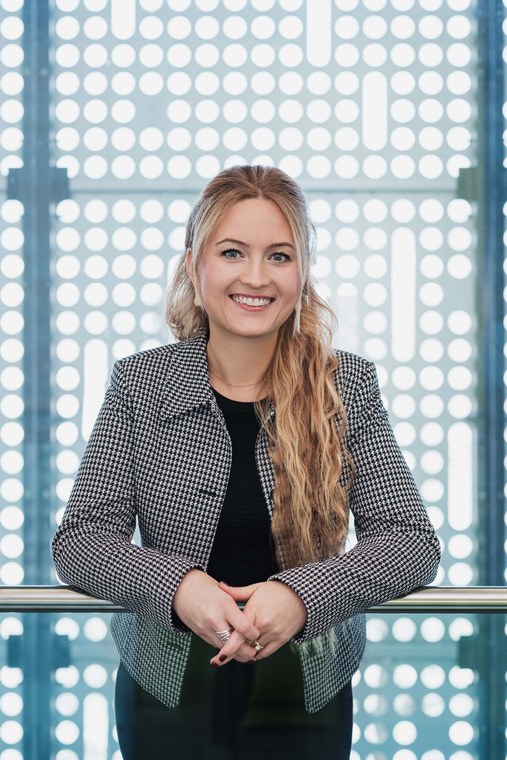
Dr. Anne Gärtner's interest in a career in science was awakened during her studies. Her enthusiasm for scientific work and her work as a Student Assistant quickly showed her that her career path would lead her into science.
In her research at the TUD Dresden University of Technology, she focuses on the processing and regulation of emotions. Dr. Gärtner is particularly interested in how emotions arise and how we can regulate them, but also why these processes can sometimes become unbalanced in people with mental illness.
"The aim is to better understand how emotions are related to health and well-being and, on this basis, to develop new approaches for clinical psychology and the treatment of affective and other mental disorders."
An important turning point in Gärtner's professional career was his involvement with the topic of open science. "It was then that I realized that problems with reproducibility and replicability were not due to me personally, but were often structurally anchored in science." Since then, one of her main concerns has been to promote quality and transparency in research. With projects such as RESQUE or the Open Science Initiative of the Faculty of Psychology at the TUD, she wants to contribute to making research more sustainable and fairer.
Dr. Gärtner has received the Karl and Charlotte Bühler Prize for Excellence in Teaching several times for her work. In 2023, she was also honored with the Einstein Foundation Early Career Award. This honor was another formative moment, as it made her work visible and at the same time gave her a personal boost.
It was not only situations like this that influenced Dr. Gärtner's career; role models also played an important role. "They make visible what is possible, for example, that career paths don't always have to be straightforward and that both family and science are possible." She was particularly influenced by her former supervisor and his wife, who showed her that it is possible to combine a family and a successful academic career. Women around her also gave her a more modern and diverse image of science through conversations and discussions.
"Role models who show that you can also be successful with warmth, caution and a cooperative, more 'feminine' management style are particularly inspiring. They make it clear that there are many ways to make an impact in science (and beyond)."
Dr. Gärtner advises young female scientists: "Consciously question whether an academic career is really what you want - and if so, stick with it and don't get discouraged." Building networks and sharing experiences play an important role in this. Dr. Gärtner was helped by networks of colleagues who support each other in dealing with the challenges of their field. She repeatedly encountered situations in which women were taken less seriously or did not dare to express their opinions.
"Personally, I think it would be great if women joined forces even more in teams, because I believe that we can often achieve more together than alone."
These experiences clearly showed her that "equality is making progress, but is not yet a matter of course." For the future, Dr. Gärtner therefore hopes that women in science will no longer be perceived as a minority, but will become a natural part of the scientific community. "Structurally, I would like to see transparent and reliable career paths, real compatibility of family and research, and a culture in which diversity is not seen as a challenge, but as a strength."