
International Weeks Against Racism
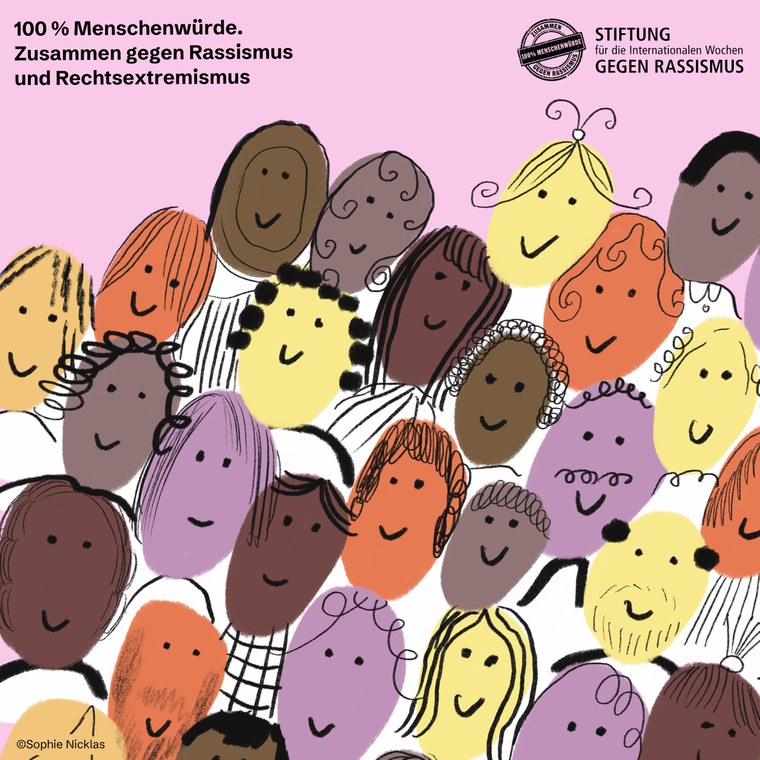
Table of contents
Introductory words

The "International Weeks against Racism" are nationwide weeks of action in solidarity with those affected by racism and opponents of racism. They take place every year around March 21, the "International Day to Overcome Racist Discrimination".
This year's motto of the Foundation against Racism is "100% human dignity. Together against racism and right-wing extremism". This year, the TUD's program will focus on various topics. On the occasion of "Tacheles - Year of Jewish Culture in Saxony", the focus is on anti-Semitism. On the occasion of "Roma Day" on 8 April, which directly follows the International Weeks against Racism, there will also be a diverse program on the topic of anti-Romaism and antiziganism.
The International Weeks against Racism start on March 16, 2026 and traditionally run in Dresden until April 6 - the anniversary of the death of Jorge Gomondai, who died on April 6, 1991 as a result of a racist attack in Dresden. Many other stakeholders are also offering a diverse supporting program within Dresden. The offers can be found on this website .
Program
People with different opinions have a strong tendency to avoid each other. This is understandable, as neither side expects a discussion with the other to be constructive in any way. However, those who avoid people with different opinions cannot influence their attitudes. The same applies to those who seek encounters but are only looking for confrontation. You cannot force others to change their attitudes, but you can “earn” their respect by making a sincere effort to engage in dialogue at a certain level. But be careful: this level is not achieved by people taking turns delivering monologues. Rather, it is determined primarily by the willingness and ability of at least one of those involved to fully understand the opinions of others.
A course offered by the Center for Continuing Education at TUD.
- Date: March 10, 2026, 9:00 a.m.–5:00 p.m. & March 11, 2026, 9:00 a.m.–4:00 p.m.
- Location: Fritz Foerster Building
- Target group: TUD employees
- Language: German
- Registration via OPAL
In a red Audi A6, the hero sets off from Austria to Germany to become Chancellor. He stops at motorway service stations and Penny car parks, gets caught up in left-wing and right-wing demonstrations, parks in front of the Bundestag, then on a circus ground, and ends up in a police interrogation room. Along the way, he meets bizarre characters who testify to an apocalyptic future, priests and rabbis, God and his angry Jewish counterpart G'tt, and political figures such as Gregor Gysi, Olaf Scholz, and Alice Weidel. In fast-paced scenes and dialogues, constantly driven by the red Audi waiting with its engine running, he explores his identity, his faith, and his sexuality, which he continually places in the context of current political circumstances.
Yevgeniy Breyger, born in Kharkiv in 1989, emigrated from Ukraine to Germany at the age of ten. He currently lives in Vienna and works as an author and lecturer in linguistic arts.
This event is organized by the Chair of German Medieval and Renaissance Literature and Culture at TU Dresden in coorporation with the Saxon State and University Library Dresden (SLUB). The event is funded by the Society of Friends and Sponsors of TU Dresden e. V. (GFF).
- Date: March 18, 2026, 6:30 pm
- Location: SLUB, Klemperer Hall (Zellescher Weg 18, 01069 Dresden)
- Moderation: Anastasia Averkova
- Free entry
It is not always easy to express yourself concisely, get to the heart of the matter, and find the right words under stress and time pressure. Yet this is something we are constantly required to do. What can be a stumbling block in speeches, presentations, or job interviews can be joyfully trained. And that is exactly what we will do in this workshop Numerous exercises, suggestions, feedback, and individual tips, as well as practicing in a safe space, will enhance your linguistic and communication skills.
A course offered by the Center for Continuing Education at TUD.
- Dates: March 19-20, 2026, 9:00 a.m.–4:30 p.m.
- Location: Fritz Foerster Building
- Target group: TUD employees, external guests
- Language: German
- Registration via OPAL
Using examples from your everyday life, you will learn how to listen to others without judgment and understand the meaning behind their words, regardless of sympathy, origin, gender, age, hierarchical level, etc. The aim is to find new ways of achieving mutual understanding through listening in order to create an appreciative working environment. The workshop is based on Dr. Marshall B. Rosenberg's model of nonviolent communication, which offers a practical tool for empathetic interaction between people.
A course offered by the Center for Continuing Education at TUD.
- Dates: March 24, 27, and 31, 2026, 9:00–11:30 a.m.
- Target group: TUD members, external guests
- Language: German
- Registration via OPAL
Over the course of three generations, EVOLUTION follows the fate of a Jewish family from 1945 to the present day. The film is divided into three parts and yet closely interwoven: A little girl is found in an abandoned gas chamber, having miraculously survived. Decades later in Budapest, Éva, already demented, is asked by her daughter Léna for birth certificates and identity papers – but all the official documents she possesses are forged to hide her Jewish origins. And then there is Éva’s grandson Jonás. He has just moved to Berlin with his mother and doesn’t even know who or what he is any more – only this he knows: that as a Jew he felt excluded at school.
An event in cooperation with SLUB.
- Date: March 30, 2026, 6:30 p.m.
- Location: SLUB, Klemperer Hall (Zellescher Weg 18, 01069 Dresden)
- Admission free.
I see something you don't see - Sinti:zze and Rom:nja in the view of the TUD
Roma Day (8 April) is an international day of action and remembrance that commemorates the self-organization of Sinti:zze und Rom:nja and draws attention to their historical and current discrimination.
As part of this day and beyond, the TUD Dresden University of Technology organizes a program of events dedicated to making Sinti:zze and Rom:nja visible and critically examining antiziganist racism.
The short film "I am what I am" traces the story of the Blum family, who lived on the Laubegaster Ufer in Dresden in the 1930s and were deported under National Socialism.
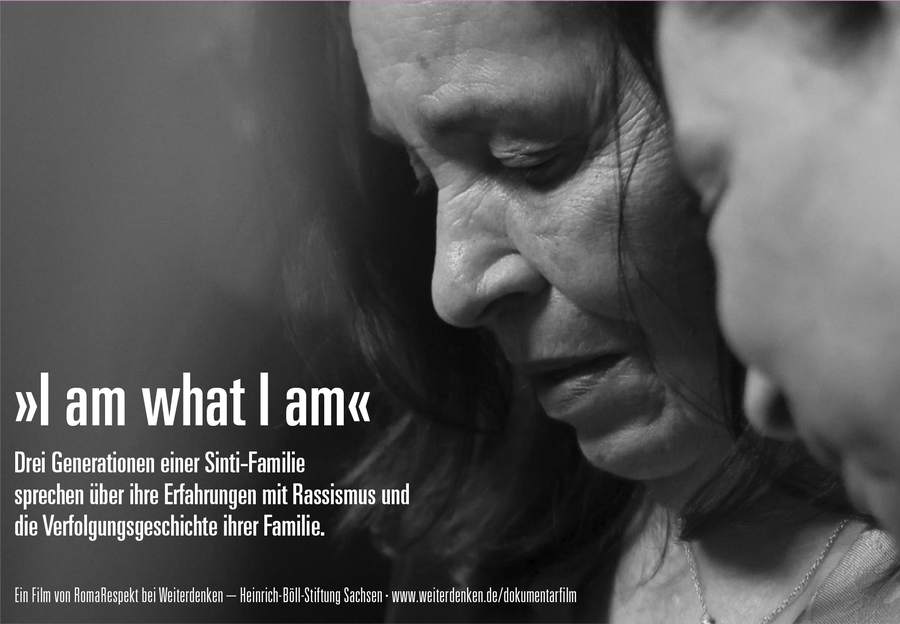
At the center of the film is Ella Braun, a contemporary witness and civil rights activist who has been fighting for the recognition and dignity of Sinti and Roma for decades. Together with her daughter and grandson, the film spans an arc from Nazi persecution through the post-war period to the present day and makes the continuities of antiziganism visible.
The film gains additional relevance for the university context in particular: Daniel also provides the perspective of a student who reflects on his identity as a Sinto in today's society. His experiences point to current challenges of diversity, belonging and discrimination in everyday student life and make it clear that antiziganism is not a closed historical phenomenon, but can also be effective in the university environment.
In the presence of the filmmaker, the production of the film as well as historical and current forms of antiziganism will be discussed afterwards.
Date: 24.04.2026 08.00 am to 09.00 am Online
The documentary Gelem Gelem - Wir gehen einen langen Weg by Monika Hielscher and Matthias Heeder follows Rrom_nja families fighting for their right to stay in Germany in the early 1990s. Made between fall 1989 and spring 1991, the film impressively shows the everyday lives, hopes and resistance of around 1,500 people who were threatened with deportation to south-eastern Europe.
The title "We are walking a long road" refers to a story that extends far beyond the documented period: to experiences of exclusion, but also to solidarity, cohesion and self-organization. With public actions, hunger strikes, a protest march through Germany and the occupation of Cologne Cathedral, the families made their situation visible, driven by the desire for security, recognition and a life in dignity.
Following the film, we invite you to a discussion with Isidora Randjelović from RomaniPhen e.V. and inirromnja. Together we will talk about the historical background of the film, about racism and political struggles, but above all about perspectives of self-empowerment, memory and today's follow-up questions.
15.04.2026 18.30 Klemperer Saal SLUB
Think far ahead, because the monument is already standing.
Gndin dur, kaj o monumento lace si kothe.
Workshop on the persecution and extermination of Roma* and Sinti* under National Socialism with artistic practices
with Stefanie Busch (artist), Renáta Horváthová and Kathrin Krahl from the Antiziganism/Antiromaism Network
The persecution and extermination of Roma* and Sinti* under National Socialism is almost invisible in this city, in Europe. Memorials and monuments had to be fought for, some are falling into disrepair. The Berlin memorial to the Sinti and Roma of Europe murdered under National Socialism is to make way for an infrastructure project. Dresden is home to one of the larger memorials in Germany commemorating the murder of Sinti* and Roma*: Boxing Ring 9841 - A Memorial to Johann Rukeli Trollmann on the grounds of the Festspielhaus Hellerau. Based on this monument, we will examine architectures and practices of remembrance - the associated struggles, forms and aesthetics. What ideas, thoughts, politics and resistance are needed to remember the persecution and murder of Roma* and Sinti* in the present? The workshop seeks answers.
April 21, 2026, 1-5 pm (location to be announced after registration )
with Renata Horváthová and Kathrin Krahl, Antiziganism/Antiromaism Network
An investigation of the TU Campus on traces of discrimination, persecution and invisibilization of Roma* and Sinti* in the past and present
The city game examines urbanity and anti-Romaism - racism against Roma* and Sinti* - "while walking" across the campus. It raises awareness of the immediate university environment and asks: By whom and for whom was this university designed and built? Where are the traces of past persecution of Sinti* and Roma* under National Socialism? What names do the buildings bear and whose names are not to be found? Who feels excluded or observed here? What could be changed to make the space more "accessible" or "just"?
We start the tour by presenting historical sources from the Münchner Platz memorial site. This learning in and with the urban space has close links to urban artistic practices. We cordially invite you!
May 19, 2026, 1 - 2:30 pm, Meeting point: Foyer of the Münchner Platz Dresden Memorial, Münchner Platz 3, 01187 Dresden, to the left of the Georg Schumann Building's outside staircase
With photographic works by Miklós Déri (photographer, photojournalist, editor)
In his 2015 series Roma Body, he photographed posed, composed portrait pairs of Roma personalities, contrasting the stereotypes about Roma with the real lives of the "models" and their actual position in the world. With these opinion photographs, he showed the absurdity of negative stereotypes. He has taken part in several international exhibitions with his pictures on the subject of Roma, including in Prague and Berlin.
The first date of the traveling exhibition is on 08.04.2026 from 11-13 o'clock in front of the old cafeteria (GeTugetherZone).
The Safer Space is designed as a confidential community space, a community of people with shared life realities. The focus is on experiences, voices and forms of self-care and mutual encouragement.
The space thus offers an opportunity for exchange about everyday student life, attributions and questions of belonging. It will be accompanied by a student representative of the Sinti:zze and Rom:nja community.
Date: June 10, 2-5 p.m.
Location: GLB- 7102
The program is continuously updated.
 © TUD
© TUD
Project and communication coordination university and society
NameElisabeth Krollpfeiffer
Send encrypted email via the SecureMail portal (for TUD external users only).
Directorate 9 – University Culture
Directorate 9 – University Culture
Visiting address:
Nöthnitzer Str. 43, room 211
01187 Dresden
Postal address:
TUD Dresden University of Technology Directorate 9
01062 Dresden