
Bridge building excursion 2025 – DACH region
Table of contents
The following text is an excerpt from the field trip report published in the proceedings of the 35th Dresden Bridge Engineering Symposium in 2026.
Overview of the 2025 field trip
Every summer, immediately after the end of the exam period, the Institute of Concrete Structures at TU Dresden organizes its traditional bridge engineering field trip with students in the Civil Engineering diploma program. The goal of the field trip is to link the theoretical knowledge gained in lectures with practical experiences and to see modern and historical bridge structures up close. The field trip is organized primarily by the students themselves, which strengthens group cohesion and encourages an in-depth engagement with the destinations.
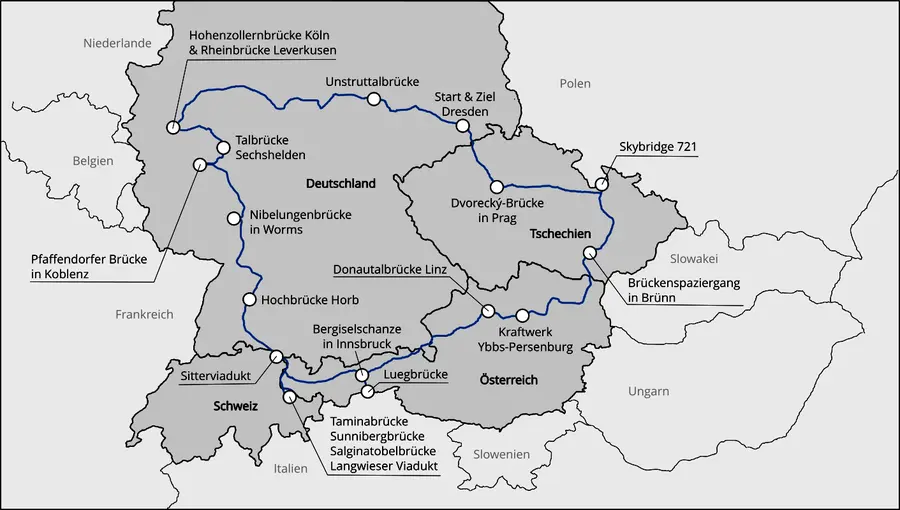
Route of Bridge Building Excursion 2025
In the summer of 2025, 18 students, accompanied by three Research Associates from the Institute, set out on an eleven-day trip to civil engineering structures in the DACH region—which includes the German-speaking countries of Germany, Switzerland, and Austria—and in the Czech Republic. The route, approximately 3,500 km long, led from Dresden via Cologne, Koblenz, St. Gallen, Innsbruck, Linz, and Brno to Prague, before the excursion group returned to Dresden. The itinerary included a total of 20 bridges, seven of which were under construction. On site, the students gained unique insights into the planning, construction, and maintenance of bridges through lectures and guided tours. The program was complemented by a visit to a hydroelectric power plant on the Danube and a tour of the Bergisel Ski Jump in Innsbruck.
The following article provides an overview of the field trip and the structures visited. Other bridges on our route that are not discussed in detail included, for example, the Unstruttal Bridge, the Horb High Bridge, the Pfaffendorf Bridge in Koblenz, the Sitter Viaduct near St. Gallen, and the Sky Bridge 721 in the Czech Republic.
Historical landmarks of bridge construction in Germany
Bridge construction is subject to constant change, driven primarily by the development of new materials, construction methods, structural designs, and calculation methods. As part of the field trip, we visited two structures that illustrate this change in different ways.
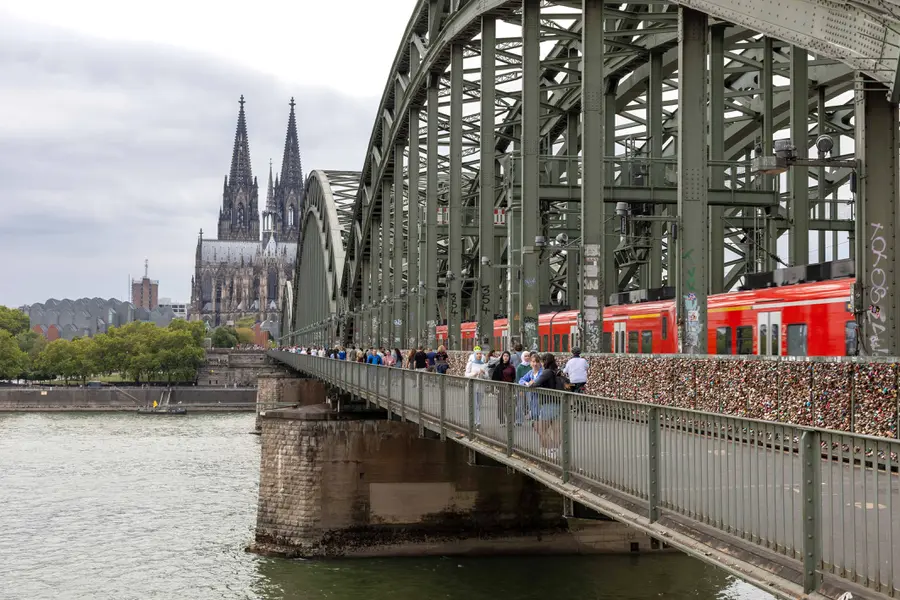
Cathedral and Hohenzollern Bridge in Cologne
The Hohenzollern Bridge is a landmark of the city of Cologne and a bottleneck in the European rail network. The bridge consists of three parallel sections, each built at different times during the past century; as pedestrians cross it, they are taken on a journey through the history of steel bridge construction. The original Hohenzollern Bridge was built between 1907 and 1911 to replace Cologne’s first Rhine bridge, the Dombridge [1]. In 1945, the bridge was partially destroyed during the retreat of the German Wehrmacht. In the years that followed, the two railway spans were rebuilt—first provisionally and later permanently—in their original form [2]. The Hohenzollern Bridge underwent its last structural modification in the 1980s, when a third span was built to accommodate the S-Bahn. The design of the new structure was visually adapted to the existing historic arches in order to preserve the bridge’s characteristic appearance. When walking across the bridge, the wide variety of different fasteners is particularly easy to spot, and the bridge’s eventful history becomes impressively clear. The superstructures from 1911 are riveted, those from the 1950s are bolted, and the 1988 section of the bridge is welded.
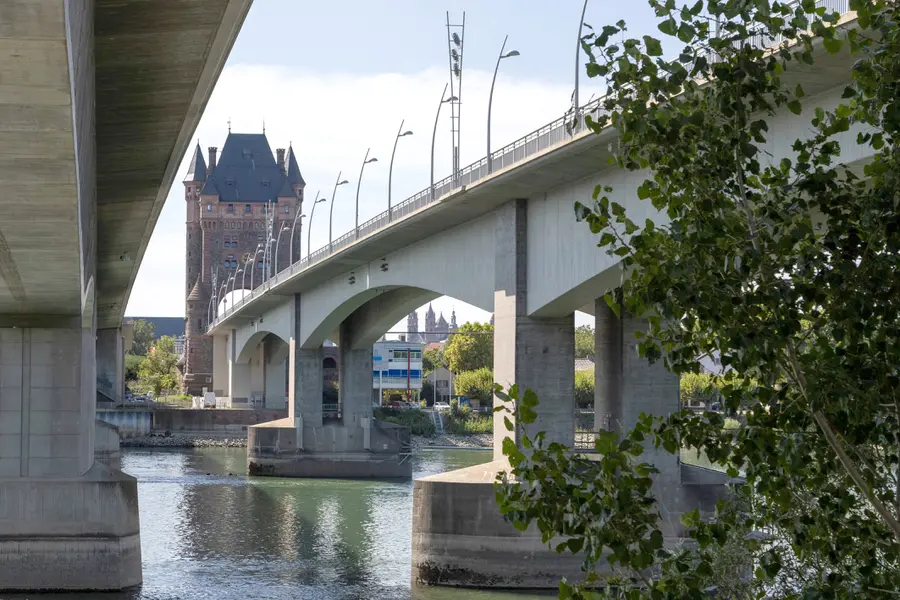
Ingineering art à la Ulrich Finsterwalder – Nibelungen Bridge Worms
The Nibelungen Bridge in Worms, built in 1953 and designed by Ulrich Finsterwalder, is a landmark of civil engineering [3]. It was the first prestressed concrete bridge across the Rhine and the first large bridge in the world to be constructed using the cantilever method. However, like many solid-section bridges from the early days of prestressed concrete construction, the 72-year-old Nibelungen Bridge has deficiencies that currently prevent its unrestricted continued use. These deficiencies relate to corrosion of the reinforcing steel and prestressing tendons, as well as the calculated shear strength of the superstructures, and led to the decision in 2010 to limit its service life to 15 years [4]. In 2022, however, this decision was revised at the initiative of the historic preservation authorities in Hesse and Rhineland-Palatinate. Currently, engineering firms and universities are collaborating with the Rhineland-Palatinate State Mobility Agency on methods to extend the bridge’s service life [5]. On site, the excursion group attended a presentation by MKP GmbH and the Rhineland-Palatinate State Mobility Agency inside the box girder of the new Nibelungen Bridge, which runs parallel to the existing one. The presentation focused on the preservation strategy for the Nibelungen Bridge [6]. This strategy includes structural diagnostic inspections, load tests, nonlinear finite element simulations, and the development of a digital twin, with the goal of preserving the bridge for at least another 30 years.
Other destinations in Germany were [7]–[14]:
- Leverkusen Rhine Bridge
- Sechshelden Viaduct
Icons of civil engineering—a journey through switzerland
Bridges and Switzerland—a perfect match. Virtually every bridge engineer is familiar with some of the many Swiss bridges; these often serve as teaching examples or are considered landmarks of civil engineering.
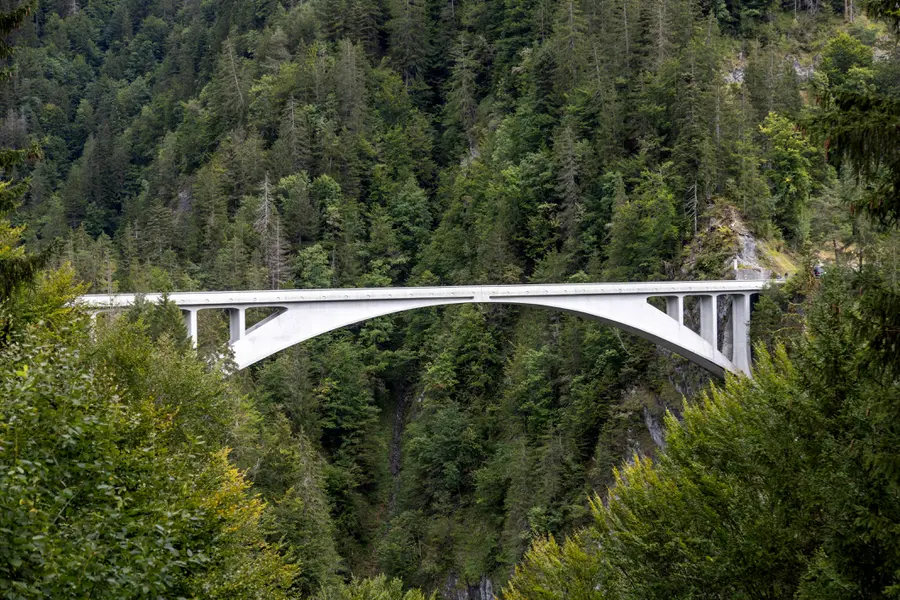
Iconic Salginatobel concrete bridge
The Salginatobel Bridge (1929–1933) is considered a milestone in engineering and concrete construction and was designed by engineer Robert Maillard. The bridge’s arch spans the 130-meter-wide, deeply incised valley with an almost effortless grace. The bridge’s structural system is a three-hinged arch, in which all joints were constructed as concrete joints [15]. The concrete arch is 40 cm thick at the abutment and 20 cm thick at the center of the bridge, curving in a crescent shape toward the apex. The side walls of the box girder run along the sides of the arch slab. To achieve a more delicate appearance, Maillard decided to open up the box girders starting at the quarter points and to elevate the roadway at regular intervals along the arch. The structural system impressively illustrates technical efficiency and a clearly discernible flow of forces [16]. The 1923 design is still regarded by architects and civil engineers today as a masterpiece. The bridge is also cited in courses offered by the Faculty of Civil Engineering at TU Dresden as an example of an innovative, economical, and architecturally first-rate design. The group wholeheartedly concurs with this assessment.
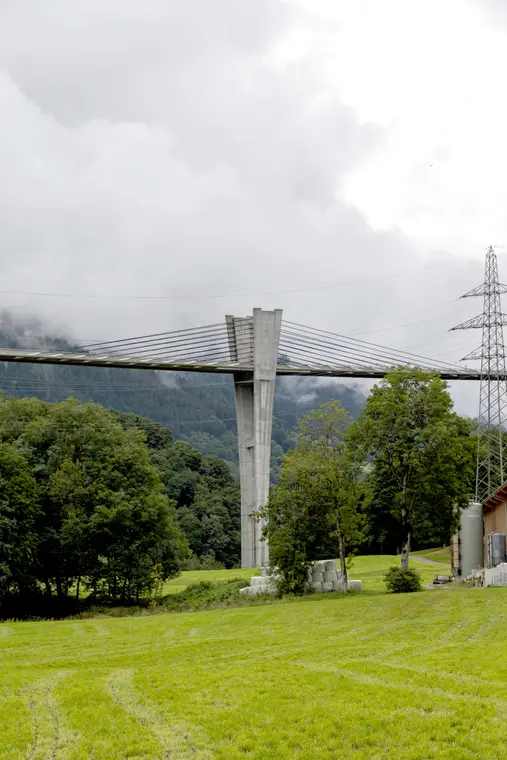
Pylon of Sunnibergbrücke
The Sunniberg Bridge is an extradosed bridge connecting Schiers and Davos. With a length of 525 m, it spans the valley near Klosters in an elegant arch. The bridge is divided into five spans. The three main spans are between 128 m and 140 m long, span the open valley, and rest on the four bridge pylons. The two outer spans bridge the sloping terrain, each with a span of approximately 60 m. The bridge was designed by Christian Menn, a professor of bridge engineering at ETH Zurich. His concept called for a slender and transparent cable-stayed system that blends harmoniously into the surrounding landscape [17]. The curved alignment of the superstructure, with a radius of 503 m, allows the bridge to shift laterally over the course of the year. As the height increases, the spacing between the tapered piers increases. The spacing between the tapered piers increases with their height. In the longitudinal direction of the bridge, the piers are designed as trumpet-shaped discs that gradually widen from the base to the top of the pylon. This not only corresponds to the flow of forces but also has the advantage that the stay cables run outside the clearance profile of the superstructure [17]. The principle of“form follows function”was wonderfully implemented in the Sunniberg Bridge.
Other projects in Switzerland were Tamina Bridge [18], and Langwieser Viaduct [19].
Civil engineering made in Austria
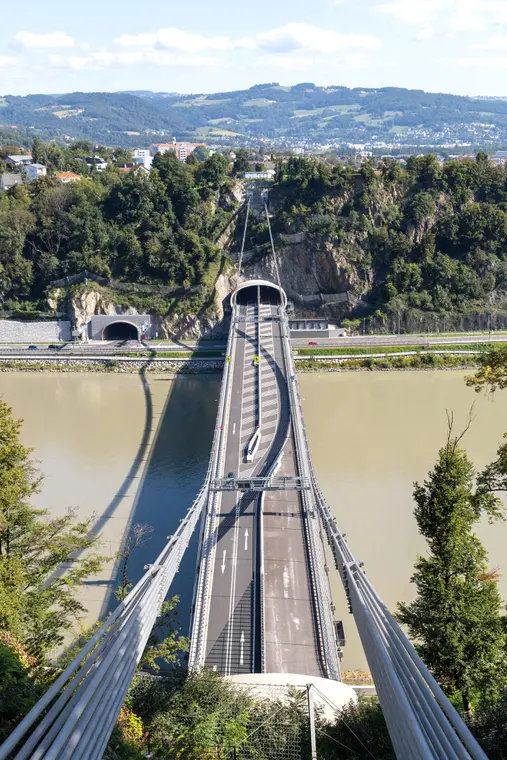
New Danube Valley Bridge in Linz
The Danube Valley Bridge in Linz, which opened in 2024, is a unique structure [23]. The 305-meter-long, back-anchored suspension bridge appears to float almost weightlessly over the Danube. The design omitted the use of pylons to support the suspension cables, resulting in this spectacular bridge. The bridge’s support system makes optimal use of the site’s unique topography. The bridge consists of only three components: the steel-composite bridge deck, the fully enclosed main supporting and suspension cables, and the two northern and southern anchorage structures. The bridge’s 500-meter-long main suspension cables are anchored on both sides using 100 permanent grouted anchors through massive anchor block structures into the gneiss bedrock. After the anchor blocks were constructed, the suspension cables were installed in stages. The composite superstructure was floated across the Danube on pontoons, lifted into position using strand hoists, and then welded in place. On site, the group of students gained an exciting insight into the construction project. Despite the high structural and functional demands placed on the supporting structure, the highway bridge blends seamlessly and delicately into the Danube Valley, which thoroughly impressed the group.
Other destinations in Austria included:
- Lueg Bridge at the Brenner Pass [21, 22]
- Bergisel Ski Jump in Innsbruck [24]
- Ybbs-Persenbeug Danube Power Plant [25]
A trip across the Czech Republic
Places visited included:
- Prague with its Vltava bridges, e.g., the Dvorecký Bridge [27] and the Charles Bridge
The field trip in numbers
- 18 students and three Research Associates from the Institute of Concrete Structures
- Approx. 3,500 km in a VW van, two Alpine passes, four border crossings
- Six nights in a tent
- 20 bridges (seven of which were under construction), a ski jump, and a hydroelectric power plant
… and unforgettable memories!
Acknowledgments
We’d like to thank all our supporters who made this trip possible and unforgettable. Many thanks to Adam Hörnig Baugesellschaft mbH & Co. KG (Aschaffenburg), BPM Ingenieurgesellschaft mbH (Freiberg), CARBOCON GmbH (Dresden), DYWIDAG-Systems International GmbH (Unterschleißheim), EIBS Entwurfs- und Ingenieurbüro Straßenwesen GmbH (Dresden), Eisermann Ingenieure (Leipzig), GMG Ingenieurgesellschaft mbH (Dresden), the Saxony Chamber of Engineers (Dresden), BUNG Ingenieure AG (Dresden), MKP GmbH (Weimar), PORR GmbH & Co. KGaA (Munich), Schöck Bauteile GmbH (Baden-Baden), WKP Planning Office for Civil Engineering GmbH (Dresden), Schulze & Rank Engineering Firm m.b.H. (Chemnitz), Schüßler-Plan GmbH (Dresden), and the Faculty of Civil Engineering at TU Dresden. We would like to express our sincere thanks to everyone who made the construction site tours possible and organized them. Many thanks to Die Autobahn GmbH des Bundes (Leverkusen Rhine Bridge), Implenia AG (Sechshelden Valley Bridge), Donges SteelTec GmbH (Pfaffendorf Bridge, Koblenz), the Rhineland-Palatinate State Mobility Agency, and MKP GmbH (Nibelungen Bridge, Worms), PORR GmbH & Co. KGaA (Horb Viaduct), ASFiNAG (Lueg Bridge at the Brenner Pass), the Operating Association—Danube Power Plant Tours Ybbs-Persenbeug, AFRY Austria GmbH (Danube Valley Bridge, Linz), Stráský, Hustý a partneři s.r.o. (bridges in Brno), and STRABAG a.s. (Dvorecký Bridge, Prague).
Special thanks also go to the Association of Friends of Civil Engineering at TU Dresden e. V., which provided essential support in the planning and follow-up of the field trip.
References
[1] Hohenzollern Bridge on Structurae: https://structurae.net/de/bauwerke/hohenzollernbruecke (accessed November 27, 2025).
[2] Website of the Rheinisches Industriekultur e.V.: https://www.rheinische-industriekultur.com/seiten/objekte/orte/koeln/objekte/bruecke_hohenzollern.html (accessed November 27, 2025).
[3] Dicleli, C.: The Nibelungen Bridge in Worms. In: Federal Chamber of Engineers (ed.): Historic Landmarks of Civil Engineering in Germany, Vol. 27, Berlin, 2021.
[4] Pelke, E.; Zichner, T.: Reinforcement of the Nibelungen Bridge in Worms. Concrete and Reinforced Concrete Construction 110 (2015) 2, pp. 113–130. https://doi.org/10.1002/best.201400082
[5] Kang, C.; Voigt, C.; Eisermann, C.; Kerkeni, N.; Hegger, J.; Hermann, W.; Jackmuth, A.; Marzahn, G.; Marx, S.: The Nibelungen Bridge as a Pilot Project for Digitally Supported Structural Maintenance. Bautechnik 101 (2024) 2, pp. 76–86. https://doi.org/10.1002/bate.202300089
[6] Voigt, C.; Barr, C.; Jackmuth, A.; Kerkeni, N.; Klein, F.; Klimt, A.; Marx, S.; Marzahn, G.; Naraniecki, H.; Waßmann, M.: Condition Assessment as a Basis for Extending the Remaining Service Life Using Digital Twins. Bautechnik 102 (2025) 3, pp. 177–185. https://doi.org/10.1002/bate.202500004
[7] Federal Highway Research Institute (BASt): Statistical Data on the Bridge Inventory. Download: https://www.bast.de/DE/Publikationen/Statistik/Bruecken/Brueckenstatistik.pdf?__blob=publicationFile&v=2 (accessed November 27, 2025).
[8] The Federal Government’s Autobahn GmbH: A-bei-LEV: Leverkusen Rhine Bridge. Online: https://www.autobahn.de/planen-bauen/projekt/a-bei-lev-rheinbruecke-leverkusen (accessed November 27, 2025).
[9] Paschen, M.; Hensen, W.; Hamme, M.: Repair and Safety Measures for the Leverkusen and Duisburg-Neuenkamp Rhine Bridges—An Interim Report (Part 1). Stahlbau 86 (2017) 7, pp. 603–618. https://doi.org/10.1002/stab.201710513
[10] Paschen, M.; Hensen, W.; Hamme, M.: Repair and Safety Measures for the Rhine Bridges in Leverkusen and Duisburg-Neuenkamp—An Interim Report (Part 2). Stahlbau 86 (2017) 12, pp. 1113–1119. https://doi.org/10.1002/stab.201710550
[11] Ritterbusch, N.; Grassl, H.; Reyer, D.: Replacement Construction of the Leverkusen Rhine Bridge. In: Curbach, M. (ed.): Proceedings of the 30th Dresden Bridge Construction Symposium · Design, Construction, Repair, and Upgrading of Bridges, March 9–10, 2020, in Dresden, Dresden: Institute of Concrete Structures at TU Dresden, 2020, pp. 123–136.
[12] Müller, T.; Hrassl, H.; Karpa, M.; Reyer, D.; Wrage, T.: Expansion of the A1 between the Köln-Niehl Interchange and the Leverkusen-West Junction. Stahlbau 92 (2023) 9, pp. 544–559. https://doi.org/10.1002/stab.202300035
[13] Autobahn GmbH des Bundes: Replacement construction of the Sechshelden viaduct. Online: https://www.autobahn.de/planen-bauen/projekt/ersatzneubau-talbruecke-sechshelden (accessed November 27, 2025).
[14] Website of the Giessen Regional Council: https://rp-giessen.hessen.de/sites/rp-giessen.hessen.de/files/2022-06/ul_01_erlaeuterungsbericht_0.pdf (accessed November 27, 2025).
[15] Schacht, G.; Hoffmann, N.; Marx, S.: Spring Hinge Joints. Stahlbau 82 (2013) 12, pp. 903–910. https://doi.org/10.1002/stab.201310115
[16] Billington, D. P.: Maillart and the Salginatobel Bridge, Switzerland. Structural Engineering International 1 (1991) 4, pp. 46–47. https://doi.org/10.2749/101686691780617355
[17] Menn, C.; Baumann, K.: Sunniberg Bridge – Concept and Design. Swiss Engineer and Architect 116 (1998) 19, pp. 337–342. https://doi.org/10.5169/seals-79498 + https://doi.org/10.5169/seals-79499
[18] Haug, H.; Striebel, F.: Tamina Bridge. Bautechnik 95 (2018) 2, pp. 157–166. https://doi.org/10.1002/bate.201700112
[19] Menn, C.: Experiences in Swiss Concrete Bridge Construction. ASTRA Research Project 2011/008_004, Federal Roads Office, Swiss Confederation (2012).
[20] Clopath, J.: A Scaffolder of International Renown: Richard Coray as a Pioneer of Construction Technology. Art+Architecture in Switzerland 73 (2022) 2, pp. 14–23. https://doi.org/10.5169/seals-984738
[21] Flatz, M.; Krichmair, M.; Michl, T.; Lechner, M.: Stabilization of the Lueg Bridge—Support Structure Under a Deteriorating Existing Bridge. Steel Construction 92 (2023) 5, pp. 280–286. https://doi.org/10.1002/stab.202300018
[22] ASFiNAG: A 13 Brenner Highway—New Construction of the Lueg Bridge. Online: https://www.asfinag.at/bauen-erhalten/bauprojekte/a-13-brenner-autobahn-luegbruecke/ (accessed November 27, 2025).
[23] Keil, A.; Widmayer, M.; Fackler, T.: Linz Danube Valley Bridge—A Special Bridge for a Special Place. In: Marx, S. (ed.): Proceedings of the 34th Dresden Bridge Construction Symposium · Design, Construction, Repair, and Reinforcement of Bridges, March 19–20, 2025, in Dresden, Dresden: Institute of Concrete Structures at TU Dresden, 2025, pp. 101–110. https://doi.org/10.25368/2025.060
[24] artmagazine: Zaha Hadid Receives the 2002 State Prize for Architecture. December 14, 2002, online: https://www.artmagazine.cc/content6811.html (accessed November 27, 2025).
[25] VERBUND AG: Ybbs-Persenbeug Run-of-River Power Plant. Online: https://power.verbund.com/de/Ybbs-Persenbeug (accessed November 27, 2025).
[26] Nováček, J.; Stráský, J.; Fixel, J.; Velesik, M.: Riviera Footbridge in Brno. In: Bronzini, G.; Conzett, J. (eds.): Proc. of the Footbridge Chur 2025: in situ, September 3–5, 2025, in Chur (Switzerland), 2025, 5 pp. https://doi.org/10.24904/footbridge2025.48
[27] Czech Republic News: Dvorecký Bridge Takes Final Shape: First Crossing Already Possible. September 11, 2025, online: https://www.tschechien.news/post/dvorecký-Brücke-nimmt-finale-gestalt-an-erste-Überquerung-bereits-möglich. (accessed February 2, 2026).
[28] Marx, S.; Scheerer, S.; Schacht, G.; Fiedler, M.; Ritter, R.; Clages, L.; Voigt, C., Czeschka, D.; Ebell, Marzahn, G.: Collapse of the Carolabrücke in Dresden, Part 1: From an Ambitious Design to a Tragic Partial Collapse. Concrete and Reinforced Concrete Construction 120 (2025) 7, pp. 526–536. https://doi.org/10.1002/best.202500029
[29] Schacht, G.; Marx, S.; Scherrer, S.; Fiedler, M.; Ritter, R.; Clages, L.; Voigt, C., Czeschka, D.; Ebell, Marzahn, G.: Collapse of the Carolabrücke in Dresden, Part 2: Investigations into the Causes of the Collapse and Its Consequences. Concrete and Reinforced Concrete Construction 120 (2025) 10, pp. 837–846. https://doi.org/10.1002/best.70008