
Master Programme Hydro Science & Engineering
Master Hydro Science and Engineering 🌊 | Studieren an der TU Dresden © TU Dresden
Inhaltsverzeichnis


Before you start: Is this Programme for you?
Why Choose This Programme?
The international Master’s in Hydro Science & Engineering (HSE) at TU Dresden prepares you to address the world’s most pressing water-related challenges, from climate-driven floods to sustainable water supply. As a full-time, English-taught programme, HSE brings together natural and engineering sciences in an interdisciplinary curriculum focused on integrated water resource management across climatic zones.
Professors Dr.-Ing. Bernhard Vowinckel and Dr. Andreas Hartmann jointly coordinate the international Master’s programme Hydro Science & Engineering at TU Dresden, alternating the roles of responsible and deputy coordinator over successive periods. Their complementary expertise bridges hydraulic and water resources engineering with hydro science and hydrological research, ensuring a balanced integration of scientific understanding and engineering application throughout the curriculum.
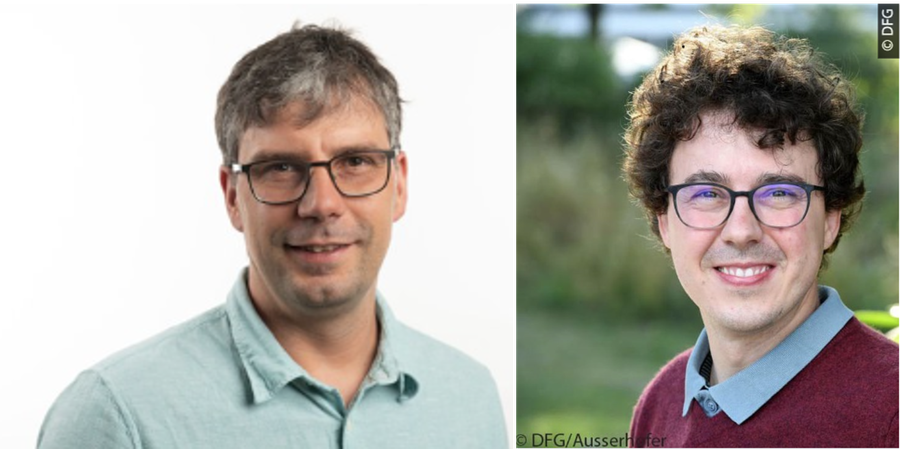
Professors Dr. Bernhard Vowinckel and Dr. Andreas Hartmann
“HSE educates civil engineers who can translate hydrological complexity into reliable, real-world water infrastructure and management solutions” (Professor Dr. -Ing. Bernhard Vowinckel)
“HSE trains water resources researchers to understand water systems in depth and to generate knowledge that supports sustainable decisions under uncertainty” (Professor Dr. rer. nat. Andreas Hartmann)
Who Should Apply? [More information]
You are a strong candidate if you:
-
Hold a degree in civil or environmental engineering, natural sciences, hydrology, geology, geography, or a related field.
-
Are passionate about sustainable water systems and eager to contribute to real-world water solutions.
-
Aim to work as an engineer, analyst or scientist in development, research, NGOs or infrastructure sectors.
-
Can prove English proficiency (C1 CEFR) and enjoy learning in a diverse, international and multicultural setting. Check accepted english test here.
Program Highlights
- International focus with students from 100+ countries
- Blend of natural science and engineering modules
- Flexible study profiles: Flood Risk, Urban Water, Groundwater, and more
- Internships, research projects, and optional Erasmus+ mobility
- Accredited. through 2027, DAAD EPOS partner since 2005
Your Journey During the Program
The Master in Hydro Science and Engineering at TU Dresden combines academic structure with exceptional flexibility. Beyond core training in water sciences and engineering, you can explore optional focus areas like Flood Risk Management, Urban Water Systems, Groundwater and Global Change, or Integrated Water Resources & Climate. These profiles help guide your choices, but they're not formal specializations. You will graduate receiving a Master of Science in Hydro Science and Engineering, tailored to your goals.
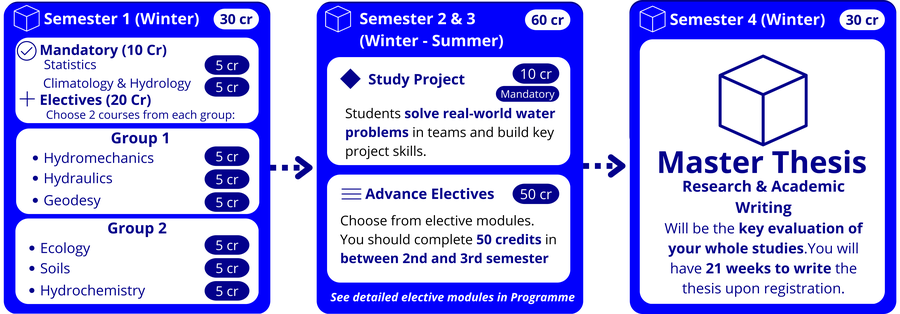
HSE - Programme Structure 2025
The HSE Master spans four semesters: the first provides a scientific and engineering foundation, the second and third include advanced electives and a mandatory research-based study project, and the fourth is dedicated to the Master’s thesis. Students shape their individual academic path by choosing from a wide, interdisciplinary module catalogue. Suggested profiles offer guidance for building thematic focus areas, though students are free to combine modules in ways that best match their background and goals.
The structure shown here is effective for intake 2020 or later!
You can find a detailed explanation of how the programme is structured here.
The structure effective for former intakes is shown here.

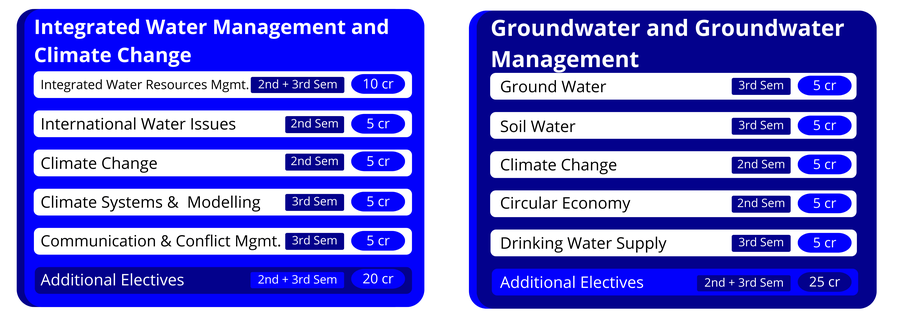
🔹Module Compendium : This document provides an overview of the module schedule. Detailed descriptions are available in the English Compendium and the German Modulhandbuch. Official documents are in German; English versions are for reference only.
🔹The Study Regulations (Studienordung) and the Examination Regulations (Prüfungsordnung) define the degree requirements.
🔹Here you find the schedules for the winter term and the summer term.
🔹It is possible to take a wide range of modules, not only from the below mentioned Module compendium, but also from courses within the Faculties of Environmental Sciences as well as Civil Engineering. Students with German proficiency can also take modules held in German.
Find a detailed overview here.
For your Master's Certificate you have to fill in an application form of the examination office. There you have to decide whether you want to have disclosed possible surplus modules in your certificate.
Facilities and Opportunities
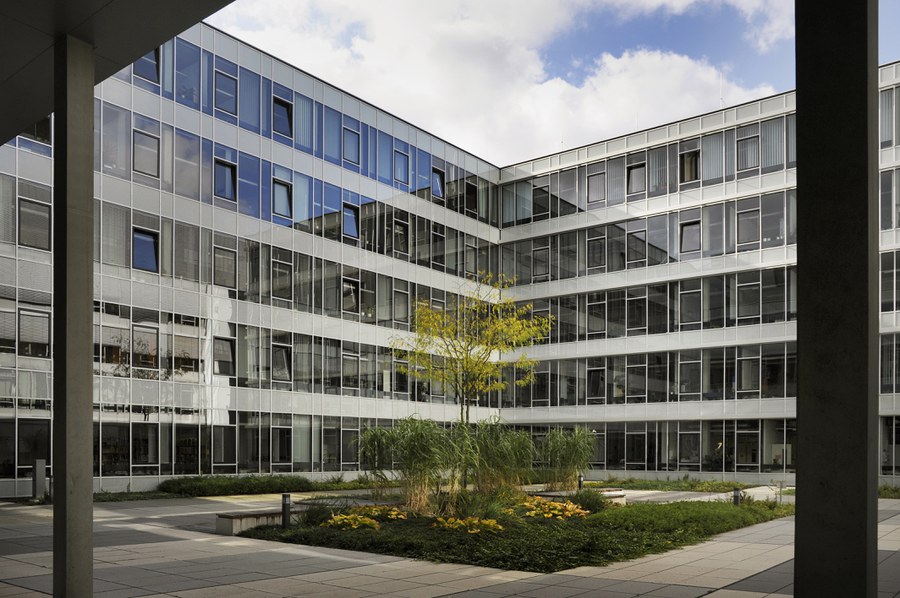
Modern research and teaching building at TU Dresden, home to labs and institutes focused on chemistry and water sciences. © FR Hydrowissenschaften
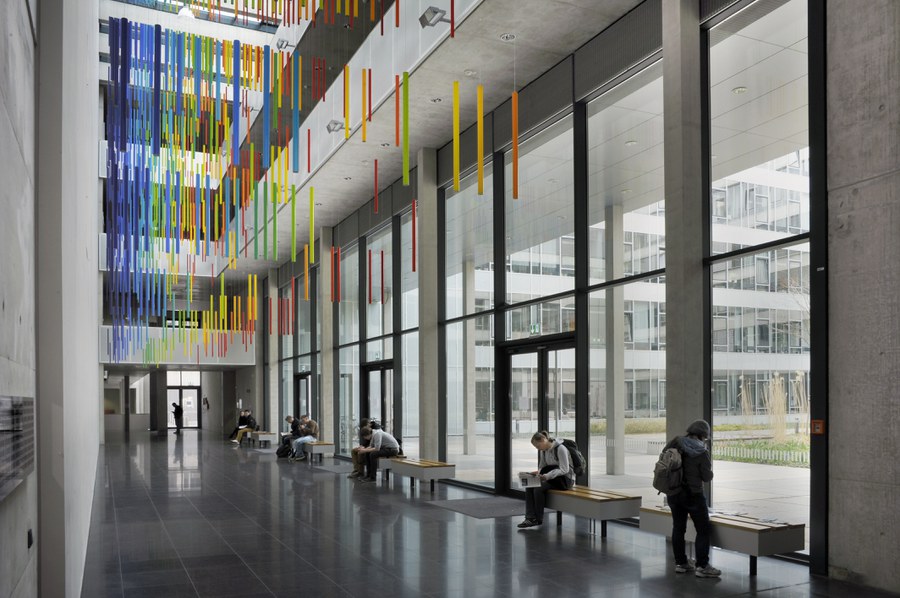
Modern research and teaching building at TU Dresden, home to labs and institutes focused on chemistry and water sciences. © FR Hydrowissenschaften
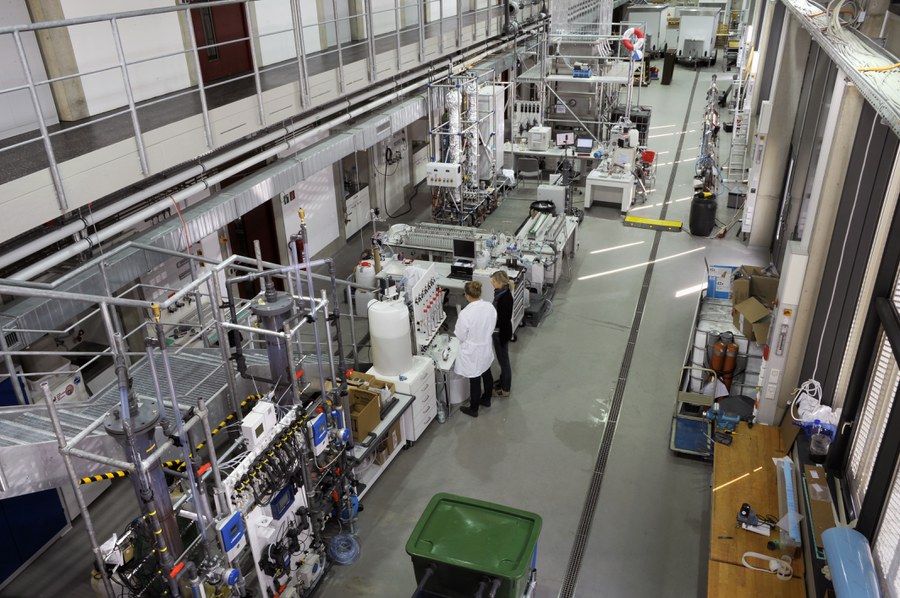
© FR Hydrowissenschaften
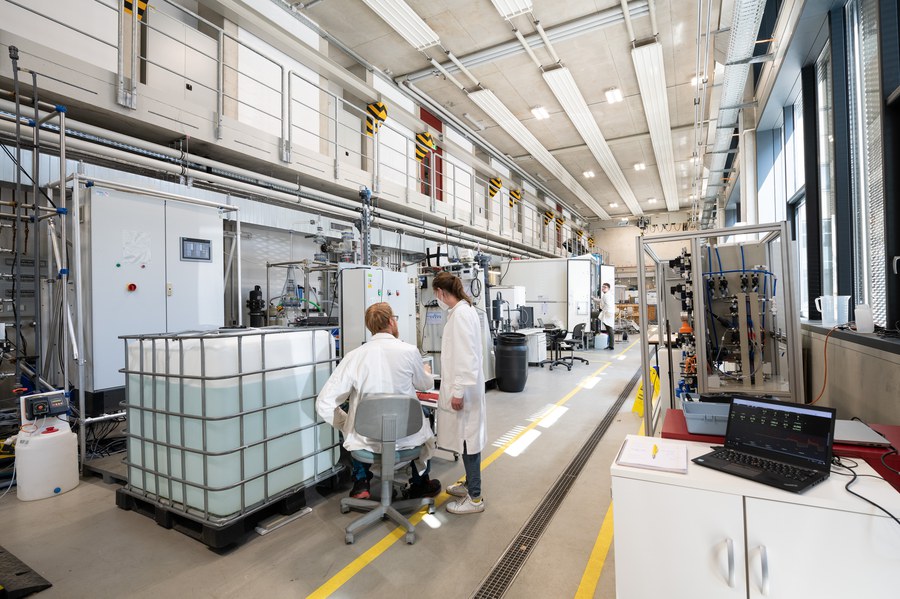
© TU Dresden, M. Kretzschmar
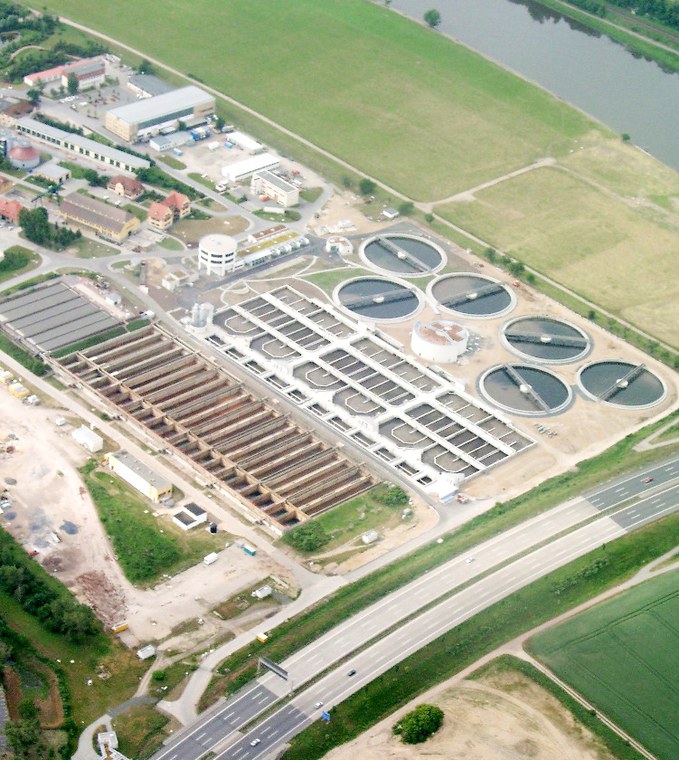
Aerial view of the Dresden-Kaditz sewage treatment plant on the A4 autobahn © Henry Mühlpfordt
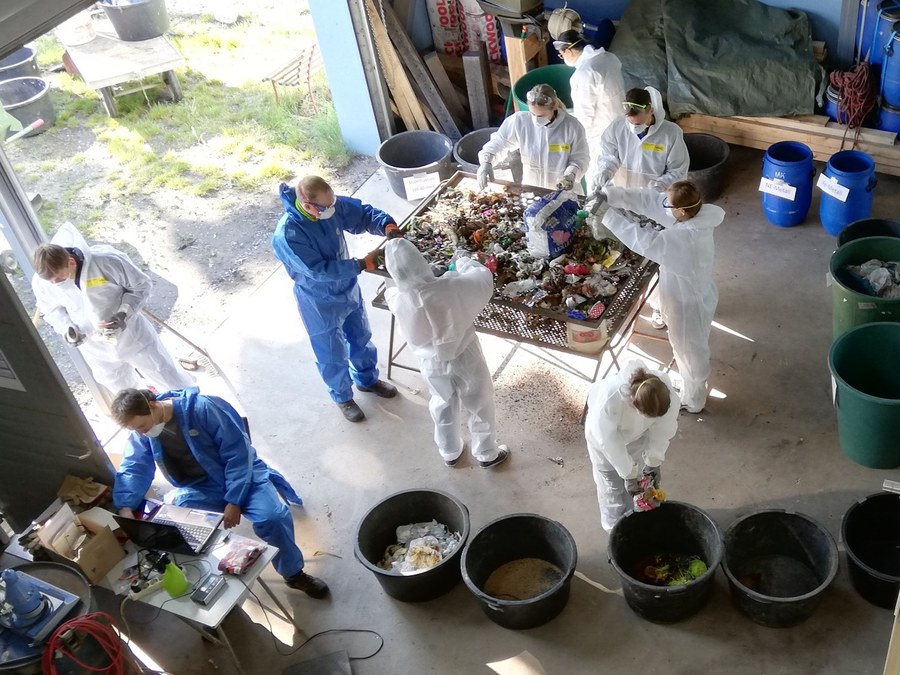
Environmental internship at the Institute for Waste Management and Circular Economy
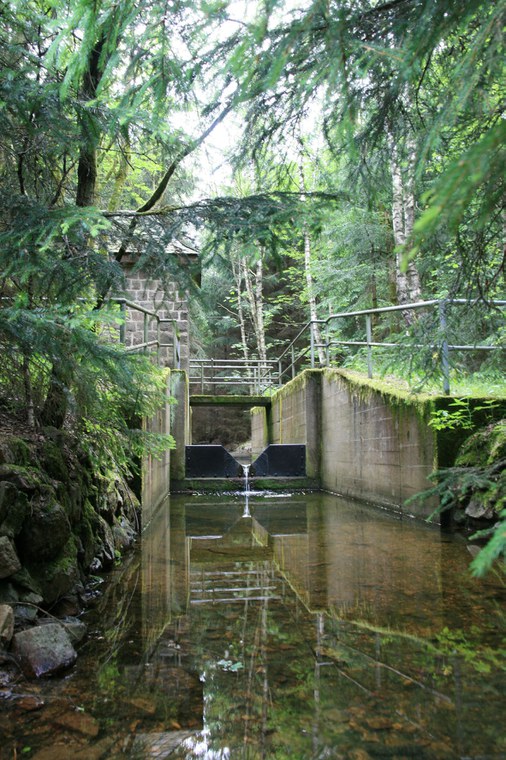
Wernersbach gauge in the Tharandt Forest © IHM
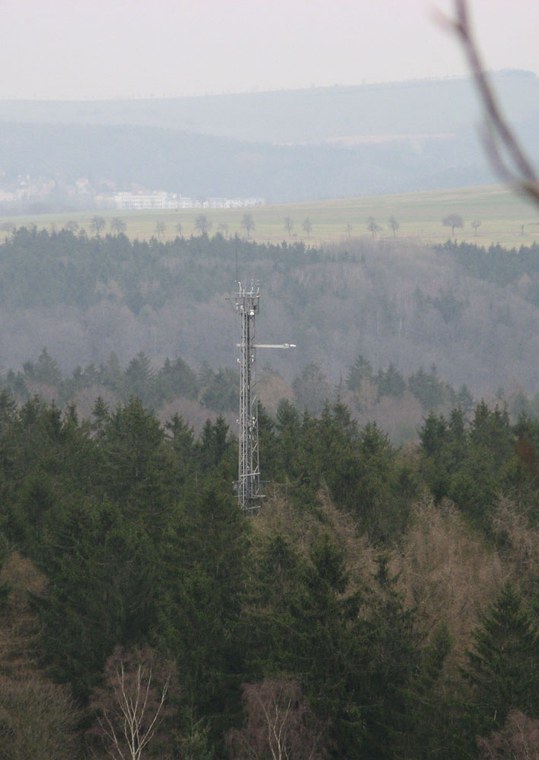
Anchor Station Tharandt © IHM
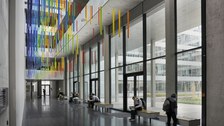
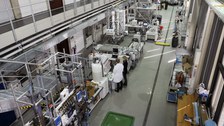
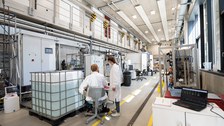
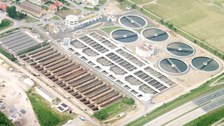
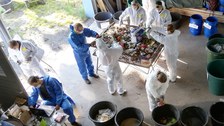
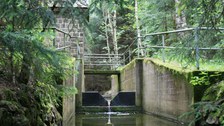
- Access to state-of-the-art labs and hydrology infrastructure
- Fieldwork across Saxony and beyond
- Potential thesis partnerships with research institutes (e.g. UFZ Leipzig)
Study Tour: Flood Risk Management in the Elbe Catchment
Flood risk management | Uni vlog: Hydro Science Engineering (MA) © fR Hydrowissenschaften
As part of the Flood Risk Management module, our students take part in an annual multi-day study tour across the Elbe catchment, with stops ranging from Magdeburg to Prague. The excursion offers a hands-on perspective on flood protection and river-basin management, complementing the theoretical knowledge gained during the programme. This video provides a short impression of the tour and the practical learning opportunities available in the HSE master’s programme.
After Graduation: What comes next?
Career Prospects
Graduates are well-prepared for roles such as:
| Water resource engineer or environmental consultant | HSE offers an interdisciplinary blend of science and engineering, with applied project work, real-world exposure, and professional flexibility. Ideal for technical roles in global water management. |
| Project leader in development cooperation | HSE prepares students to lead water-focused development projects across cultures, sectors, and institutional frameworks worldwide. |
| Analyst or scientist in hydrological research institutions | HSE emphasises scientific thinking, data analysis, and research practice. Students engage early in applied science, supported by academic networks and access to real research environments. |
| PhD candidate in hydro-related research | HSE’s research-centred structure, extended thesis phase, and exposure to interdisciplinary methods build a strong academic foundation for competitive PhD entry in water-related fields. |
Alumni Impact
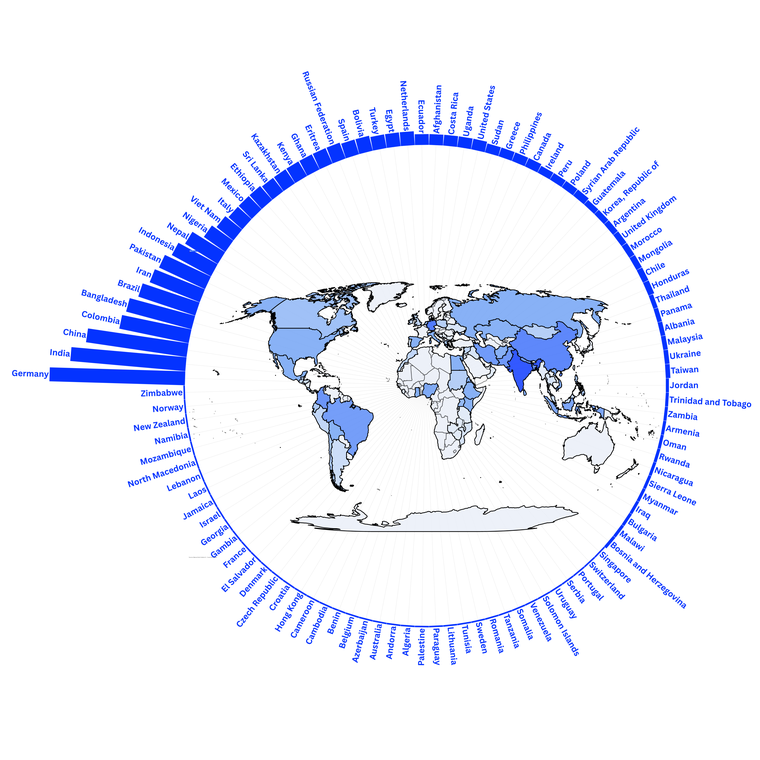
HSE Impact Map Alumni - Updated 2025
HSE Students and Alumni come from all around the world. Including students from the Erasmus Mundus programmes in Flood Risk Management and GroundwatCH, these international tracks bring students to Dresden for part of their studies, where they join the HSE academic community. All alumni share a strong foundation in interdisciplinary water science and continue to make an impact globally.
If you are an alumni of HSE and wish to be active in our community, please sign up to our Alumni database.
Quick Facts about the Alumni
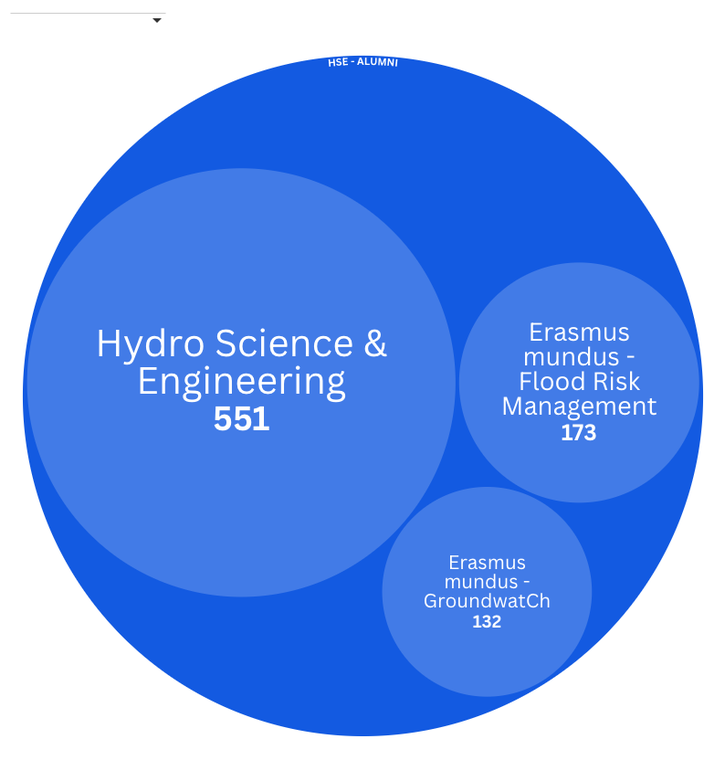
Statistics HSE Alumni - (2025 Updated)
-
893 total Alumni across all tracks
-
From 107 countries spanning 5 continents
-
168 DAAD-funded Alumni
-
561 Alumni exclusively enrolled in the Hydro Science & Engineering Master
-
192 Alumni in Erasmus Mundus Flood Risk Management
-
139 Alumni in Erasmus Mundus GroundwatCh
Get to know our alumni better, their journeys, impact, and global reach:


Application and Scholarships
Deadlines for application
- German and EU applicants and applicants with a German university degree:
1 April to 15 July each year - Non-EU applicants with a foreign university degree:
1 April to 31 May each year - Applying for DAAD scholarship to start studies the following year:
TU Dresden directly: 15 October each year
German Embassy or DAAD Regional Office: 31st July each year
More information in DAAD Official Webpage
The following webpages of TU Dresden International Office contain information relevant for applicants of master programs in English.
| Requirements | Applicants with German Degree | Applicants without German Degree | 🎓 DAAD Scholarship Applicants |
|---|---|---|---|
| Academic Requirements |
B.Sc. in relevant field (min. 6 semesters) + Vordiplom |
B.Sc. in Natural Sciences or Civil Engineering |
B.Sc. in Natural Sciences or Civil Engineering + ≥2 years of proven relevant professional experience |
| Who Applies Here? |
Applicants with a German degree (independent of nationality) |
Applicants with a foreign degree |
Highly qualified applicants from developing countries |
|
🗓 Application Deadline |
1 April – 15 July each year |
1 April – 31 May each year 1 April – 15 July each year (German/EU Applicants) |
To start studies the following year:
|
|
Where to apply? |
Find your application portal here |
||
| Aptitude Test |
All applicants have to fill: Application for Aptitude Assessment for the Master Programme Hydro Science and Engineering |
||
| Language |
The master course is held in English All applicants have to prove proficiency Level C1 (CEFR) in writing, reading, listening and speaking by an independent language test. A confirmation by a university that the language of instruction is English is NOT an independent language test. Check accepted english test here. |
||
| Special Notes | |||
| 1 | Formal Application for Aptitude Assessment for the Master Programme Hydro Science and Engineering |
|---|---|
| 2 | Officially authenticated photocopy of your higher education entrance qualification (Abitur, Baccalaureate, School-Leaving Certificate, O- and A-Levels etc.), including list of grades and a scale (minimum to pass, maximum achievable). Include translation.🔸 |
| 3 |
Officially authenticated photocopy of your university degree certificates. Include translation. 🔸 Please note: Applicants from China, Vietnam and India must apply for an APS certificate (should ideally be ready before applying for the programme) that proofs the authenticity of educational certificates of the applicant. More Information can be found on the corresponding APS webpages: |
| 4 |
Certificate demonstrating proficiency in English: English language certificates showing evidence of C1-level according to the European Reference Framework are considered. Check accepted english test here. |
| 5 |
Letter of Motivation to join HSE |
| 6 |
CV including educational background and professional career. |
Officially authenticated photocopy of the English translation of your degree certificate(s) (if the original was issued in a language other than German or English), completed with a list of grades and the corresponding scale (minimum to pass, maximum achievable).
🔹All applicants have to check several criteria, which are to find in detail in the Eignungsfeststellungsordnung and the Aptitude Test Regulations, respectively.
Having the eligibility regulations in mind the Admission Board will decide on candidate´s admission. In case of acceptance a letter of admission will be issued by TU Dresden International Office, called "Zulassungsbescheid". This letter can be used to apply for a student visa at the German Embassy of your home country. You are not allowed to start studies with a tourist visa. Accepted German citizens should report to the TU Dresden Immatrikulationsamt beginning of the semester.
Applicants must demonstrate English proficiency at the C1 level through recognized tests such as IELTS, TOEFL, Cambridge English qualifications, or equivalent certifications. Detailed information on accepted tests and minimum score requirements can be found in the attached document. Check accepted english test here.
A Medium of Instruction (MOI) certificate is generally not considered sufficient proof of English language proficiency for admission to the HSE program. Applicants are required to provide standardized English language test results that meet the C1 level requirement.
The Master Course Hydro Science and Engineering is supported by the German Academic Exchange Service DAAD. The German Academic Exchange Service (DAAD) offers a limited number of scholarships to highly qualified applicants. The current call for applications and necessary application documents for the scholarship for an EPOS study program can be found on the DAAD's website. The checklist you can find HERE.
Other scholarships: The International Office of TU Dresden provides information to interested applicants and students as well as information about scholarships in general and in particular:
- DAAD/STIBET scholarship
- National Scholarship Program (Deutschlandstipendium)
- Erasmus Mundus Master Programmes scholarship
External funding: Check out different funding opportunities in our list of funding bodies.
Part-time job: As an international student in Dresden, it is possible to get part-time jobs within and outside university, as long as it will not jeopardize your studies. You can find more information about working and studying such as allowed working hours, minimum wages and more in the Federal Employment Agency website.
The credit point system, which is to be used is the European Credit Transfer and Accumulation System (ECTS).
For example, if the module has 4 credit hours and the entire degree program comprises 133 credits, conversion factor from credit hours to ECTS:
U = 60 x D / CS
D is the number of years that the degree program comprises. CS is the number of credits that the entire degree program comprises, i.e. 133.
Assuming that the duration of study is D = 3, the conversion factor would be:
U = 60 x 3 / 133 = 1.35;
ECTS for the 4-credit-hour module would therefore correspond to 5.41 ECTS. (Make sure to include two decimal places!)
With D = 4:
U = 60 x 4 / 133 = 1.80 ;
ECTS for the module would then be 7.22 (Make sure to include two decimal places!)
Frequently Asked Questions
Find also a general FAQ about studying by the Department of Hydro Sciences.
There is a forum for interested applicants with answers to the most common questions. It is possible to also ask further questions.
Yes! Students come from diverse fields such as civil/environmental engineering, earth sciences, biology, or geography. The program is designed to integrate scientific and technical backgrounds, and the first semester offers core modules to bridge knowledge gaps.
HSE combines interdisciplinary water science with practical engineering tools, a strong link to research institutions, and global relevance through DAAD EPOS scholarships and Erasmus Mundus partnerships. The program is hosted in a university with a century-long tradition in water engineering and offers flexible study profiles to match your interests.
Yes. The HSE program has welcomed students from over 130 countries throughout its history. While the number varies by year, the community is consistently diverse and supportive. You’ll find assistance through welcome events, student tutors, the International Office, student councils, and cultural programs. Dresden is a student-friendly city where international students quickly feel at home.
Yes, even if most of you are already abroad, there are several options of further exploring the world, especially Europe.
One great opportunity in our Department is the ERASMUS+ network. In addition there are numerous project-related partnerships at different chairs.
Additionally, TU Dresden offers many other opportunities for a stay abroad with TUDweltweit.
Please also check the website of the International Office for further information.
Absolutely. TU Dresden offers free and low-cost courses in “German as a Foreign Language” and other languages. Each student receives a budget of 4 SWS (course hours per week) per semester for language learning (not counted toward the Master’s degree). You can also join the Buddy Program, language cafés, or local schools. Knowing some German improves daily life and job opportunities in Germany.
Compared to most European university cities, Dresden offers a high quality of life at a reasonable cost. Monthly living expenses usually range from €750–900, covering rent, food, health insurance, and public transport. Student dormitories typically cost €250–350 per month. The semester fee includes a public transport pass valid across Dresden and much of Germany.
Yes, within limits. International students can work up to 120 full or 240 half days per year. Many students take part-time jobs in research groups or the university. Knowing some German helps if you seek jobs outside academia.
There are many clubs and associations—sports, music, international groups, sustainability, culture, and more. The Studentenwerk, ESN (Erasmus Student Network), and TU Dresden offer a wide variety of cultural programs, hiking trips, game nights, and events to meet both German and international students.
| Main contact persons | Veronika Saiz, M.Sc. and Nane Weber, M.Sc. |
|
Scientific Coordinators |
|
|
Examination Board |
Head: Prof. Dr. Andreas Hartmann, see internet for all members |
|
Eligibility Commission |
Prof. Dr. Andreas Hartmann and Prof. Dr. Bernhard Vowinckel (Part of the Commission) |
|
Erasmus Mundus FRM and GroundwatCh |
|
|
Coordination of Scholarships (DAAD): |
|
|
HSE Tutors |