
Master of Hydrology
Table of contents
The master's program in Hydrology is accredited.
Important note: The Master of Hydrobiology is a german-language study program.
Educational goals and career perspective
Water is the basis for life on earth. Consequently, since 2010 water is part of the UNO Charter of Human Rights. The global population development, the escalating destruction of the environment, climate change, weather extremes and pollution are a global threat to water resources availability and quality. To counteract these adverse effects the master program in hydrology aims to build skills and competences to develop and implement innovative strategies for a sustainable management of water resources and the management of extreme events like floods and droughts. Within the courses the students use the latest lab and field equipment as well as modern computer systems with a large range of software.
The study program enables the students to solve and manage complex hydrological and meteorological problems in a national and/or international work environment. The possible work fields cover the sectors of agro-, forest-, urban- and mountain hydrology as well as hydrometeorology, the management of extreme events, watershed management and eco-simulation. Possible career paths lead to:
- international organizations like e.g. EU-administration, WMO, FAO
- national water-, climate- and environmental entities on state and federal level
- consultancies, associations and institutes
- insurance companies
The qualification for a scientific career at national and international universities or other research entities is particularly supported.
Study contents and modules
Our courses build on one another and offer the professional skills and competences, which are required to treat complex problems as e.g. the sustainable management of surface and groundwater resources following the EU water framework directive, or the evaluation and design of flood protection measures. Also, the quantification of climate change impacts on the water budget and aquatic ecosystems are part of the program. To successfully deal with such complex problems the students need a deep understanding of the water and energy cycle on different scales and special skills to quantify and simulate hydrological processes. We designed specific modules, field exercises and excursions to build these abilities putting special emphasis on the fields:
- of planning, implementation and operation of measurement networks and measurement campaigns
- of data processing, analysis and storage in data bases and GIS systems
- of comprehensive skills in hydrologic modelling and simulation
- of numerical tools for the planning and operation of hydrologic and water development schemes as well as for eco-simulation
The master program in hydrology takes four semesters and is of a modular design. The program combines engineering solutions, which make up for 50 % of its contents with the necessary background in natural science, which make up for the other 50 % of the program. This combination is unique for Germany. Besides the mandatory courses there is a broad range of elective courses, which, depending on the field of interest, offer the opportunity to specialize. The program concludes with the master thesis and a colloquium. A vocational university degree in Hydrology or other Hydro- and engineering Science, which is recognized in Germany is the necessary precondition to register in the program. Another precondition is English proficiency equal to the B2 level of the Common European Framework of Reference for Languages. Please see the directive of suitability from the master program in Hydrology for more information.
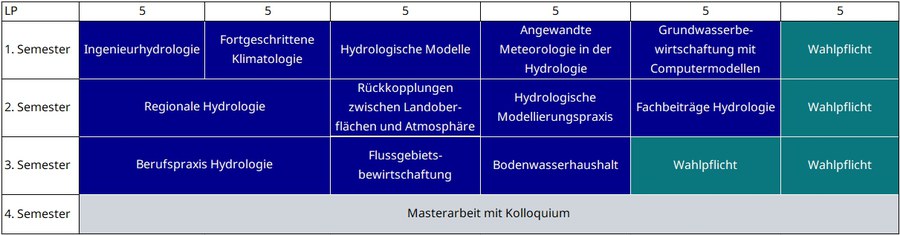
Studienablauf Master Hydrologie
You can find the program documents for our degree programs on the website of the Office of Academic Affairs for Civil Engineering and Environmental Studies.
Here you will find the following for the master’s program in Hydrobiology:
- the examination regulations
- the study regulations, including module descriptions and the program schedule
The required curriculum includes the following modules:
| Modulname | LP | Winter | Summer |
|---|---|---|---|
| Ingenieurhydrologie | 5 | X | |
| Fortgeschrittene Klimatologie | 5 | X | |
| Hydrologische Modelle | 5 | X | |
| Angewandte Meteorologie in der Hydrologie | 5 | X | |
| Grundwasserbewirtschaftung mit Computermodellen | 5 | X | |
| Regionale Hydrologie | 10 | X | |
| Rückkopplungen zwischen Landoberflächen und Atmosphäre | 5 | X | |
| Hydrologische Modellierungspraxis | 5 | X | |
| Fachbeiträge Hydrologie | 5 | X | |
| Flussgebietsbewirtschaftung | 5 | X | |
| Bodenwasserhaushalt | 5 | X | |
| Berufspraxis Hydrologie | 10 | X |
For more detailed information, please refer to the module descriptions ( Appendix 1 of the Study Regulations).
The elective-required track includes the following modules:
| Modulname | LP | Winter | Summer |
|---|---|---|---|
| Vertiefungspraxis Meteorologie | 5 | X | |
| Spezielle Aspekte der Hydrologie | 5 | X | |
| Vertiefungspraxis Hydrologie | 5 | X | |
| Water Extremes - Hazard and Risk Assessment | 5 | X | |
|
Water Extremes – Risk Assessment and Management |
10 | X | |
| Bewässerung | 5 | X | |
| Wasserqualität | 5 | X | |
| Numerical Methods for Hydrosciences | 5 | X | |
|
Statistical Learning for Earth System Sciences |
5 |
X |
|
| Hydrowissenschaftliche Studienfahrt | 5 | X | |
| Große hydrowissenschaftliche Studienfahrt | 10 | X | |
| Genehmigungs- und Planungsrecht für Umweltingenieurinnen und Umweltingenieure | 5 | X | |
| Hydrogeologische und hydrogeochemische Methoden | 5 | X | |
| Modellierung von Abwassersystemen | 5 | X | |
| Bewirtschaftung und Optimierung von Abwassersystemen | 5 | X | |
| Isotopenanalytik in aquatischen Systemen | 5 | X | |
| Fallstudien der Grundwasserbewirtschaftung | 5 | X | |
| Wassertransport und -verteilung | 5 | X | |
| Grundwasserbewirtschaftung in bergbaulich beeinflussten Gebieten | 5 | X | |
| Fundamentals of Integrated Water Resources Management | 5 | X | |
| Integrated Water Resources Management case studies | 5 | X | |
| Hydrobiologie und Gewässergüte | 5 | X | |
| Statistische Methoden in der Ökologie | 5 | X | |
| Analyse und Simulation aquatischer Ökosysteme | 5 | X | |
| Ökotoxikologie | 5 | X | |
| Freilandkurs Gewässerökologie | 10 | X | |
| Ökologie und Wasserqualitätsmanagement | 10 | X | |
| Landschaftswasserhaushalt | 5 | X | |
| Geodateninfrastrukturen | 5 | X | |
| Stauanlagen | 5 | X | |
| Wasserkraftanlagen | 5 | X | |
| Nichtstationäre Wasserbewegung | 5 | X | |
| Weiterführende Hydromechanik | 5 | X | |
| Küsteningenieurwesen | 5 | X | |
| Verkehrswasserbau | 5 | X | |
| Numerische Strömungsmodellierung | 5 | X | |
| Softwareanwendungen im Wasserbau | 5 | X | |
| Gewässerentwicklung | 10 | X | X |
For more detailed information, please refer to the module descriptions ( Appendix 1 of the Study Regulations).
Affiliated Institutes
Institute of Hydrology and Meteorology
Contact
If you have any questions about the program, please contact the academic advising office of the Department of Hydro Sciences, the Faculty Student Council, or the program coordinators.
Informationon the previous course structure for the 2018 Study Plan ( and earlier) can be found here.
Study requirements
This Master programme is a German-language study programme. More detailed information can therefore be found on the German web page.
Here you find further information about the study possibilities at the TU Dresden, application, necessary language skills and students' life in Dresden.