
Informationen für potenzielle Auftraggeber
Inhaltsverzeichnis
Herausforderung
Die Auseinandersetzung um langfristig wirksame, kostenintensive Konzepte und Projekte gehört in der kommunalen Verkehrsplanung zur Tagesordnung. Hierbei gilt es, knapper werdende Ressourcen so effektiv wie möglich einzusetzen und kontroverse Debatten durch wissenschaftlich gesicherte Erkenntnisse zu versachlichen. Die sach- und abwägungsgerechte Einschätzung der Risiken und Potenziale planerischer Maßnahmen hängt wesentlich von der Qualität der genutzten Informationen und Daten ab. Im kritischen Fall kann der Rückgriff auf veraltete Datengrundlagen zu Fehleinschätzungen und teuren Fehlinvestitionen führen sowie die Gerichtsbeständigkeit von Beschlüssen gefährden.
Das Projekt "Mobilität in Städten – SrV" bietet interessierten Städten und Gemeinden, Aufgabenträgern, Verkehrsunternehmen und -verbünden an, einen Teil der bestehenden Datenlücken zu schließen. Dazu trägt auf lokaler Ebene einerseits das nach wissenschaftlichen Standards entwickelte und an den Erkenntnissen der Mobilitätsforschung orientierte Erhebungskonzept herausragend bei. Andererseits gewährleistet die jahrzehntelange Erfahrung in der standardisierten Aufbereitung und Auswertung komplexer Datensätze qualitativ hochwertige Daten und Erkenntnisse zum Status quo der Alltagsmobilität auch auf stadtübergreifender Ebene.
Vorteile
Je mehr Städte sich an einer SrV-Erhebung beteiligen, umso geringer werden die Kosten pro Stadt. Gleichzeitig vergrößert sich die Datenbasis für stadtübergreifende und vergleichende wissenschaftliche Untersuchungen. Deren Ergebnisse kommen in Form von Fachartikeln und Forschungsberichten den SrV-Partnern wiederum zugute.
Die Kostenvorteile, der Zuschnitt auf die Anforderungen der Verkehrsplanung sowie das wissenschaftlich fundierte Erhebungskonzept veranlassen immer mehr Städte dazu, Partner in diesem Gemeinschaftsprojekt zu werden. Sie nutzen damit die Möglichkeit, ihre verkehrliche Entwicklung sowohl in Bezug auf eigene Zielsetzungen als auch im Städtevergleich einzuschätzen.
Darüber hinaus bietet die Beteiligung an einer SrV-Erhebung weitere Vorteile:
- Das einheitliche Erhebungsdesign garantiert eine aussagekräftige Standortbestimmung im Vergleich zu ähnlichen Städten (Benchmark).
- Die Erhebung wird alle fünf Jahre wiederholt. Bestehende Zeitreihen werden damit verlässlich fortgeschrieben.
- Der inhaltliche und methodische SrV-Standard sichert die Vergleichbarkeit der Ergebnisse innerhalb der SrV-Zeitreihe.
- Auch teilräumlich differenzierte Analysen innerhalb des Stadtgebietes sind mit einer Stichprobenaufstockung möglich.
- Die Standardauswertung umfasst eine breite Palette planungsrelevanter Kennziffern. Sie lässt sich durch stadtspezifische Zusatzauswertungen erweitern.
- SrV-Daten sind auf Anforderungen üblicher Verkehrsmodelle zugeschnitten.
- Die Zusammenfassung von Einzelstädten zu Stadtgruppen ermöglicht die Auswertung modellierungsrelevanter Kennziffern, für die städtische Stichproben im Regelfall zu klein sind.
- Örtliche Kooperationen (z. B. zwischen Stadt und Verkehrsunternehmen) bei der Beauftragung der SrV-Erhebungen führen zu Synergieeffekten. Die Aufteilung der Kosten auf mehrere Partner erlaubt größere oder zusätzliche Stichproben, die wiederum räumlich differenzierte Analysen für die Stadt selbst oder für das Umland von Kernstädten ermöglichen. Gleichzeitig verbessert sich die Vergleichbarkeit und Widerspruchsfreiheit der Datengrundlagen im Planungsraum.
- Die Abstimmung wichtiger inhaltlicher und methodischer Erhebungsmerkmale mit der Bundeserhebung Mobilität in Deutschland (MiD) eröffnet weitere Auswertungsspielräume und Vergleichsmöglichkeiten.
- Es besteht ggf. die Möglichkeit, dass die Erhebung durch Bundesländer gefördert wird.
Organisation
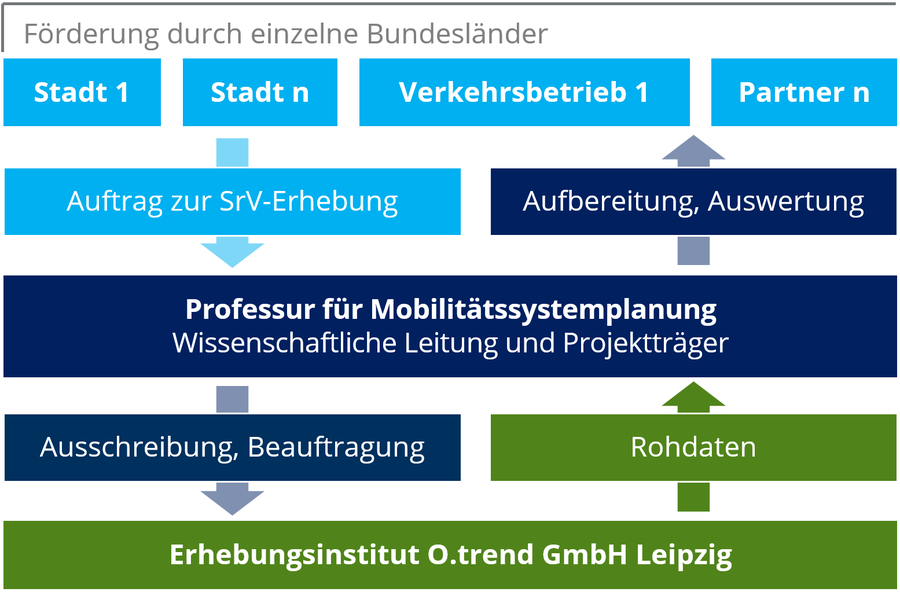
Bei den SrV-Erhebungen arbeiten Städte, Aufgabenträger, Verkehrsunternehmen und -verbünde sowie die Technische Universität Dresden und das jeweils für die Feldarbeit verantwortliche Erhebungsinstitut zusammen.
Die Professur für Mobilitätssystemplanung übernimmt als Treuhänderin der Auftraggeber die wissenschaftliche Leitung und Koordinierung der Erhebung im Auftrag und in enger Abstimmung mit den SrV-Partnern. Sie ist verantwortlich für folgende Aufgaben:
- Erarbeitung des Erhebungskonzeptes
- Entwicklung der Erhebungsunterlagen
- Ausschreibung und Vergabe der Leistungen für die Feldarbeit
- Überwachung des Feldverlaufs
- Datenaufbereitung und -auswertung
- Ergebnisdokumentation
Teilnahme
 © IVST
Wissenschaftlicher Mitarbeiter
NameDr.-Ing. Frank Ließke
Auftraggeberkoordination SrV
Eine verschlüsselte E-Mail über das SecureMail-Portal versenden (nur für TUD-externe Personen).
Besuchsadresse:
Gerhart-Potthoff-Bau, POT 216 Hettnerstraße 1
01069 Dresden
Sprechzeiten:
Mo–Do n. V.
Der nächste SrV-Durchgang wird 2028 stattfinden. Die TU Dresden hat Anfang des Jahres 2026 mit den Vorbereitungen für den SrV-Durchgang 2028 begonnen.
Am 4. Mai 2026 fand eine digitale Informationsveranstaltung für alle interessierten Kommunen und Institutionen statt. Die während der Veranstaltung gezeigten Präsentationsfolien stehen zum Download bereit.