
Research areas
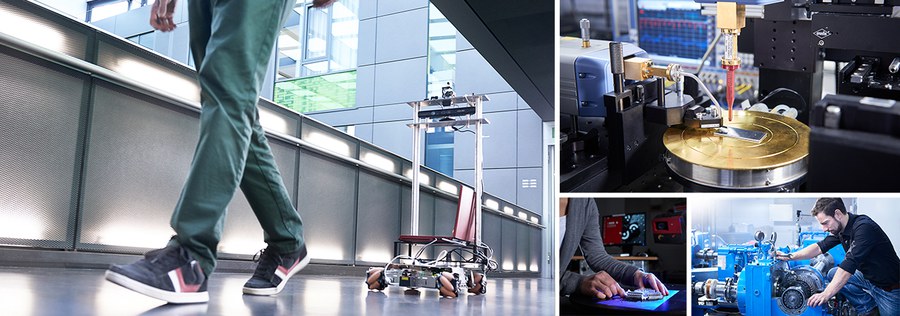
The scientific, interdisciplinary research fields of the School of Engineering Sciences cover a wide range of topics. The focus is on people and their needs with the aim of making our lives easier and better for tomorrow. To find innovative solutions, the researchers build networks with each other and work together in interdisciplinary research fields.
Digital health
New technologies and findings in medicine enable an unprecedented quality of life. In order to make knowledge and technology available in the right place at the right time, we need a new digital infrastructure, sustainable processes and interdisciplinary cooperation to reflect the progress made in all areas of life. With research projects focusing on digital health, we are making an important contribution to reliably improving the efficiency, quality and safety of healthcare.
Industry 4.0
The fourth industrial revolution is in full swing. Digitalization and technological development are changing the manufacturing processes of our goods and will change the way we work in the future. The real and virtual worlds are merging in the "Internet of Things". Thanks to modern information and communication technology, machines and processes in industry are being intelligently networked. People, machines, systems and products will communicate and cooperate with each other in the future.
Circular economy
The circular economy aims to consistently avoid waste and emissions(zero waste, zero emissions). With this in mind, processes for processing and recovery must be developed for each individual substance/material from a recycling and utilization cycle. In this context, the networking of material and energy flows at different levels at a site is important. Sites that are currently characterized by the provision of energy from fossil sources must be transformed into climate-neutral, sustainable industrial sites. Starting with today's recycling approaches, the path to a sustainable economy can only be achieved through a functioning circular economy with networked production processes. The general goal, as set out in the European Green Deal, is to reduce the absolute consumption of resources as well as dependence on rare earths or other raw materials that are difficult for Germany to access.
Materials 4.0
Digitalization, mobility, new energy systems - the world is changing. Innovative materials are one of the key technologies for keeping products and industrial processes economically competitive and ecologically sustainable. Digitalization is not only affecting the materials used in products, but is also revolutionizing the development of new materials. The "digital laboratory in the computer" is becoming increasingly important here as a "third pillar" alongside experimentation and model-based theory. This is made possible by enormous scientific progress in simulation methods and the constant expansion of available high-performance computers. Without simulations, it is no longer possible to imagine new materials.
Smart Human
Our lives are changing, everything is networked. To enable people to cope with this change, we are researching technologies to expand our reality (virtual/augmented reality) and to support our senses. So that everyone in society can participate and have a say.
Future energy systems
To master the energy transition, we need new technologies based on renewable energy sources. To ensure that this transition is safe and effective, research is being carried out in the engineering sciences on various topics.