
Molecular Mechanisms of Collagen Cross-Linking and Tissue Calcification
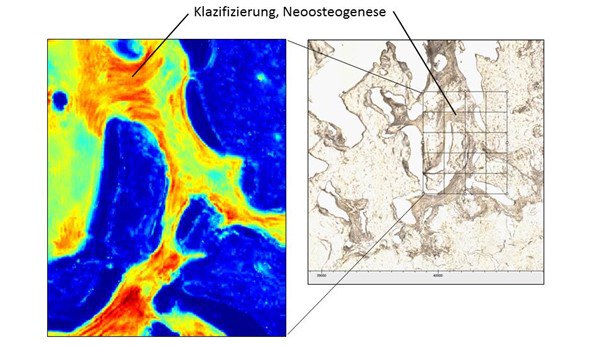
IR-spektroskopisches Image (links) einer partiell kalzifizierten Gewebeprobe einer Aortenklappe. Der Ausschnitt rechts zeigt das Rasterfeld der spektroskopischen Messung.
In collaboration with the Dresden Heart Center, research is being conducted to determine which
mechanisms lead to the light-induced cross-linking of heart valve prostheses made from bovine pericardium. The investigations include the analysis of collagen structures and the formation of interactions or bonds between the collagen strands. The results showed that the desired stiffening of the tissue is primarily due to polar interactions between the collagen fibers. These interactions link the collagen fibers preferentially at the domains, thereby resulting in a higher modulus of elasticity in the treated pericardium.
The calcification and subsequent neoosteogenesis of both natural and prosthetic heart valves are only partially understood. Molecular spectroscopy is being used to investigate which processes promote or even trigger this undesirable calcification. The research focuses on changes in the secondary structure of collagen and elastin. The IR spectroscopic images reveal a connection between these mechanisms, although the exact causal relationships are still the subject of ongoing research.
Collaboration: PD Dr. C. Dittfeld, Department of Cardiac Surgery at the Dresden Heart Center
Contact
 © Jonas Golde, KSM
Mr apl. Prof. Dr. rer. nat. habil. Gerald Steiner
Send encrypted email via the SecureMail portal (for TUD external users only).
Clinical Sensoring and Monitoring
Clinical Sensoring and Monitoring
Visiting address:
Medizinisch-Theoretisches Zentrum (MTZ - Haus 91) Fiedlerstraße 42
01307 Dresden