
Coupled impact events (fuell tank impact phase 2)
Table of contents
Project data
| Titel | Title TP Phase 2: Betrachtung eines gekoppelten Impaktereignisses auf Stahlbetonstrukturen durch klein- und großmaßstäbliche Experimente im Verbundvorhaben Bauteilverhalten unter stoßartiger Beanspruchung durch aufprallende Behälter (Flugzeugtanks) | SP Phase 2: Coupled impact analysis on RC structures carried out in small and large experiments by applying impact load conditions caused of tank collisions (aircraft fuel tanks) Förderer | Funding Bundesministerium für Umwelt, Naturschutz, nukleare Sicherheit und Verbraucherschutz (BMUV) Zeitraum | Period 09/2022 – 12/2025 (Phase | phase 2) Teilprojektleitung | Subproject managers Prof. Dr.-Ing. Dr.-Ing. E.h. Manfred Curbach apl. Prof. Dr.-Ing. Birgit Beckmann Bearbeiter | Contributors Thomas Schubert, Petr Máca (bis | until 2025) Projektpartner | Project partner Bundesanstalt für Materialforschung und -prüfung (BAM), Berlin Link zum Projekt Phase 1 | Link to the project phase 1 |
Supported by: Federal Ministry for the Environment, Nature Conservation, Nuclear Safety and Consumer Protection based on a decision by the German Bundestag under project No. 1501647.
Report in the year book 2024/25
Hard impacts, smart solutions
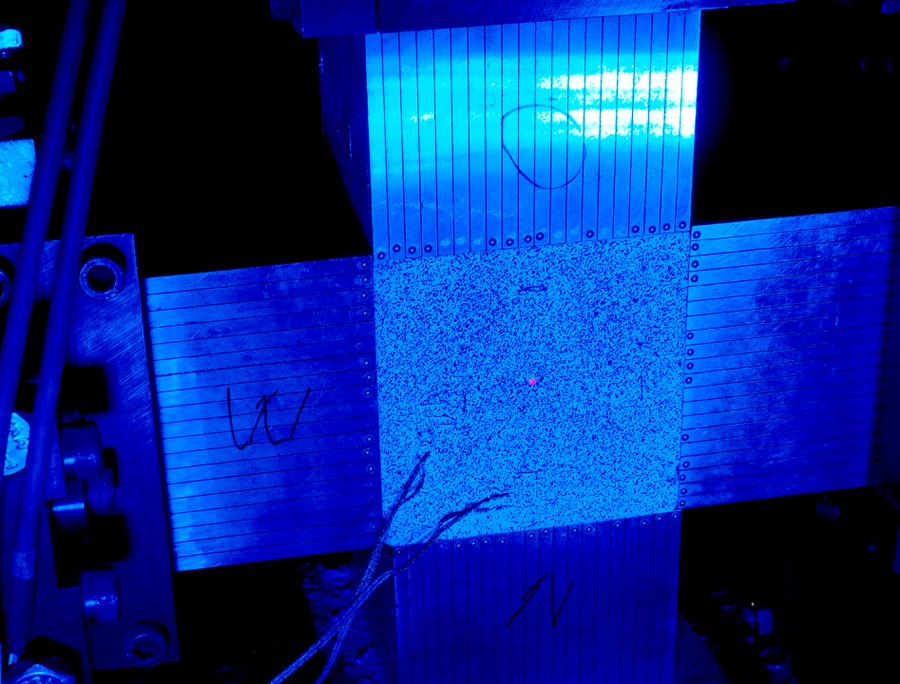
Concrete specimen with speckle pattern for DIC prepared for biaxial compressive testing
The Tank Impact 2 project continues its mission to enhance the safety of critical infrastructure by investigating the behavior of reinforced concrete under extreme loading conditions. In its second and third year, significant milestones in both experimental testing and numerical simulation were achieved.
Building on previous work, slab tests were conducted using soft impactors to better understand how deformable materials, such as fuel tanks, interact with concrete upon impact. These tests offered valuable insights into damage patterns, including cracking extent and crater formation. In addition, scaled impact tests on concrete slabs were performed to investigate important scaling questions. The slabs were scaled by a factor of two and the experiments were conducted in collaboration with our project partner BAM in Berlin. These large-scale experiments helped to narrow the gap between laboratory tests and possible real-world scenarios.
In the numerical part of the project, an innovative machine learning optimization tool was developed. Using Bayesian operators, we calibrated nonphysical material parameters for concrete models based on biaxial compressive test data. This advancement enables more exact predictions in numerical simulations, improving how we model concrete behavior under complex loading scenarios. Additionally, beam specimens without shear reinforcement (representing slab strips), that were previously tested experimentally, were successfully simulated. Both deformable and non-deformable projectile impacts were simulated, with results closely matching experimental data.
The combined progress in experimental testing, collaboration with BAM, and advancements in numerical modeling positions the Tank Impact 2 project as a key contributor to understanding and improving the resilience of concrete structures against extreme events such as impacts. The project results and the extensive experimental database bring us closer to designing safer, more impact resistant infrastructure for the future.
Report in the year book 2023
Impact on concrete structures
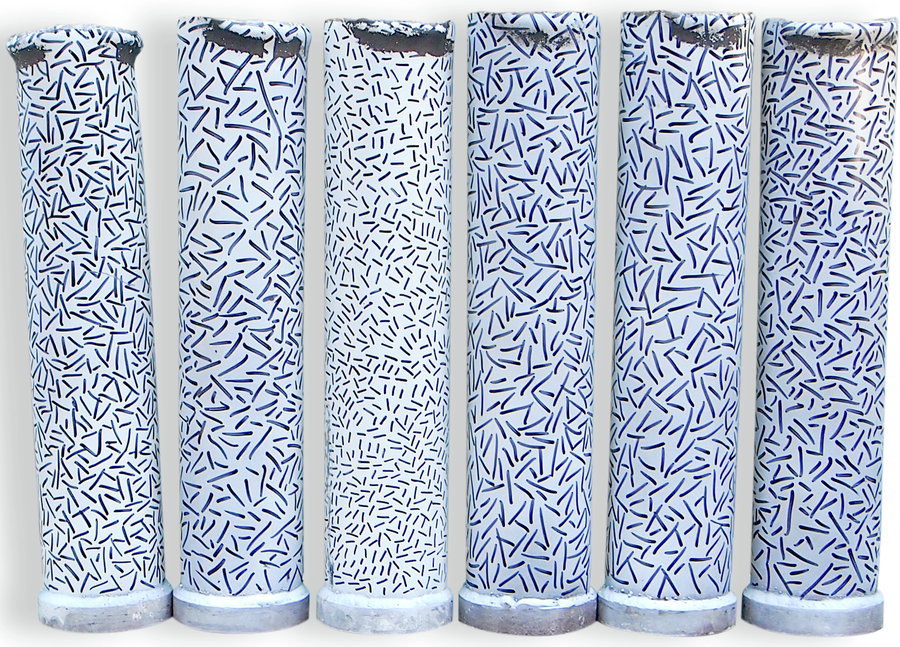
Deformable impactors after impact test
According to current standards, concrete structures of critical infrastructure require stability verification for the exceptional load case of impact. The verification for the component facing the impact must determine its protective effect by absorbing the impact energy and, if necessary, the residual load-bearing capacity. This serves to ensure the protection of those secondarily affected, for example, people. Greater absorption of impact energy is often achieved through non-linear material and structural behaviour. Currently much improved technologies and materials therefore require detailed research into the resistance of concrete structures.
The project “Tankaufprall“ (aircraft fuel tanks), phase 2, builds upon prior research at our institute on the component behavior of reinforced concrete slabs under impact-like loading from colliding tanks. A coupled impact event is analyzed in detail, in which a hard object first hits the concrete surface during the impact process, and then a soft, deformable object follows. Following these impact processes, the possible penetration of liquids into the resulting crack structures will also be investigated experimentally.
We use a large drop tower facility developed at our institute to conduct the experiments. In this tower, cylindrical impactors with a diameter of 10 cm and a mass of up to 100 kg are being accelerated with pressured air and shot onto concrete bodies. The impact process and the structural behavior are documented using numerous sensors, accompanied by high-speed cameras for digital image correlation.
The aim is to use test results to determine the relationships between impact energy, damage state, and crack sizes. Initial investigations have shown that a soft impact with the same energy input following a hard impact widens the visible crack structures and produces an enlarged punching cone on the concrete surface. Another main objective is to improve the possibilities of numerical modeling and analysis of impact-stressed components. A detailed investigation aims to calibrate a suitable material model, facilitating the design of robust protective structural components.
Report in the year book 2022
Collision with a deformable object
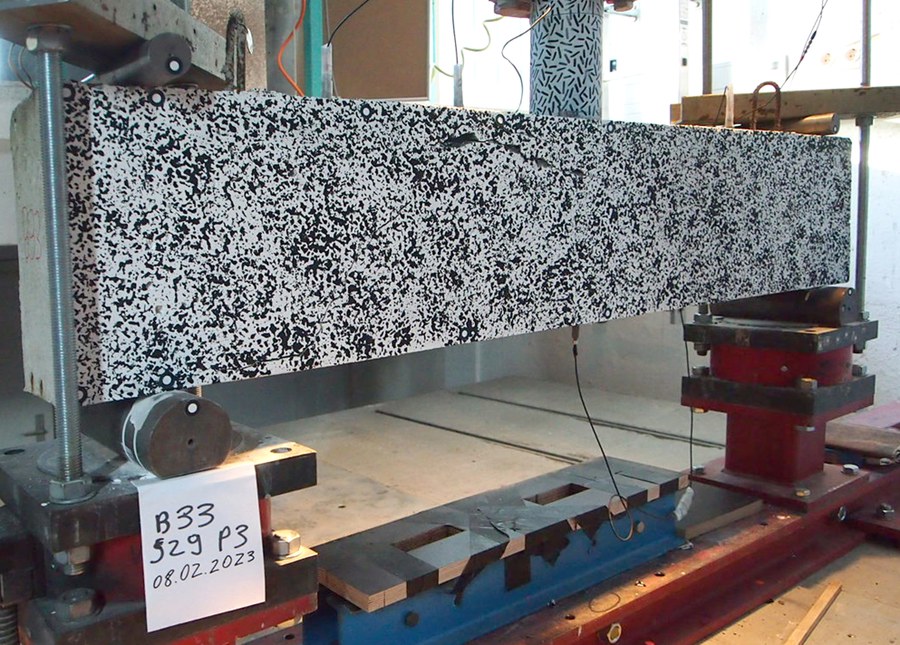
Beam specimens and digital image correlation are used to validate the numerical model
The structural safety of critical infrastructure against natural or artificial risks has always been discussed among experts. Since the latest global developments, the safety of nuclear power plants has increasingly become the focus of public attention. Reinforced concrete is the preferred material for constructing power plants, both for new construction and for any planned retrofits. Despite many decades of intensive worldwide research, there are still unanswered questions about reinforced concrete’s complex structural and material behavior in case of impact of deformable or rigid objects. The goal of the 2nd phase of the tank impact project is to fundamentally investigate concrete structures on a large scale to be in a position to assess the damage that occurs as a result of an impact event.
The project builds on extensive previous work performed in Phase 1 of the project, and the results made it possible to estimate correlations between impact energy, damage pattern, and crack volume. In project Phase 2, we will investigate concrete structures under combined load effects of hard and subsequent soft impact, including possible penetration of flammable liquids. The experimental results will be accompanied and complemented by extensive numerical investigations.
Based on the damage patterns, we will investigate other effects from secondary loadings such as fuel impaction. To be considered are the type of fire scenario depending on the damage form and degree as well as other load-related parameters. For example, combustible pools could form on the surface, or the fuel penetrating the concrete body could ignite. Research relevant to this question is the conditions under which the respective scenario is created and the effects of the scenarios on the damaged structure as well as on the protected structures.