
Master of Water management
Table of contents
The master's program in Water management is accredited.
Important note: The Master of Hydrobiology is a german-language study program.
Educational goals and career perspective
Water management includes all human interventions on the above- and below ground water in terms of quantity, quality and ecology. Water management is concerned with space-related planning within the spatial planning regulated by laws and ordinances. In this sense, water management is responsible for all water functions (the natural and cultural functions of water) in our society - in compliance with legal requirements.
The program is designed to train graduates who are able tobsolve problems in the field of water management. The water industry is to a large extent responsible for the vital development of the population, industry and agriculture. The prerequisites for the resulting tasks are the engineering and technical mastery of water extraction, water use, water discharge and outflow regulation. Water management meets the requirements of the increasingly compelling multiple and circulatory use of water and its ingredients by researching the water quantities and qualities. This includes scientific, procedural and structural development tasks, taking into account the natural environmental conditions.
Due to its specific composition of three comprehensive subject areas (management of above-ground and underground waters, drinking water production and wastewater management), the master program is very complex. In the compulsory modules the students acquire in-depth knowledge in the areas of groundwater management, hydrogeology, hydrogeochemistry, sewage systems, process water treatment, water supply and make reference to application-oriented questions of management and optimization.
The offer of elective modules enables a deepening of this knowledge and skills in special, water management relevant areas. These include the planning, construction and operation of technical facilities for the extraction, storage and redistribution of the limited resource water. Further emphasis of the study are scientific basics of the Hydrobiologie and - chemistry as well as constructive bases of the civil engineering including the hydraulic engineering.
After completing their studies, graduates are qualified to take on responsibility in water and wastewater associations, in public authorities, in planning and consultancy offices, in research institutes as well as in companies in the plant construction, manufacturing, food, pharmaceutical and chemical industries.
Study content and modules
In the master program, the compulsory modules will initially be expanded during the first two semesters. A total of 65 credit points can be awarded in total.
The comprehensive elective catalog enables students to deepen their knowledge according to their personal interests and goals. The focus is on urban and industrial water management.
In compulsory elective courses, at least 25 credits must be earned. The exams take place during the course of studies.
The master thesis is part of the master exam, which completes the degree program with the colloquium. It is written in the 4th semester. The processing time is 5 months. The aim of the work is the independent handling of a problem with scientific methods within a given deadline. A total of 30 credit points will be awarded for the Master Thesis and the Colloquium. The modularized training comprises a total of 120 credit points.
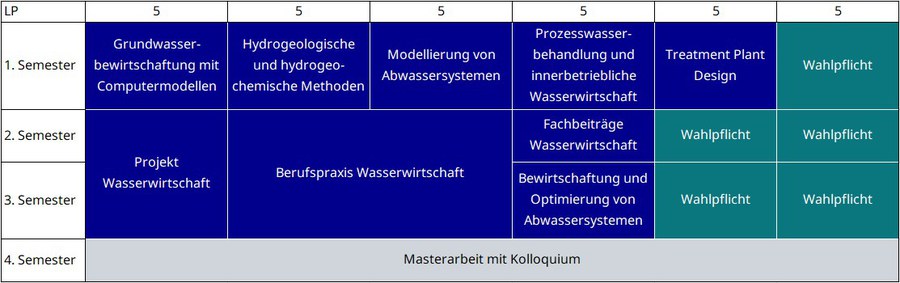
Studienablauf Master Wasserwirtschaft
You can find the program documents for our degree programs on the website of the Office of Academic Affairs for Civil Engineering and Environmental Studies.
Here you will find the following for the master’s program in Water Management:
- the examination regulations
- the study regulations, including module descriptions and the program schedule
with effect from the 2026/2027 winter term.
The required curriculum includes the following modules (from the winter term 2026/27):
| Modulname | LP | WiSe | SoSe |
|---|---|---|---|
| Grundwasserbewirtschaftung mit Computermodellen | 5 | X | |
| Hydrogeologische und hydrogeochemische Methoden | 5 | X | |
| Modellierung von Abwassersystemen | 5 | X | |
| Prozesswasserbehandlung und innerbetriebliche Wasserwirtschaft | 5 | X | |
| Treatment Plant Design | 5 | X | |
| Projekt Wasserwirtschaft | 10 | X | X |
| Berufspraxis Wasserwirtschaft | 20 | X | X |
| Fachbeiträge Wasserwirtschaft | 5 | X | |
| Bewirtschaftung und Optimierung von Abwassersystemen | 5 | X |
For more detailed information, please refer to the module descriptions ( Appendix 1 of the Study Regulations).
The elective-required track includes the following modules:
| Modulname | LP | Winter | Summer |
|---|---|---|---|
| Isotopenanalytik in aquatischen Systemen | 5 | X | |
| Fallstudien der Grundwasserbewirtschaftung | 5 | X | |
| Wassertransport und -verteilung | 5 | X | |
| Integriertes Wasser-, Energie- und Ressourcenmanagement in der Industrie | 5 | X | |
| Grundwasserbewirtschaftung in bergbaulich beeinflussten Gebieten | 5 | X | |
| Planung und Betrieb von Abwassersystemen | 5 | X | |
| Fundamentals of Integrated Water Resources Management | 5 | X | |
| Integrated Water Resources Management case studies | 5 | X | |
| Numerical Methods for Hydrosciences | 5 | X | |
| Hydrometeorologie und Landschaftsklima | 5 | X | |
| Hydrowissenschaftliche Studienfahrt | 5 | X | |
| Große hydrowissenschaftliche Studienfahrt | 10 | X | |
| Genehmigungs- und Planungsrecht für Umweltingenieurinnen und Umweltingenieure | 5 | X | |
| Water Extremes – Hazard and Risk Assessment | 5 | X | |
| Flussgebietsbewirtschaftung | 5 | X | |
| Bodenwasserhaushalt | 5 | X | |
| Bewässerung | 5 | X | |
| Wasserqualität | 5 | X | |
| Behandlungstechnologien für Siedlungsabfälle | 10 | X | |
| Planung von Abfallbehandlungsanlagen | 5 | X | |
| Modellierung und Bilanzierung in der Abfall- und Kreislaufwirtschaft | 5 | X | |
|
Schadstoffbewertung und -sanierung in der Praxis |
5 | X | |
| Vorsorge in der Abfall- und Kreislaufwirtschaft | 5 | X | |
| Statistische Methoden in der Ökologie | 5 | X | |
| Analyse und Simulation aquatischer Ökosysteme | 5 | X | |
| Ökotoxikologie | 5 | X | |
| Landschaftswasserhaushalt | 5 | X | |
|
Stoffhaushalt terrestrischer Biogeosysteme |
5 | X | |
| Stauanlagen | 5 | X | |
| Wasserkraftanlagen | 5 | X | |
| Nichtstationäre Wasserbewegung | 5 | X | |
| Weiterführende Hydromechanik | 5 | X | |
| Küsteningenieurwesen | 5 | X | |
| Verkehrswasserbau | 5 | X | |
| Numerische Strömungsmodellierung | 5 | X | |
| Softwareanwendungen im Wasserbau | 5 | X | |
| Gewässerentwicklung | 10 | X | X |
| Wärmeübertragung |
5 |
X | |
|
Grundprozesse der Thermischen Verfahrenstechnik |
5 | X | |
| Engineering verfahrenstechnischer Anlagen | 5 | X | |
|
Anwendung der Thermischen Verfahrenstechnik |
5 | X | |
|
Nachhaltige Produkt- und Prozessentwicklung |
5 | X | |
| Grenzflächen- und Nanopartikeltechnik | 5 | X |
For more detailed information, please refer to the module descriptions ( Appendix 1 of the Study Regulations).
Affiliated Institutes
Institute of Urban and Industrial Water Management
Institute of Groundwater Management
Contact
If you have any questions about the program, please contact the academic advising office of the Department of Hydro Sciences, the Faculty Student Council, or the program coordinators.
Informationon the previous course structure for the 2018 Study Plan ( and earlier) can be found here.
Study requirements
This Master programme is a German-language study programme. More detailed information can therefore be found on the German web page.
Here you find further information about the study possibilities at the TU Dresden, application, necessary language skills and students' life in Dresden.