
Master's programme Literature and Culture in Social Change
Table of contents
The orientation session for the LiKWa master's program will take place on Tuesday, October 6, 2026, at 10 a.m. at Wiener Straße 48 (W48), in Room 004 .
The consecutive master’s program “Literature, Culture and Societal Change” (LiKWa) can be pursued across all areas of philology or with a subject-specific focus. The focus can be chosen from among the subjects offered by the faculty:
- English and American Studies
- German Studies and Media Cultures
- Classical Philology
- Romance Studies
- Slavic Studies
Two elective modules allow for further specialized study. Students can choose between a language-focused or a discipline-focused track.
The program is divided into four semesters. The third semester is reserved for a mandatory1 Numerous funding opportunities are available for this.
The degree program allows students to engage with current social issues that transcend disciplinary boundaries, such as digitalization, gender and queer studies, future studies, and environmental humanities.
Further information on the specializations
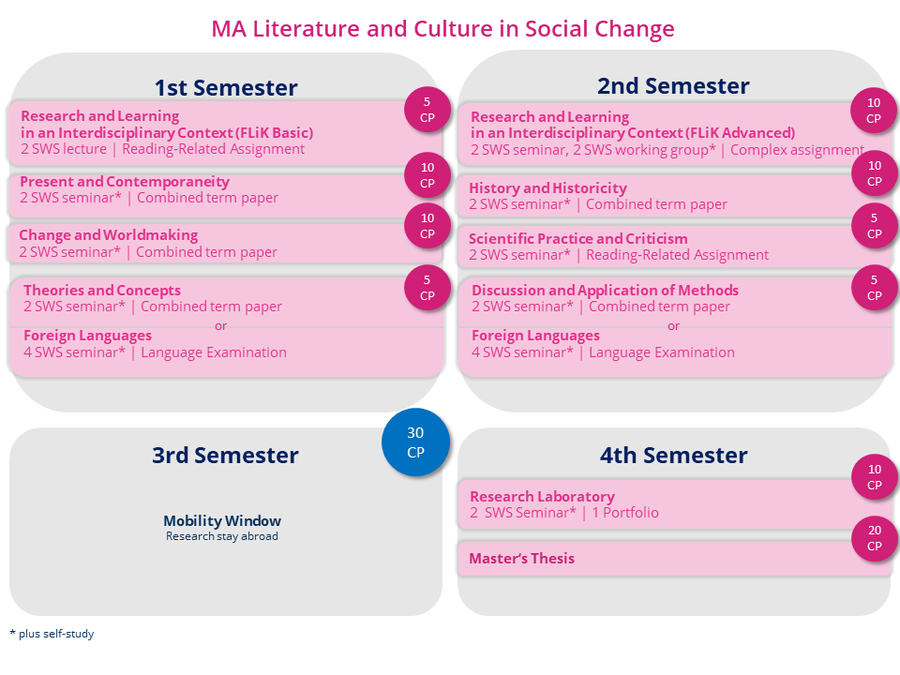
LiKWa – Aufbau und Struktur mit Modulnamen, Umfang in Semesterwochenstunden (SWS), Art der Prüfungsleistung und Creditpoints (CP)
Brief Profile: The consecutive master’s program “Literature, Culture and Societal Change”
- is designed for you as a distinctly research-oriented, modular degree program with a standard duration of four semesters and 120 credit points. It leads to a professionally qualifying university degree, conferring the academic title “Master of Arts” (M.A.);
- allowing you to acquire specialized knowledge and professional competencies across the spectrum of literary, cultural, and media studies (admission requirement: a BA in this subject area). These qualifications enable you to engage in independent, self-directed work in a wide variety of fields, such as academia, education, (specialized) publishing, the media, journalism, cultural management, business and politics, or international organizations;
- enables you to achieve this goal, on the one hand, through a high level of general qualification in literary, cultural, and media studies, and on the other hand, through a high degree of specialized expertise. You can choose between a language-focused and a discipline-focused track and have the option to specialize in one of the five sub-disciplines of the SLK Faculty (English and American Studies, German Studies and Media Cultures, Classical Philology, Romance Studies, and Slavic Studies);
- The program is research-oriented, interdisciplinary, and international. You will acquire theoretical and methodological skills for the critical reflection on historical and, above all, contemporary phenomena of cultural and social change. A mandatory study abroad period, along with support for building your national and international networks, enables you to participate intensively and independently in academic and societal discourses even during your master’s studies.
Information on admission requirements and the application process can be found in the SINS system at TU Dresden. If you have further questions , your academic advisors will be happy to assist you.
Jakob studiert den Master LiKWa und hat sich für das Mobilitätsfenster für einen Auslandsaufenthalt in Japan entschieden. Im Vlog nimmt er uns eine Woche lang mit durch seinen Studiumsalltag.
Oliver studiert den Master LiKWa und zeigt uns seine Eindrücke bei Exkursion mit dem Institut für Romanistik nach Apulien. © TU Dresden
Academic Documents
- Examination Regulations of July 27, 2020
- Academic Regulations of July 27, 2020
- Aptitude Assessment Regulations of June 13, 2020
- Study Plan
Academic Advising
Academic Advisor Master EuroS, LiKWa and DH
NameMs Katharina Fritzsch M. A.
Send encrypted email via the SecureMail portal (for TUD external users only).
Academic Affairs Office:
BZW, Sockelgeschoss, Raum ASG06 Zellescher Weg 17
01069 Dresden
Deutschland
Office hours:
by appointment
If you have any questions or concerns, please feel free to contact the student program coordinator.
Lenny Márki:
Application
Admission to the master’s program “Literature, Culture and Societal Change” is open to all applicants (no minimum grade requirement), but includes a selection interview with each applicant to assess their suitability. The approximately 20-minute suitability interviews with two professors from the degree program take place every year between July and mid-September via Zoom. The selection process is designed to assess applicants’ specific suitability for this degree program. To apply, please fill out the application for the aptitude assessment and send it to the program coordinator.
For more information, see: Information for Prospective Students
Career Prospects
Literature and culture are at the heart of societal transformation processes. The academically grounded skills needed to observe, describe, and critically examine the conditions of these processes are becoming increasingly important. This applies both to the academic disciplines themselves and to the knowledge society beyond the university.
The master’s program in Literature, Culture and Societal Change (LiKWa) offers you a research-oriented, interdisciplinary, and international education focused precisely on developing these skills. Through a mandatory study abroad period and by fostering national and international networking among students, LiKWa enables intensive and independent participation in academic and societal discourses even during the master’s phase. In addition to academia, these include, among others: education, publishing, cultural management, media, scientific and corporate communications, foundations, politics, etc.
The academic training is supported by numerous programs offered by TU Dresden and its institutions—the Graduate Academy, the Career Service, and the International Office. TU Dresden and its partners in DRESDEN-concept also offer on-site opportunities to explore, alongside academia, a wide range of professional fields that encompass the tasks of science communication and science management, as well as modern librarianship, knowledge dissemination in museums and other cultural institutions, as well as tourism-related opportunities and communication challenges in the business world.
Discontinued Degree Programs
The SLK Faculty of Linguistics, Literature and Cultural Studies offers the consecutive master’s program in Linguistics, Literature and Cultural Studies to all students who began their studies between the 2013/14 winter semester and September 30, 2020.
The regulations for the phased-out master’s programs can be found here. Please note the alternative options for minors in the faculty’s master’s programs.
Additional Information: Dual Master’s Programs
Dual Master’s with the Università di Trento
The “Dresden-Trento” dual Master’s program offers the opportunity to earn a dual degree while studying at the partner university in Italy. The planned program can be easily combined with the mobility window or research stay abroad provided for in the LiKWa degree program’s study regulations. Courses at the Università di Trento are offered not only in Italian but also in English, German, Spanish, French, and, in some cases, Russian. If you are interested, you can find more information on the Doppia Laurea website.
Dual Master’s Degree with Università Ca’ Foscari Venezia
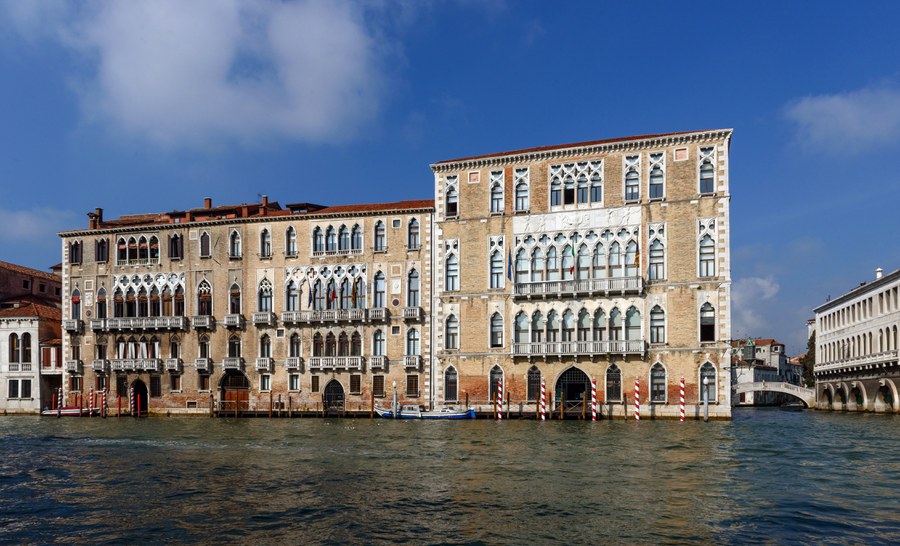
The Double Degree Master’s program offered by the TUD Dresden University of Technology in cooperation with Ca’ Foscari University of Venice allows students to earn two recognized degrees: a Master of Arts from TU Dresden and a Laurea magistrale from Ca’ Foscari. Students in the Master’s program in Literature, Culture and Societal Change (LiKWa) spend one semester at the partner university in Venice during their third semester. The course content is coordinated with the program coordinator in advance to ensure smooth recognition of academic achievements.
The study abroad period is a central component of the program and features interactive courses, language classes, and the opportunity to study in an academically and culturally diverse environment. Through this academic exchange, students not only expand their subject-specific knowledge but also develop intercultural competencies and gain insight into Italian research landscapes. Participation in the program offers a unique opportunity to study in two renowned cultural cities. Both universities combine academic excellence with a vibrant academic atmosphere and are members of the European university alliance EUTOPIA.
For more information on the application process, the course of study, and the partner university, please visit the Double Degree website
Frequently Asked Questions
Students of the Master LiKWa can specialize in one of the five departments of the SLK faculty. German Studies and Media Cultures, English/American Studies, Slavic Studies, Romance Studies and Classical Philology are available.
The main focus is determined at the end of the study program. Students can have a specialization in their chosen field of study shown on their diploma, as long as they have received 60 credit points in this field during their studies. In addition, the master thesis must have been completed in the respective department.
Credits for the main focus can be obtained in each module, except in the language courses where a practical language profile is required. (Even if the language practical profiling was chosen, there are enough modules left to set a focus).
No. Students can also study on a broad basis and attend seminars according to their interests, without having to worry about the necessary credits and their affiliation.
Practical language profiling means that you can take language courses in the first and second semester with 4 semester hours per week each. You can use the language courses offered by the faculty or TUDIAS. For both options you will find information under point 1 (Foreign Languages) under this link.
If you decide on a practical language profile, please contact the coordination of the MA LiKWa.
Scientific profiling means that instead of the language courses you will take the modules "Theories and Concepts" and "Method Discussion and Application". Please refer to the Course Catalogue for information on the courses you can take to complete these two modules.
No, you don't have to. You can take an A1 course in French in the first semester and a B2 course in Russian in the second semester. However, the language course offer depends on the offer of the respective institute (e.g. the Institute of Slavic Studies cannot offer the A1 and A2 courses every semester for capacity reasons) or TUDIAS.
Please contact the responsible persons listed (listed under 1.Foreign Languages).
Yes, the stay abroad is individually tailored to the interests of the respective students. This requires advice from the study program coordinator. Together we will try to find a partner university in the respective desired field of study. You are also welcome to find universities or offers yourself, which you can then suggest to the coordination. The only premise is that it must be a research stay.
A list of university cooperations in the respective department and information about Erasmus+ can be found here.
No, internships or regular study visits do not count. It must be a research stay.
The students are responsible for financing themselves. However, there is the possibility to receive funding through Erasmus+. Please follow this link or contact the International Office. Of course you can also use other scholarships.
You register using the form provided by the Examinations Office. The Master's thesis takes 17 weeks to complete and 20 credit points are earned.
You will be informed of the deadline when you register. If you have any outstanding examinations, you will also be informed of these. You can register your Master's thesis at any time, even if you are still missing examinations.
Footnotes
-
In justified exceptional cases that make a stay abroad impossible, alternative solutions can be sought in consultation with the program administrators.