
New Examination Regulation 2024 and compulsory transfer
Table of contents
- Motion to Suspend the Change to the Examination Regulations
- Information events
- What is the compulsory transfer and am I affected by it?
- What does compulsory transfer mean for me, how does it work?
- Information on the module Computer Science (ET, BMT, MT, RES)
- Information on the Circuit Design modules in the study programme Electrical Engineering
- Equivalence tables
- Further information
Motion to Suspend the Change to the Examination Regulations
Motion to Suspend the Change to the Examination Regulations: Please submit your application to the Registrar's Office by August 30, 2026, at the latest. Please note: Requirements for remaining under the previously applicable examination regulations
Note: Additional applications regarding the transition to the new examination regulations (for MT students: special case of retaining old required modules; for all students: retaining elective modules in their previous 7 LP format with a reduction in credit points) will follow; these will be announced simultaneously via TU email. These applications will not be processed until after the automatic transition has taken place.
!!! Even students who have already begun their thesis must, if desired, submit an application to remain under the old study regulations!
Your transcript will be issued in accordance with the old examination regulations, which means:
- All modules completed to date will be listed on the transcript with their original titles and credit points
- All individual examination results associated with the modules will be listed in the supplement to the transcript
- You will complete your studies in accordance with the rules of the previous examination regulations (including the provisions for the thesis, i.e., 23 weeks of work time)
- For modules that still need to be taken after the transition, students may only choose from the new course offerings with new examination requirements; the old examination requirements are no longer offered
- Final grades are determined primarily based on grades from the advanced study phase (weighted according to credit points); for details, see § 11 (4) of the 2013/2014 Study Regulations for the respective degree program
- Only the module grades from the main phase of study are listed on the diploma transcript, the module grades from the introductory phase of study are listed on the preliminary diploma (According to the Study Regulations 2013 or 2014 (IST) in § 21 or the amending statutes dated August 20, 2018 (ET, IST) or August 31, 2018 (MT), Article 1)
Your transcript will be issued in accordance with the new examination regulations, which means:
- All previously completed modules will be transferred according to the equivalence tables (see below), and the new module titles—including the new credit points (the originally earned credits will not be listed)—will be shown on the transcript
- No listing of the individual exam results associated with the modules in the supplement to the transcript, since modules are credited only as a whole
- In some degree programs or areas of specialization, newly introduced modules listed in the equivalence table (see there) may need to be completed
- The following applies to ET: In the MEL, IT, and AMR (AR) programs, modules must be completed upon changing the program structure (Digital Circuit Design or an elective module from AR); in the GMM and EET programs, no modules need to be completed
- For MT: newly added required modules must be completed (see equivalence table); alternatively, after completing all previous required modules, these can be transferred in a condensed form to new (alternative) modules upon request (see above), in which case no modules need to be completed
- For modules and the thesis begun after the transition, the course loads and examination requirements under the new examination regulations apply (for the thesis, the completion period is 22 weeks)
- The final grade is primarily calculated based on the grades from the main phase of study (weighted according to credit points); for details, see § 35 (ET, BMT) or § 36 (IST, MT, RES) of the Study Regulations 2024
- All module grades from the introductory and main phases of study are listed on the transcript (pursuant to § 27 (2) PO and § 33 PO); for grades from the introductory phase, an interim transcript is also issued (provided that a preliminary diploma has not yet been issued under the old regulations)
Information events
An information event for all diploma degree programs of the faculty with basic information on the compulsory transfer took place on 31.1.2025: Slide set (supplemented by slide 9, 10, 15 and 24).
A question and answer session on compulsory transfer is planned for the beginning of the summer semester 2025 after publication of all equivalence tables. You will be invited by email.
What is the compulsory transfer and am I affected by it?
- A new examination regulation (PO) applies to all students newly enrolled at the Faculty of Electrical and Computer Engineering in the winter semester 2024/2025 (or later).
→ PO 2024 - For students enrolled earlier than winter semester 2024/2025
- in ET, IST, MT and RES the previously valid version of the examination regulations will continue to apply until summer semester 2026.
- in BMT enrolled earlier than winter semester 2024/2025, the previously valid version of the examination regulations will continue to apply until summer semester 2025.
- Compulsory transfer
- From the winter semester 2026/2027, the new PO 2024 will apply to all students of ET, IST, MT and RES enrolled at this time.
- From the winter semester 2025/2026, the new PO 2024 will apply to all students of BMT enrolled at this time.
This compulsory transfer is therefore a compulsory change of the examination regulations applicable to students and the associated study regulations (SO) during their studies.
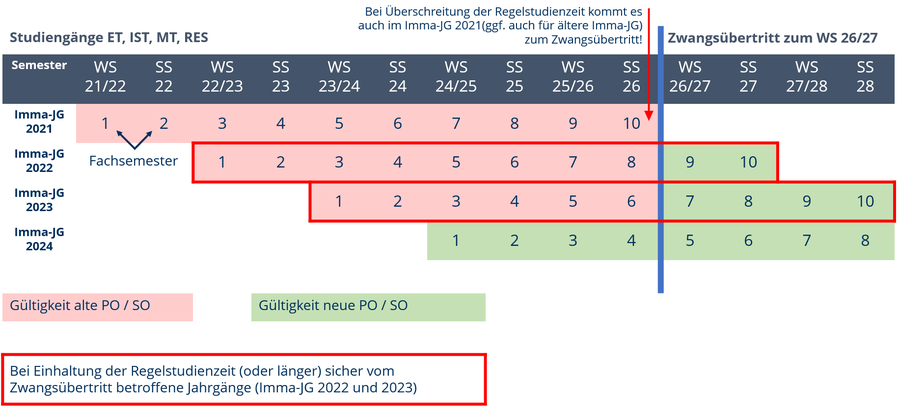
- All students of ET, IST, MT and RES enrolled at the Faculty of Electrical and Computer Engineering on 01.10.2026 (regardless of their original year of enrollment) are affected by the compulsory transfer if they started their studies before the winter semester 2024/25. Specifically, this means
- Students from the 2022 and 2023 enrolment years, if they have not completed their studies early (by 30.09.2026), and
- Students from enrolment years up to 2021, if the standard period of study is exceeded so that their studies are not completed by 30.09.2026.
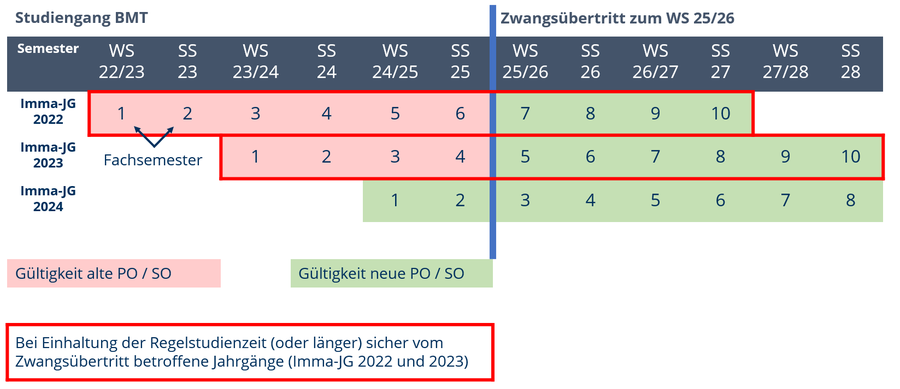
- All students of BMT enrolled at the Faculty of Electrical and Computer Engineering on 01.10.2025 (regardless of their original year of enrollment) are affected by the compulsory transfer if they started their studies before the winter semester 2024/25. Specifically, all students who have been enrolled on the degree program since its introduction.
What does compulsory transfer mean for me, how does it work?
- All students affected by the compulsory transfer must complete their studies in accordance with the rules and regulations of the new examination regulations (PO 2024) and the associated study regulations.
- All compulsory and elective modules required under the new regulations must be successfully completed in order to graduate.
- The change from the old to the new regulations (in HISQIS / SELMA) is automatically done for students. This will be implemented by the Examination Office / Academic Affairs Office.
- An intermediate diploma completed by 30.9.2026 (ET, IST, MT, RES) or by 30.9.2025 (BMT) will be issued according to the old examination regulations.
- Modules already passed in the previous course of study (according to the old PO) will not be lost. They are mapped to modules of the new PO / SO by means of so-called equivalence tables and thus result in a new course of study (according to the new PO).
- Modules or examinations from the new PO that could not be assigned an equivalent from the old regulations must be made up for by the students. Separate information will be provided for these cases.
Information on the module Computer Science (ET, BMT, MT, RES)
The module “Computer Science” (ET-11 02 01) does not have identical examination results in the future modules “Software Engineering Basics” (EuI-ET-C-SwEgG, EuI-BMT-C-SwEgG, EuI-MT-C-SwEgG, EuI-RES-C-SwEgG) and “Software Engineering Advanced” (EuI-ET-C-SwEgV, EuI-BMT-C-SwEgV, EuI-MT-C-SwEgV), so there will be no 1:1 transfer. The figure shows the special features to be observed for students from the regulations prior to 2024.
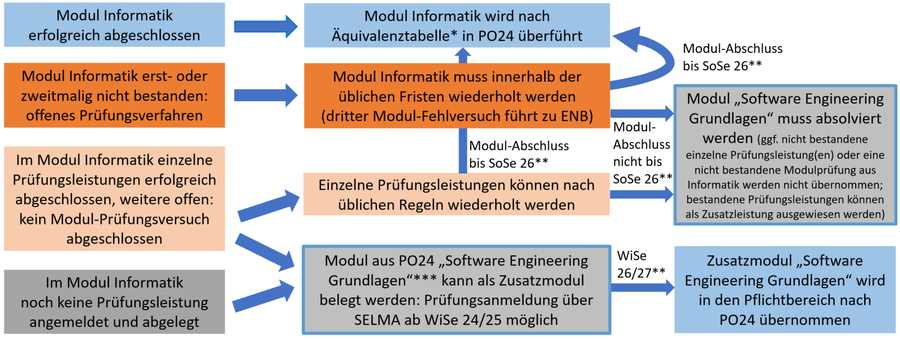
* “Computer Science” is booked as “Software Engineering Basics” and “Microcomputer Technology” as
“Software Engineering Advanced” (subject to the final decisions of the examination boards)
** for BMT already until summer semester 25 or in winter semester 25/26 (according to compulsory transfer according to diploma examination regulations 2024)
*** taught jointly as “Software Engineering Basics/Microcomputer Technology 1” in winter semester 2024/25
Note: The usual deadlines/rules for exam retakes can be found on the exam website and the examination tutorial slides linked there.
Information on the Circuit Design modules in the study programme Electrical Engineering
According to the examination regulations of 2013 for Electrical Engineering, there are the following Circuit Design modules:
- ET-12 08 31 Circuit Design (7 credits, basic studies) and
- ET-12 08 32 Circuit Design - Experiments and Measurements (3 credits, main studies)
- for Information Systems Engineering students there is also: ET-12 08 33 Digital Circuit Design (3 credits).
According to the new examination regulations of 2024, there are the following Circuit Design modules:
- EuI-ET-C-ST Circuit Design (5 credits, basic studies)
- EuI-ET-C-STV Circuit Design Advanced (5 credits, AMR, compulsory elective module EET)
- EuI-ET-C-ADST Analogue and Digital Circuit Design (5 credits, GMM)
- EuI-ET-C-ADSTV Analog and Digital Circuit Design Advanced (8 credits, MEL, IT).
The following equivalence tables apply for the transition to the examination regulations 2024 as off winter semester 2026/27 according to the fields of study:
- AMR, EET: ET-12 08 31 + ET-12 08 32 ⇒ EuI-ET-C-ST + EuI-ET-C-STV
- GMM: ET-12 08 31 + ET-12 08 32
OR ET-12 08 31 + ET-12 08 33 ⇒ EuI-ET-C-ST + EuI-ET-C-ADST - IT, MEL: ET-12 08 31 + ET-12 08 32 + ET-12 08 33 ⇒ EuI-ET-C-ST + EuI-ET-C-ADSTV
Consequences:
- AMR, EET and GMM students should take the previous Circuit Design modules; these will be automatically transferred to the new modules at a later date
- GMM students can also take ET-12 08 33 instead of ET-12 08 32 (see timetable)
- In addition to ET-12 08 31 and ET-12 08 32, IT and MEL students must also take
ET-12 08 33 (see timetable) later or now in order to transfer the new module
EuI-ET-C-ADSTV in full.
Equivalence tables
- overview of compulsory areas
- Electrical Engineering Overview of compulsory areas, detailed equivalence table for compulsory areas, Main Studies elective modules
- Mechatronics: Overview of compulsory areas, detailed equivalence table for compulsory areas, Slides of online information event on 3rd April, 2025;
Main Studies elective modules "Methoden und Andwendungen" - Biomedical Engineering: Basic Studis, Main Studies
- Information Systems Engineering: Legend, Basic Studies,
Main Studies Comulsory Modules, Main Studies "Orientierung",
Main Studies "Kompetenzvertiefung" Computer Science,
Main Studies " Kompetenzvertiefung" Electrical Engineering - Regenewable Energy Systems: Basic Studies, Main Studies without "Kompetenzvertiefung"
- Nanoelectronic Systems
Further detailed information can be obtained from your academic advisor or the Examination Office.