
Bachelorarbeiten
Table of contents
Allgemeine Informationen zu Bachelorarbeiten am IKTP:
Die Vortragsfolien der Bachelor-Informationsveranstaltung im Wintersemester 2020/21 gibt es als Institutsübersicht hier zum Download. Die Folien der einzelnen Gruppen sind im weiteren Lauf dieser Seite verlinkt. Unter Forschung lässt sich im Link Publikationen eine Übersicht der bisherigen Bachelorarbeiten im IKTP mit pdf-Files erstellen.
Bitte melden Sie sich 1-2 Monate vor dem geplanten Beginn der Bachelorarbeit in der Arbeitsgruppe!
Teilchenphysik
Siehe auch: Aktuelle Informationen zu Abschlussarbeiten in der Professur Teilchenphysik.
 © IKTP
Group Leader
NameProf. Dr. Frank Siegert
Chair of Particle Physics and its Simulation
Send encrypted email via the SecureMail portal (for TUD external users only).
Certificate of DFN-PKI for encrypted email communication.
Institute of Nuclear and Particle Physics
Visiting address:
Andreas-Schubert-Bau, Ground floor, room E17 Zellescher Weg 19
01069 Dresden
Office hours:
By arrangement
Themenübersicht:
Comparisons of theoretical calculations with experimental data require some definition of particles that are typically chosen to closely match the selection in measurements. This project will study particle-level definitions of the lepton and photon isolation, and their effect on the theoretical predictions.
For hadron decays with only 2 or 3 final state particles, the partial width can be calculated with simple equations of low dimensionality. Their evaluation with Monte Carlo methods is not efficient and this thesis should extend our current Monte Carlo event generator with an evaluation of these based on standard numerical integration techniques, e.g. similar to 6.2 in[https://arxiv.org/pdf/2512.16645].
The matrix elements for the decay of a B meson into a D meson resonance typically assumes the momenta of all external particles to be on-shell. But some D resonances can have a large width, which is currently accounted for kinematically in an a posteriori shift of the momenta to an offshell mass, but the matrix element calculation is not corrected for these offshell effects. This effect has been shown to be important [https://arxiv.org/abs/2602.18378] and in this thesis we want to study its impact within the Sherpa simulation and possibly implement mitigation strategies.
The calibration of the energy scale of the ATLAS electromagnetic calorimeter typically uses decays of the Z boson to two electrons, and the energy scale is determined relative to the (precisely known) Z-boson mass. This approach leads to large uncertainties in measurements of the (less precisely known) W-boson mass. To overcome this limitation, this project will used W->ev decays to determine the electron energy scale relative to the momentum measured in the ATLAS inner detector.
The longitudinal polarisation of the W and Z bosons is a direct consequence of electroweak symmetry breaking via the Brout-Englert-Higgs mechanism. A measurement of polarisation implies the treatment of multiple correlated quantities reconstructed in the detector, e.g. by using machine learning techniques. This project will explore an alternative method, the so-called Matrix Element Method, to reconstruct the polarisation in the hadronic decay of W bosons. A probability that measures the compatibility of experimental data with a given hypothesis is computed for each event, based on the theoretical knowledge of this process, i.e. the underlying Lagrangian from which the matrix element of the partonic process is derived.
Our simulation program Sherpa is capable of simulations beyond the Standard Model theory using a universal format. This topic is about exploring this in a model contain doubly-charged H++ bosons, which another student in our group is analysing in ATLAS data.
Current experimental constraints on the Higgs-boson decay width are obtained indirectly through the interference of Higgs-boson production with other processes. This study will explore the experimental sensitivity of setting an upper bound on the Higgs-boson lifetime with the ATLAS detector by measuring the longitudinal displacement of the Higgs-boson decay vertex from the primary interaction vertex. This displacement is expected to be much smaller than the experimental resolution. However, if an upper bound on the lifetime could be set, it would translate into a lower bound on the decay width.
The reconstruction of the electric charge of an electron produced in the ATLAS detector relies solely on the measurement of the curvature of its associated track in the inner detector. Interactions of an electron with the detector material can create secondary particles: photons and electron-positron pairs. The production of these secondary particles can lead to distortions of the primary electron track. Incorrect charge reconstruction can thus be caused either by an erroneous determination of the track curvature or by the choice of the wrong track. This project will study information of reconstructed secondary particles in the vicinity of the electron to reject electrons with signatures indicating a high probability for charge misreconstruction.
One of the proposed new experiments planned to explore physics beyond the Standard Model at CERN is SHiP (Seach for Hidden Particles), a beam-dump facility, where a high-energy beam is directed onto a fixed target. To search for new particles produced in the decays of D-mesons (mesons containing a charm quark), we first need to validate the Sherpa simulations of their production and decay. Especially their accuracy at the relatively low energies (~ GeV range) reached there, compared to the LHC (14 TeV), will have to be examined.
For now, Sherpa, the simulation software we are working with, is only able to simulate collision experiments, such as the LHC, where two high-energy particle beams collide. However, several current and upcoming experiments use fixed-targets, where a high-energy beam is directed onto a stationary target. To effectively search for new physics there, we need to be able to simulate these experiments as well. Thus, further development on Sherpa (by you?) is needed!
Quarkonia are unstable hadrons made up of identical quark-antiquark pairs, which decay according to the electromagnetic, strong or weak interactions. This project will work on improving the modelling of these decays in the simulation program "Sherpa" by updating branching ratios from measured results and implementing matrix elements for the most relevant decay channels.
The complexity of matrix element calculations for final states with a high multiplicity is so high, that their computational cost often limits theory simulations for the LHC. In this project we want to extend a machine learning based approach to simplify these calculations by approximating the matrix elements. The goal is to study various parameters for the architecture and training of deep neural networks in this approach.
The simulation of different polarisation states allows us to study effects from physics beyond the Standard Model in more detail. In this project we want to study, how effective-field-theory extensions of the Standard Model will affect different polarisations of W bosons in W±W± pair production at the LHC.
Experimentelle Teilchenphysik
 © IKTP
Group leader
NameProf. Dr. Arno Straessner
Experimental particle physics
Send encrypted email via the SecureMail portal (for TUD external users only).
Institute of Nuclear and Particle Physics
Visiting address:
Andreas-Schubert-Bau, 4. OG, Raum 428 Zellescher Weg 19
01069 Dresden
Themenübersicht:
Bachelor Thesis, Research Studies Master, Master Thesis in Experimental Particle Physics
- Multivariate analysis, machine learning and artificial intelligence
- Optimisation of data analyses for particle searches and reconstruction of particle decays
- Application and development of software for statistical data analysis
One of the research activities of the ATLAS group at the Institute of Nuclear and Particle Physics is the search for new Higgs bosons in extensions of the Standard Model at the Large Hadron Collider (LHC). A large data set is available from ATLAS Run-2 and Run-3 with a total luminosity of more than 300 fb-1, which can be analysed. More data are currently being recorded by ATLAS.
In many scenarios beyond the Standard Model, the decay of the new Higgs bosons is into a pair of tau leptons. We therefore study the hadronic decay of such tau leptons in detail, in particular, to obtain a high significance for the Higgs signal, and a large suppression of backgrounds.
In the data analyses, we exploit advanced statistical methods and very often apply methods of machine learning to optimize the selection algorithms or parameter settings.
The topics of the Bachelor and Master theses will be defined individually according to your interest and to the current state of research.
In the thesis project, you will learn software-based methods of data analysis and statistics, the application of machine learning tools, and the use of modern particle detectors.
You should bring a basic knowledge of particle physics. Programming skills would be an asset, but we will also provide introductory sessions to all necessary programming and analysis tools.
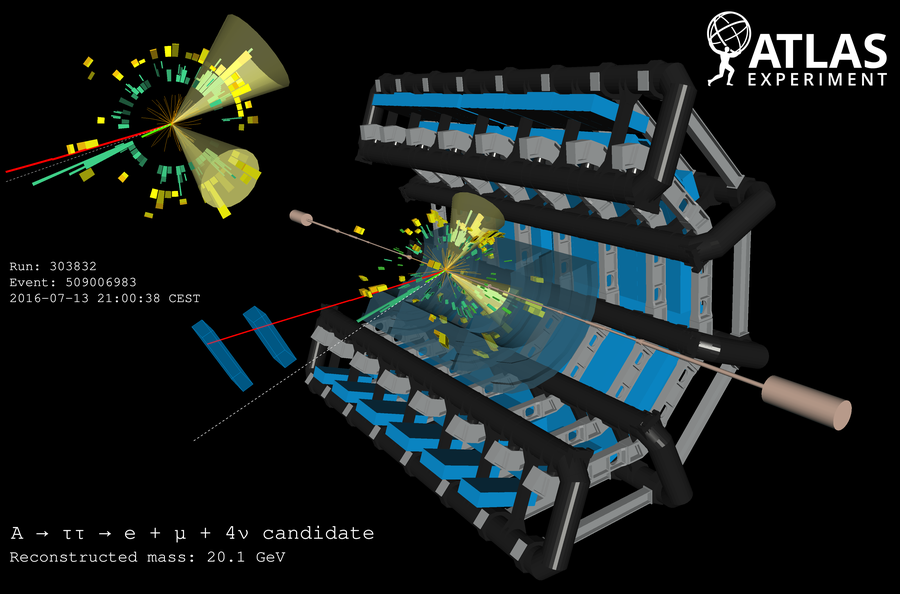
pp collision event recorded by the ATLAS detector at the LHC. The picture shows a candidate of a low-mass Higgs boson decay into a pair of tau leptons, which subsequently decay into an electron, a muon and neutrinos.
Bachelor Thesis, Research Studies Master, Master Thesis in Experimental Particle Physics
- Machine learning und artificial neural networks
- Optimisation of the energy measurement of photons, electrons and hadronic jets with Liquid-Argon calorimeters
- Programming or simulation of electronic and digital signal processing
- Statistical analysis of measurement data
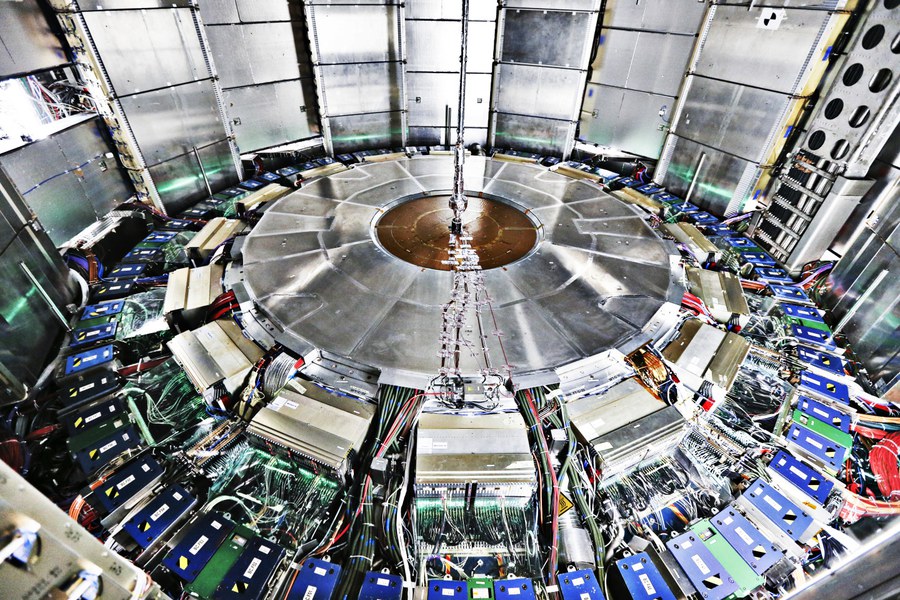
The Liquid-Argon Calorimeters (LAr Calorimeters) of the ATLAS detector at the LHC are going to be upgraded with new readout electronics for operating at highest LHC luminosities. The calorimeter signals shall be reconstructed with improved energy and spatial resolution so that particles produced in proton-proton collisions can be identified with higher precision. The goal is, for example, an improved detection of Higgs boson decays with the ATLAS detector.
The particle identification and energy reconstruction must be performed in real-time, and the time to provide the energy calculation in each detector cell must not take longer than 0.5 μs. For this reason, we use modern and fast programmable electronic circuits, so-called Field Programmable Gate Arrays (FPGAs) for signal reconstruction. We exploit deep learning methods and artificial intelligence to optimize our measurements.
In the Bachelor or Master thesis, the energy reconstruction of the ATLAS LAr Calorimeters shall be improved using machine learning approaches.
In the research project, you will learn the application of machine learning tools (e.g. keras), software-based data analysis, and the functioning of a modern particle detector and electronic readout systems.
If you are interested you may also learn about programming of FPGAs using the programming language VHDL. You can get involved in the application of machine learning algorithms or on advanced data processing procedures running on FPGA devices.
You should bring a basic knowledge of particle physics, and the motivation to learn more about machine learning and/or FPGA programming. Basic programming skills are an asset. We also provide introductory sessions to VHDL and the analysis tools needed for your work.

Theoretische Teilchenphysik
 © IKTP
Institute Director, Group leader
NameProf. Dr. Dominik Stöckinger
Theoretical particle physics
Send encrypted email via the SecureMail portal (for TUD external users only).
Institute of Nuclear and Particle Physics
Visiting address:
Andreas-Schubert-Bau, EG, Raum E13 Zellescher Weg 19
01069 Dresden
Themenübersicht zum Download: WiSe2020/21 ( WiSe2019/20 )
- Vorhersage des magnetischen Moment des Myons
- Theorie der grossen Vereinigung
Weitere Informationen: Poster mit Themenübersicht
Experimentelle Kernphysik
 © IKTP
Group leader
NameProf. Dr. Kai Zuber
Nuclear and neutrino physics
Send encrypted email via the SecureMail portal (for TUD external users only).
Institute of Nuclear and Particle Physics
Visiting address:
Andreas-Schubert-Bau, EG, Raum E11 Zellescher Weg 19
01069 Dresden
Themen für Abschlussarbeiten zur Neutrino- und Kernphysik finden Sie auf dieser Webseite.
Themen für Abschlussarbeiten im Felsenkeller finden Sie auf dieser Webseite.
Strahlungsphysik am IKTP
 © IKTP
Group leader
NameMr Dr. Thomas Kormoll
Strahlungsphysik
Send encrypted email via the SecureMail portal (for TUD external users only).
Institute of Nuclear and Particle Physics
Visiting address:
Andreas-Schubert-Bau, 4. OG, Raum 406 Zellescher Weg 19
01069 Dresden
Folien zu den Abschlussarbeiten
- Medizinische Dosimetrie: Entwicklung der Faserdosimetrie als neue Form der Qulitätskontrolle bei therapeutischen Bestrahlungen, insbesondere in Protonenfeldern.
- Kerntechnischer Rückbau: Konzeption und Entwicklung kompakter Sonden für die Radionuklididentifikation in schwer zugänglichen Geometrien (Bohrlöcher, Betonreste aus dem Rückbau etc.).
- Strahlenschutz-Messtechnik: Mitarbeit in der Entwicklung eines handgehaltenen Dosisleistungsmessgeräts für den Strahlenschutz des medizinischen Personals an klinischen Röntgen- und Therapieeinrichtungen.
- Bildgebung: Ausbau eines präklinischen Kleintier-PET-Scanners zu einem Praktikumsversuch am IKTP und Entwicklung eigener Algorithmen zur weiteren Nutzung für die Tomographie in der Entsorgung von radioaktiven Abfällen.
Institut für Strahlenphysik am HZDR
Group leader
NameProf. Dr. Thomas Cowan
Radiation Physics
Institute of Nuclear and Particle Physics
HZDR:
Bautzner Landstraße 400
01328 Dresden
Group leader
NameMr Prof. Dr. Ulrich Schramm
Strahlenphysik
Institute of Nuclear and Particle Physics
HZDR:
Bautzner Landstraße 400
01328 Dresden
Die verschiedenen Gruppen des Instituts für Strahlenphysik am HZDR www.hzdr.de/fwk bieten auf dieser Seite Bachelorarbeiten innerhalb des Helmholtz-Forschungsprogramms "Materie und Technologie" an.
Abteilung Beschleuniger-Massenspektrometrie und Isotopenforschung am HZDR
Für die Abteilung Beschleuniger-Massenspektrometrie und Isotopenforschung am HZDR www.hzdr.de/fwir findet man das Forschungsspektrum und die angebotenen Bachelorarbeiten in dieser Präsentation der Infoveranstaltung vom Januar 2021.