
Table of contents
Admission requirements
To be admitted to the degree program, applicants must have completed a general university entrance qualification (Abitur) or a comparable university entrance qualification.
German language requirements
International applicants and German applicants with a foreign university entrance qualification are kindly advised to read the requirements for German-language courses.
Information regarding Studienkolleg
Applicants with a foreign university entrance qualification that does not grant them direct access to university education in Germany pursuant to the qualification comparability regulations of the Standing Conference of the Ministers of Education and Cultural Affairs must attend a Preparatory College (Studienkolleg) prior to studying. You can acquire the subject-specific university entrance qualification here. Further information can be found on the website of the Preparatory College (Studienkolleg).
This degree program relates to the following specialized course at the Studienkolleg:
T-course
General information about the degree program
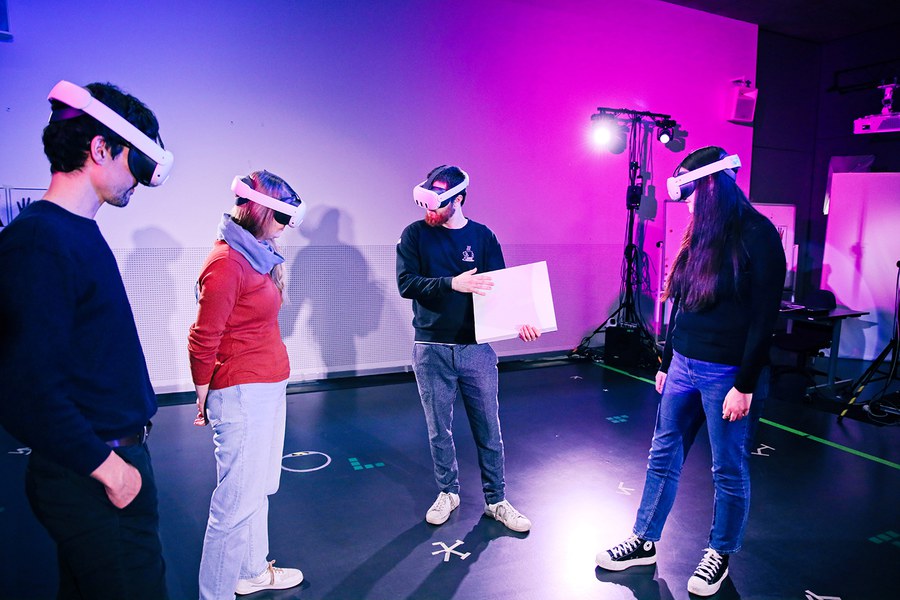
Computer science is changing our everyday lives: artificial intelligence is revolutionizing our industry and medical care, smart solutions for housing and transport are designed to make our future sustainable and simpler. On the bachelor's degree course in Applied Computer Science, you will learn to develop suitable structures and methods for complex and intelligent systems and to design them efficiently and securely. To do this, you will acquire application-oriented knowledge in information processing, software engineering and the architecture and technical foundations of complex and intelligent systems. You will learn to use scientific methods and work in interdisciplinary teams.
Study contents
The bachelor's degree course in Applied Computer Science combines mathematical and computer science fundamentals with an introduction to modern computer science topics. The course has a modular structure and comprises 18 compulsory modules. In the first semester, working in seminar groups with a joint timetable and exercise plan makes it easier for you to get started.
The course focuses on mathematics, algorithms, programming, structure and behavior of complex systems, human-computer interaction, artificial intelligence, database systems, operating systems, security aspects of data, systems and users.
In addition to the broad-based training in the scientific foundations of computer science, you can choose between two fields of study:
Media Computer Science
As a hybrid subject, Media Computer Science combines the best of two worlds. As a link between people and machines, it combines computer science and design to make digital systems optimally usable for people. You will develop interactive user interfaces that make operating devices and systems easy and pleasant.
Medical informatics
Digital health is changing the way we provide healthcare with fascinating IT solutions: Robots as surgeons, digital medical records, telemedicine and health apps that guide us through everyday life in a fit state are examples of this. In the Medical Informatics specialization, you will create information systems for medical applications. You will learn about computer-aided diagnostic and therapeutic procedures made possible by imaging or robots.
You will also acquire key skills such as teamwork, communication and languages, which will prepare you for professional life.
Particularities
• An interdisciplinary and diverse range of courses
• Two fields of study: Media Informatics and Medical Informatics
• High-calibre, pioneering research at a university of excellence
• Intensive support with an induction week and mentoring program
• Modern building with cutting-edge technology and special laboratories
• Opportunities to specialize in Artificial Intelligence and Machine Learning, Interactive Media, System Architecture, Software Technology, Embedded and High-Performance Computing, Computer Graphics and Data Security
• International and committed student body
• Dresden is one of the most important research locations in Germany and Europe
Occupational fields
Software development
Web design
Digital film production
3D graphics development
Research institutions
Authorities and companies
Universities in research and teaching
Healthcare sector
Postgraduate studies
Study documents
The official announcements of TU Dresden include all published regulations . Please use the search bar to find the document you need: Official proclamation
The regulations are also available on each institution’s website.
- Examination Regulation
- Study Regulation
… you will find on the respective site of the responsible unit.
Contacts
Central Student Information and Counselling Service
Study Counsellor
Ms. Antonia Zacharias M.A.
Central Student Information and Counselling Service
Post address:
TU Dresden
Zentrale Studienberatung
01062 Dresden
Faculty of Computer Science
Team Student Affairs
Admissions Office
ServiceCenterStudies
Post address:
Technische Universität Dresden
Immatrikulationsamt
01062 Dresden
Office Hours:
International Office
International Office
Office address:
Bürogebäude Strehlener Str. (BSS) 22, 6. Etage, Raum 671
Post address:
TU Dresden
International Office
01062 Dresden
Office Hours: