
Referenzkraftwerk Lausitz (RefLau)
Lausitz Reference Power Plant (RefLau)
Authors: Dipl.-Ing. Sebastian Rochau, Krishnakumar Rana, M.Sc
Duration: January 2023 to May 2026
Funding Agency: Federal Ministry for Economic Affairs and Energy (BMWE)
Grant ID: 03EWR018D
Project Partner: Lausitz Reference Power Plant GmbH
Schwarze Pumpe Industrial Park Special-Purpose Association
Energy source
Energy yield
Research partner: Fraunhofer IEG
BTU Cottbus-Senftenberg
Chair of Power Electronics, TU Dresden
Project Objectives
- Construction of a reference power plant in the Schwarze Pumpe Industrial Park, consisting of an electrolyzer, storage tanks, battery storage, supercapacitors, and a fuel cell, in which only renewable energy sources are used
- Demonstrating opportunities for sector coupling in conjunction with the reference power plant
- Demonstrating that the power plant can provide grid services as a substitute for the rotating masses of conventional turbine-based power plants
Project Status
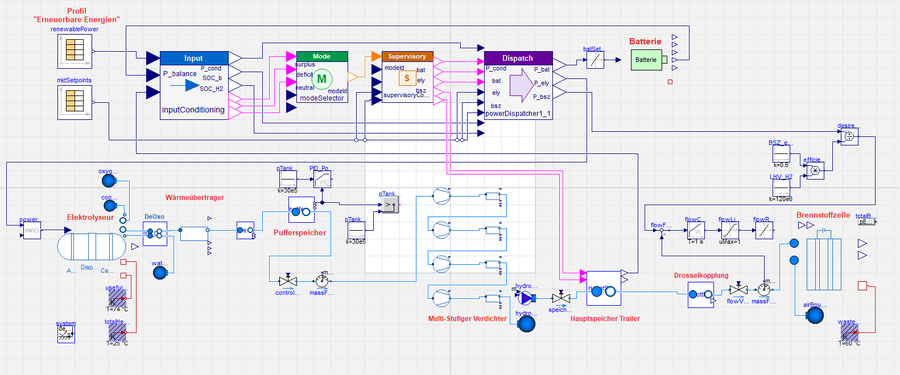
- A detailed simulation model of the entire process chain has been implemented in Dymola. The model depicts the entire process—from the feed-in of renewable energy through hydrogen production, purification, multi-stage compression, and high-pressure storage, all the way to the reverse process of extracting the stored hydrogen via a fuel cell to generate electricity, as shown below.
- The model includes a higher-level control layer that manages the power flows between the renewable energy sources, the grid/market requirements, and the battery, and controls the battery’s charging and discharging processes as well as the operation of the electrolyzer and the fuel cell. In this way, the battery can compensate for short-term power fluctuations, while the hydrogen pathway (electrolysis, purification, compression, and storage) handles long-term energy storage.
- On the output side, the hydrogen stored in the high-pressure trailer can be recirculated via a throttling stage and converted into electrical energy via the fuel cell, thereby closing the “electricity-to-gas-to-electricity” cycle.
- This model enables the analysis of energy management and energy storage strategies (battery and hydrogen), hydrogen production and purification processes, compression and storage concepts, as well as power reconversion via the fuel cell, including their interactions within the entire system. It forms the basis for evaluating deployment strategies and control concepts relevant to the project’s sector coupling objectives and will be expanded to enable further analyses of grid services and process integration.
Objectives of the subproject led by the Chair of Energy Process Engineering
- Development of a process management tool that analyzes not only hydrogen but also other material and energy flows with regard to their integrability into additional processes or sectors.
- Identification of potential applications for sector coupling.