
Zahlen und Fakten im Überblick
Inhaltsverzeichnis

- 1828 gegründet
- seit 2012 Exzellenzuniversität
- Studierende in 17 Fakultäten in 5 Bereichen und Lehramt
- 8.400 Beschäftigte
- davon 5.500 wissenschaftliches Personal (davon 25 % international und 38 % weiblich)
- 3.600 finanziert aus Drittmitteln
Vielfältig und international studieren
Die TU Dresden bietet ein breites Studienangebot aus nahezu allen Wissenschaftsdisziplinen.

- 29.000 Studierende, davon etwa 21 % internationale Studierende aus 128 Ländern
- 22,7 % Ingenieurwissenschaften
- 26,6 % Bau und Umwelt
- 12,8 % Mathematik und Naturwissenschaften
- 9,7 % Geistes- und Sozialwissenschaften
- 13,3 % Lehramt
- 12 % Medizin
- 21:1-Verhältnis Studierende : Lehrende
- 121 Studiengänge, davon 28 englischsprachige Studiengänge und 26 Doppelabschluss-Programme
- 25.000 Mitglieder im TUD-Alumni-Netzwerk
- 6.500 Promovierende, davon 27% international
- 1.200 Personen im Tenured Academic Staff, davon mehr als 600 Professor:innen
Exzellent und interdisziplinär forschen
Die TUD zählt zu den leistungsfähigsten Universitäten weltweit und ist eine der deutschen Exzellenzuniversitäten.
© AVANGA Filmproduktion
- Die TUD belegt mit 5 Exzellenzclustern (EXC) Platz 1 aller Technischen Universitäten in Deutschland.
- CeTI: Zentrum für Taktiles Internet mit Mensch-Maschine-Interaktion
- ctd.qmat: Komplexität, Topologie und Dynamik in Quantenmaterialien – gemeinsames EXC mit Universität Würzburg
- PoL: Physik des Lebens
- CARE: Klimaneutrales und ressourceneffizientes Bauen – gemeinsames EXC mit RWTH Aachen
-
REC²: Verantwortungsvolle Elektronik im Zeitalter des Klimawandels
- 4 Alexander von Humboldt-Professuren, 8 Stiftungsprofessuren und 11 Heisenberg-Professuren
- 16 DFG-Graduiertenkollegs
- In 15 DFG-geförderten koordinierten Sonderforschungsbereichen (SFB) und Transregios (TRR) ist die TUD antragstellende oder mitantragstellende Uni.
- 24 ERC-Grants (aktiv)
- 2 BMFTR-Zukunftscluster und 4 BMFTR-Projekte mit einer Förderung von mind. 1 Mio. Euro pro Jahr
- Sprecherrolle für Verbundprojekt Base4NFDI sowie im Konsortium NFDI4Earth und Beteiligung an 12 weiteren NFDI-Konsortien
- Beteiligungen an Vorhaben priorisierter FIS Forschungsinfrastrukturen: Einstein Telescope, DALI, SLICES-DE
- Center for Interdisciplinary Digital Sciences (CIDS) mit
- ScaDS.AI Dresden/Leipzig: 1 von 7 Zentren für
skalierbare Datenanalyse und Künstliche Intelligenz - NHR@TUD: 1 von 9 Zentren für Nationales Hochleistungsrechnen
- ScaDS.AI Dresden/Leipzig: 1 von 7 Zentren für
- 23 acatech-Mitglieder
- 27 Leopoldina-Mitglieder
Erfolgreich in Wissenschaft und Transfer
Die TU Dresden ist drittmittelstark und die patentstärkste Universität Deutschlands.
Was wir bei TUD|excite tun © Avanga
- Durchschnittlich 20 Ausgründungen pro Jahr unterstützt durch TUD|excite®
- Drittmittelstark: 924 Mio. Euro Gesamtbudget (im Jahr 2025), davon 371 Mio. Euro (40 %) über Drittmittel
- Platz 3 in Deutschland bei der Einwerbung von Drittmitteln (Destatis)
- Platz 1 weltweit im THE Impact Ranking (SDG 9) 2025 im Feld „Industrie, Innovation und Infrastruktur“
- Platz 1 bei Patent-Anmeldungen (Institut der Deutschen Wirtschaft)
- DFG-Atlas 2025:
- Platz 1: Electrical Engineering
- Platz 1: (Neuro) Psychology
- Platz 2: Civil Engineering
- Platz 3: Solid State Chemistry
- Platz 3: Condensed Matter Physics
- Platz 4: Computer Science
- 100 Patentanmeldungen im Jahr 2025
- 1.000 Forschungskooperationen mit Unternehmen im Jahr
Globaler Impact, regionale Verantwortung
Unsere Vision: die TUD als global ausgerichtete und zugleich regional verankerte Spitzenuniversität für das 21. Jahrhundert.
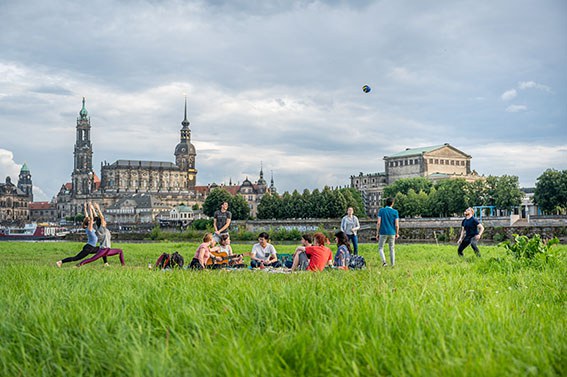
- International über 500 Partnerschaften in über 70 Ländern weltweit
- Saxon Science Liaison Offices in Taiwan (Taipeh) und Indien (Chennai)
- 6.500 internationale Mitglieder im TUD-Alumni-Netzwerk
- transCampus: transnationale strategische Partnerschaften der TUD mit dem King’s College London sowie dem IIT Madras
- EUTOPIA: Verbund von 10 europäischen Universitäten
- TU9: Allianz führender Technischer Universitäten in Deutschland
- TUD|Campus Lausitz: Forschungsinfrastruktur für den Strukturwandel in der Lausitz
- Science and Innovation Campus:
- 47 Forschungseinrichtungen und forschende
Kulturinstitutionen in der Forschungsallianz DRESDEN-concept - 58 gemeinsame (aktive) Berufungen mit DRESDEN-concept-Partnereinrichtungen
- 10 gemeinsame Forschungsgruppen
- 9 gemeinsam genutzte Technologieplattformen
- 5 gemeinsam genutzte Gebäude
- Die Sächsische Landesbibliothek – Staats- und Universitätsbibliothek (SLUB) ist eine der größten und innovativsten wissenschaftlichen Bibliotheken Deutschlands mit > 90 Mio. Quellen im Katalog und > 1,1 Mio. Besuchen im Jahr.
- 47 Forschungseinrichtungen und forschende
Nachhaltige und lebenswerte Universitätskultur
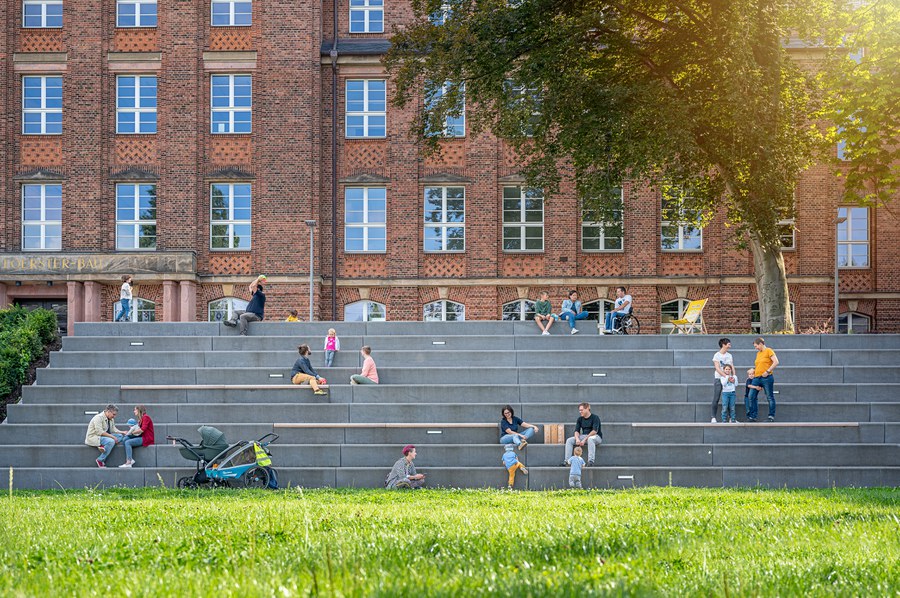
Der Campus der TUD bietet eine hohe Aufenthaltsqualität: Innovativ und nachhaltig gestaltet, dient er als exzellenter Lern- und Arbeitsort.
- Zertifiziertes Umweltmanagementsystem nach EMAS seit 2003
- Nachhaltigkeitsstrategie mit über 80 Maßnahmen
-
Green Office (seit 2021) und Masterplan (seit 2019) für einen grünen und lebenswerten Campus mit derzeit ca. 4,9 ha insektenfreundlichen Wiesen
-
Zertifiziert nach Diversity Audit „Vielfalt gestalten" seit 2024
-
Familiencampus: Campusbüro Uni mit Kind, Ferien- und Veranstaltungsbetreuung, Pflegeberatung
-
Gesundheitsmanagement für Studierende und Beschäftigte
-
1.478 Kurse in mehr als 200 verschiedenen Sportarten im Dresdner Hochschulsportzentrum (DHSZ)
-
40 naturwissenschaftliche und technische Sammlungen
- Kunstbesitz mit 4.000 Werken aller Gattungen in der Kustodie
- 5 Botanische Gärten: Dresden, Boselgarten, Zuschendorf und Fichtelberg sowie Forstbotanischer Garten Tharandt (Sächsisches Landesarboretum)
- Compliance-Managementsystem mit anonymem Hinweisgebersystem