
Research projects
On a regular basis, the faculty members of the Chair develop interdisciplinary connections based on their individual or collaborative research, which are then integrated into research projects or presented at conferences.
Table of contents
- Current Projects
- Completed Projects
- The Theater of Trans-lation. Dynamics and Constellations of Translation and Demeaning in 21st-Century Theater and Performance (2022–25)
- Subproject K of the SFB 1285 (2017–22)
- Precarious Nature: Landscape, Climate, and People in Village History (01/2017–01/2020)
- Horror Stories: Literary Practices of Fear around 1800 (2021–25)
- The Principle of Disruption (01/2013–12/2018)
- Forms of Play and Fear (01/2009–12/2011)
Current Projects
Psychonarratology of Resentment: Trans- and Intermedial Modelings of Consciousness in Narrative Media (Literature, Film, Comics) (Walter Benjamin Institute, 09/2026–08/2028)
Project Leader: Dr. Florian Scherübl
Further details will follow shortly.
Completed Projects
The Theater of Trans-lation. Dynamics and Constellations of Translation and Demeaning in 21st-Century Theater and Performance (2022–25)
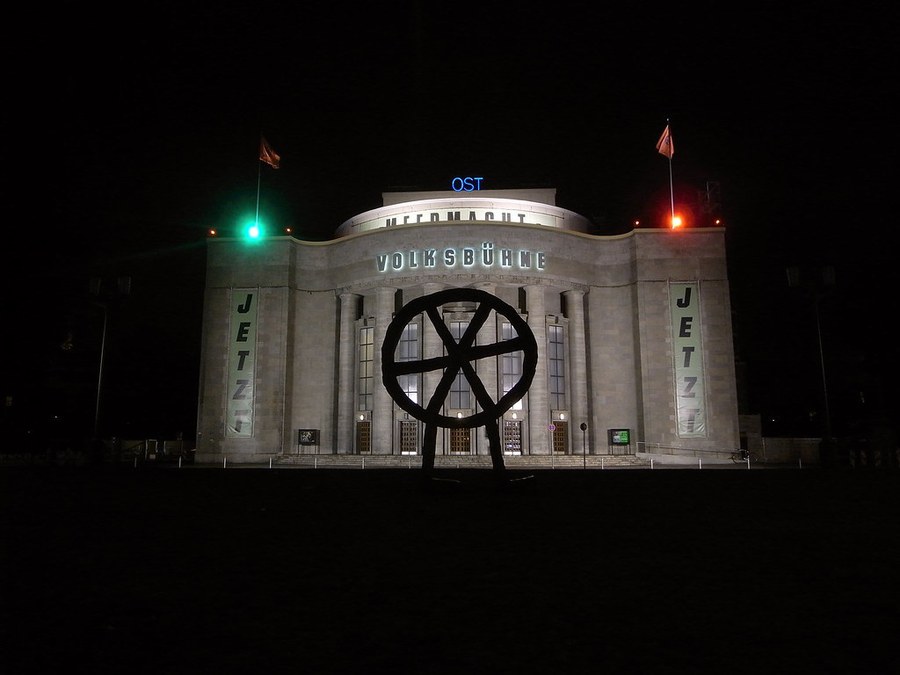
Project Leaders: Lars Koch and Julia Prager
Structured around three areas of research, the project examined the representation, performance, and reflection of invective (derogatory, insulting, and discriminatory) dynamics in contemporary theatrical forms and their institutional contexts in German-speaking countries. Its distinctive methodological approach consisted of productively linking theoretical work on an expanded conception of disruptive “translation” with concrete performance analyses and research in the field of Cultural Institutions Studies. In this way, the theater is considered an arena for the negotiation of audibility, that is—in a thoroughly literal sense—in its function as a space for hearing linguistic and vocal invective as well as a resonant space for social conflicts arising from cultural and media-spatial translation processes. Linked to this, on the one hand, was the examination of theatrical dynamics of humiliating affective events within the auditory-acoustic spectrum of other languages, voices, and sounds (e.g., speaking with an accent, dialect, sociolect, or “jargon”). On the other hand, art- and culture-political practices of “misunderstanding” (such as theaters’ refusal to engage in discussion with the “New Right” and vice versa, or controversies surrounding artistic freedom, political correctness, and “cancel culture”) as specific media operations designed to generate an audience and capture attention.
This perspective was also intended to contribute to current research trends in the reflection on discriminatory practices, particularly in the context of racism, by ensuring that invective practices are not related solely to visual phenomena (such as “skin color”) but are explicitly linked to exclusion based on vocal and tonal markers, which in turn produces segregation in the sociopolitical and art-political fields of audibility. The project was based on the assumption that this would enable a concise examination of discriminatory practices in and around theaters, insofar as these can increasingly be addressed as interdependent phenomena (such as in the areas of racism, sexism, and, in particular, classism). In doing so, the project addressed aspects of discrimination and denigration both in terms of their sometimes critical functions in artistic productions and with regard to power-preserving operations within institutional contexts.
Subproject K of the SFB 1285 (2017–22)

SFB 1285: Invectivity. Constellations and Dynamics of Degradation.
Subproject K: Theater of Discrimination. Representation and Reflection of Invective Dynamics in Contemporary Theater, Performance, and Action Art
Project Leaders: Lars Koch and Tanja Prokić
This subproject examined theater, performance, and action art in their dual nature as both social and aesthetic spaces of communication, in which invective is exemplarily realized as a cultural practice and framed by the media. It proceeded from the assumption that it is precisely here that evaluative and invective constellations and processes become perceptible on an affective, perceptual, and reflexive level. The subproject focused on the theater of discrimination as an institution—in its mediality and its affective politics, in its relationship to other social stakeholders (media, institutions, systems), as an arena granting licenses to speak and act, in its blurring of boundaries and its discursive relationship to the social order. The project’s aim was to examine theater, performance, and action art from the 20th century to the present with regard to the (non-)success of invective strategy—with its aesthetic, affective, and identity-political means of address—and its proliferation: How is invectiveness, as a function of the social, aesthetically implemented, reflected upon, and commented on by the discourse-shaping protagonists of contemporary German-language theater (such as Milo Rau, Christoph Schlingensief, Yael Ronen, and many others)? What strategies for politicizing affects and what knowledge about the response effects of invective communication are generated and tested? What spatial and medial dispositions underpin the respective aesthetics of invective-critical impact, and how are these historically anchored (as exemplified, for instance, by Valie Export or F.W. Fassbinder)? The project’s interweaving of discourse-analytic, phenomenological, and genealogical perspectives ultimately made it possible to reflect deeply on social constellations of social and political discrimination and to critically examine latent mechanisms of discrimination produced by the theater itself.
Precarious Nature: Landscape, Climate, and People in Village History (01/2017–01/2020)
Nineteenth-century realist literature became a platform for (proto-)ecological thought long before ecology established itself as a science and a “movement.” In particular, village and regional histories can be read as an ecological commentary on a historical transformation. It is ecological because the need to elevate a natural way of life to the status of an ideal arises only when that way of life is no longer taken for granted. It is through dialogue with a multitude of non-fictional texts appearing in the same publication sphere as narratives of the “natural homeland” (Sebald)—that is, in journals and folk almanacs, for example—that the conditions for ecological thought are established in the first place. The project focused on this discourse in order to compare it internationally and historically and to trace the conditions of contemporary conceptions of how human-nature relationships are and should be.
OTPP Project, Director: Dr. Solvejg Nitzke
Horror Stories: Literary Practices of Fear around 1800 (2021–25)

Signatur: DD93 A 33414:4,4 PURL: http://resolver.sub.uni-goettingen.de/purl?PPN884538338
The project examined the literary treatment of fear in German-language horror literature around 1800. It explored how literary fear can be more precisely defined from a praxeological perspective—in terms of its objects, forms, and functions—as an element of an emotional practice during the Sattelzeit. With a focus on literary studies and incorporating approaches from the history of emotions and media and cultural studies, the project aimed to identify the specific historical signature of fear during the period under study. Accordingly, the project conceived of fear as a knowledge-driven, performative practice that must be situated within its enabling context, constituted equally by historical knowledge of emotions and the treatment of fear in horror literature. This gave rise to a two-part research framework: on the one hand, the aesthetic form of historical fear in literature; on the other, the productive effects of popular literary communication on the manifestation of contemporary fear. Specifically, this gave rise to three interrelated research objectives that needed to be addressed: The project characterized fear, in a historical form to be reconstructed, as a guiding emotion in German-language literature around 1800 (1); it worked toward a comprehensive historicization grounded in the history of emotions and media, thereby offering a functional reinterpretation of German-language horror literature of that period (2); and it established a productive relationship between literary emotional research and the history of emotions (3). The project was thus grounded in fundamental reflections on the historicity of literature and the relationship between literature and emotion, addressed questions regarding the deep cultural dimensions of fear, and linked the emotional history of fear with a media anthropology of popular horror literature.
Against this backdrop, the project sought to examine—using the genre of horror literature, which was popular in the 19th century—which literary devices and techniques articulate fear in a manner typical of the era (modes of presentation, concepts, motifs) and communicate it (emotionalizing effects, narrative structure, thematic treatment, and commentary). Adopting a broad understanding of the term “horror literature,” the project focused on a corpus that includes, for example, Friedrich Schiller’s novel fragment *Der Geisterseher* (1787) as well as E.T.A. Hoffmann’s *Nachtstücke* (1816) or Wilhelm Hauff’s satirical and macabre novella *Mittheilungen aus den Memoiren des Satans* (1825/26), but also, in particular, popular literary texts of the “second” and “third” categories. In order to analyze a corresponding corpus of primary texts from the perspective of the practice of emotions, it was necessary to take into account their contexts in the history of knowledge and discourse, that is, to examine the fear in horror literature in terms of its reciprocal interactions with contemporary knowledge of emotions on the one hand, and prominent discourses on fear (ghosts, apparent death, secret societies, dreams, and madness) on the other. By testing the productivity of an emotional-historical and praxeological perspective on German-language horror literature in this way, the project simultaneously explored the possibilities of a literary-historical praxeology of fear.
DFG Project:
- Director: Prof. Dr. Lars Koch
- Project Collaborator: Jakob Baur, M.A.
The Principle of Disruption (01/2013–12/2018)

Funded by the European Research Council, the interdisciplinary research group “The Principle of Disruption” explored the cultural-diagnostic potential inherent in feedback loops centered on media-related, artistic, and sociopolitical disruptions.

As part of the lecture series “Figures of Disruption,” lecturers and authors were regularly invited to TU Dresden to reflect on “figures of disruption” from their respective fields of expertise, thereby helping to define the contours of this research area. The lectures were often held in conjunction with in-depth workshops.
Forms of Play and Fear (01/2009–12/2011)

DFG Network “Forms of Anxiety”:
https://gepris.dfg.de/project/75323038