
CC-Mesh
Project data
|
Titel | Title |
Report from year book 2024/25
3D reinforcement for CRC
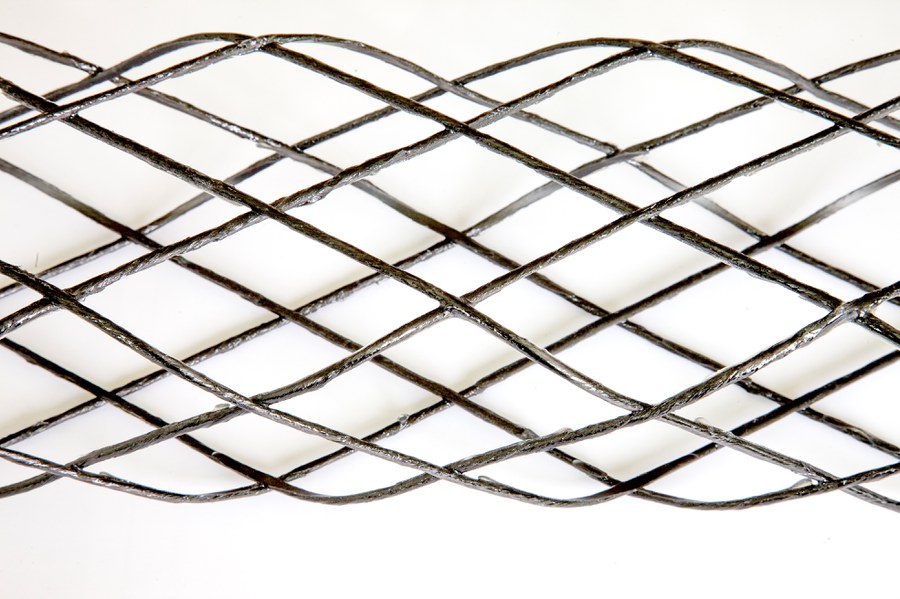
3D reinforcement cage made of carbon fibers
The research project has the goals of integrating lightweight construction principles into concrete construction and of developing a new, fully automated manufactured, three-dimensional carbon fiber reinforcement structure. This structure offers an efficient use of resources in comparison to conventional steel reinforcement, and is distinguished by its adaptability to different geometric shapes and load paths. The advanced reinforcement structure composed of carbon fibers is produced by wrapping a central core with carbon fiber yarns. By modifying the core geometry and the number and angle of inclination of the yarns, it is possible to achieve a high degree of flexibility in the design of reinforcement structures, which allows for the production of reinforcement elements in a variety of shapes.
In comparison to traditional carbon fiber grids, the mesh exhibits a more pronounced stiffness in all spatial directions and a more robust processing in concrete. This is due to the spatial structure and the mutually stabilizing fiber strands, which are entangled in opposite directions and delay buckling of the strands, allowing for a wide range of applications. In particular, the mesh can be employed for concrete elements that necessitate shear reinforcement, as well as for surface reinforcement or reinforcement of highly stressed edge areas. Furthermore, the mesh can be employed as punching shear reinforcement for slabs, including those of a minimal thickness, due to the spatially anchored fiber strands within the self-contained cage. In the context of prestressed carbon-reinforced concrete elements, the mesh can also secure the concrete in areas of high stress and serve the dual function of providing splitting tensile reinforcement and helical reinforcement.
The flexibility permits the cage to be utilized for a multitude of reinforcement functions, tailored to the specific load flow. The remarkable rigidity of the reinforcement structure and its minimal dead weight in comparison to conventional steel reinforcement enables its efficient, accurately positioned, and damage-free installation on construction sites and in precast plants.
Report from year book 2023
Reinforcement cages made from carbon fibers

Expansion body with a single reinforcing bar
The project’s main focus is the development of market-ready components for concrete construction. This will be achieved through the use of innovative, large-format, and force flow-optimized carbon-fiber reinforcement structures. The reinforcement design will be optimized to reduce the amout of reinforcement in the component and to realize small component geometries. This will result in a significant reduction of CO2 emissions due to the associated reduction in concrete consumption.
The practical use of the new type of reinforcement structure in construction was examined with regard to its material characteristics. Component tests as well as long- and short-term tests were carried out for this purpose. The component tests showed that an increase in load can be achieved with the aid of the reinforcement structure compared to components conventionally reinforced with carbon rods, as demonstrated by 4-point bending tests. In previous long-term tests on expansion bodies, carbon fiber reinforcement structures were tested for several thousand hours under varying temperatures to determine their durability. Yarn pull-out (YPO) tests and single fiber strand tests were conducted to determine material characteristics under short-term loading.
The knowledge acquired serves as the foundation for ongoing development of reinforcement structures. To be able to dimension and to construct components at the end of the project, high-temperature and durability tests are also conducted using various reagents.
Abstract
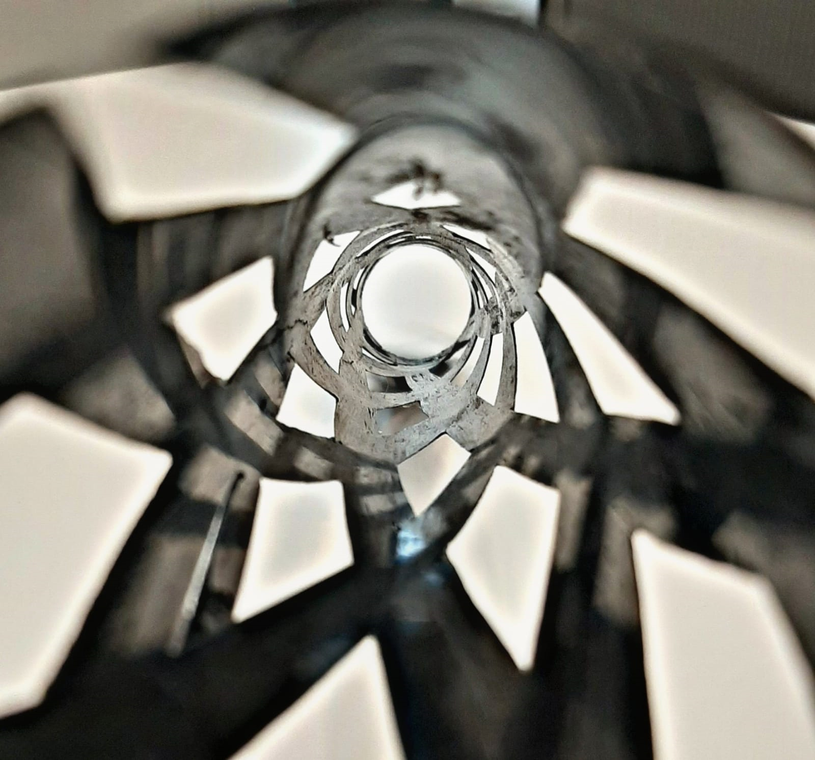
In the CC-Mesh project, novel reinforcement structures in the form of carbon tubes with a helix-like fiber strand layer are being developed. The aim is to reduce the amount of reinforcement used in the component by means of a more force-flow-oriented reinforcement design and to realize small component geometries. The associated simultaneous saving of concrete can significantly reduce CO2 emissions.
The novel reinforcement structures have to be investigated with regard to their material properties for practical construction applications. For this purpose, tensile and composite tests as well as component tests under quasi-static loading at indoor climatic conditions will be carried out. In the further course of the project, the reinforcement will be tested under permanent load, under high-temperature stress and in fire tests. By the end of the project, the most important material parameters will be known and components can be dimensioned and designed with the reinforcement material.