
Image-based 3D reconstruction of bridges
Project data
| Titel | Title TP der TU Dresden im Verbundprojekt Pic2Bridge: Bildbasiertes Ingenieurdesign für Brücken | SP of TU Dresden in the joint research project Pic2Bridge: Image-based engineering design for bridges Förderer | Funding Bundesministerium für Verkehr (BMV) / mFUND Zeitraum | Period 08/2024 – 07/2025 Verbundvorhaben- und Teilprojektleiter | Joint research project and subproject manager Prof. Dr.-Ing. Steffen Marx Bearbeiter | Contributor Morris Florek |
Short description

Pic2Bridge: Image-based engineering design for bridges
Bridge designs often rely on the experiential knowledge of engineers, which can lead to differences in quality. There is a lack of publicly accessible bridge data and efficient analysis methods to learn from existing structures. Image data is often the only available data source, but it must be processed to extract design-relevant information. The goal of the Pic2Bridge project is to develop methods for extracting semantic and geometric information from bridge images and structuring this data. To achieve this, the feasibility of image-based 3D reconstruction using limited image data was investigated, enabling the extraction of information and its collection in a database.
As part of the project, a bridge-specific knowledge graph database based on ontologies was designed and enriched with image and metadata from 28,000 bridges. A training dataset for semantic bridge segmentation was created, which was used to train segmentation models capable of extracting semantic information from bridge images and supporting 3D reconstruction. In a feasibility study, a deep learning model was identified that enables more efficient 3D reconstructions with fewer images compared to conventional methods. Using the 3D models, it was demonstrated how valley situations, one of the most critical factors in bridge planning, can be extracted and stored in the database.
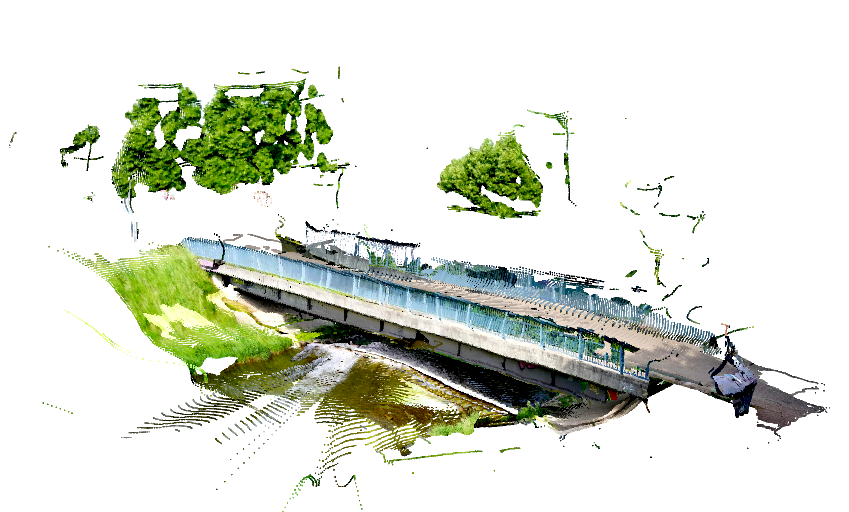
3D reconstruction of the Gaskugel Bridge in Freiburg (Breisgau)
The results form the foundation for extracting additional design-relevant bridge parameters from images and 3D models. Furthermore, they open up the possibility of developing automated planning tools based on the collected data. This approach can make bridge design more efficient and less dependent on individual experiential knowledge.