
Events as part of the International Day against Homo-, Bi-, Inter- and Trans-hostility 2026
The International Day against Homophobia, Biphobia, Intersex and Transphobia is celebrated worldwide on May 17. The day was established in 2004 to draw attention to the violence and discrimination faced by lesbian, gay, bisexual, transgender, intersex - queer people with different sexual orientations, gender identities or expressions.
After the Progress Pride Flag was raised at TU Dresden for the first time on May 17, 2022, TU Dresden is also participating with various awareness-raising and empowerment formats.
Program
Diversity to go@TUD: Visibility and safety - The impact of right-wing counter-mobilizations on Pride participants in Saxony
Queer Science Panel
Self-assertion/self-defense for queers
Self-assertion/self-defense for queers
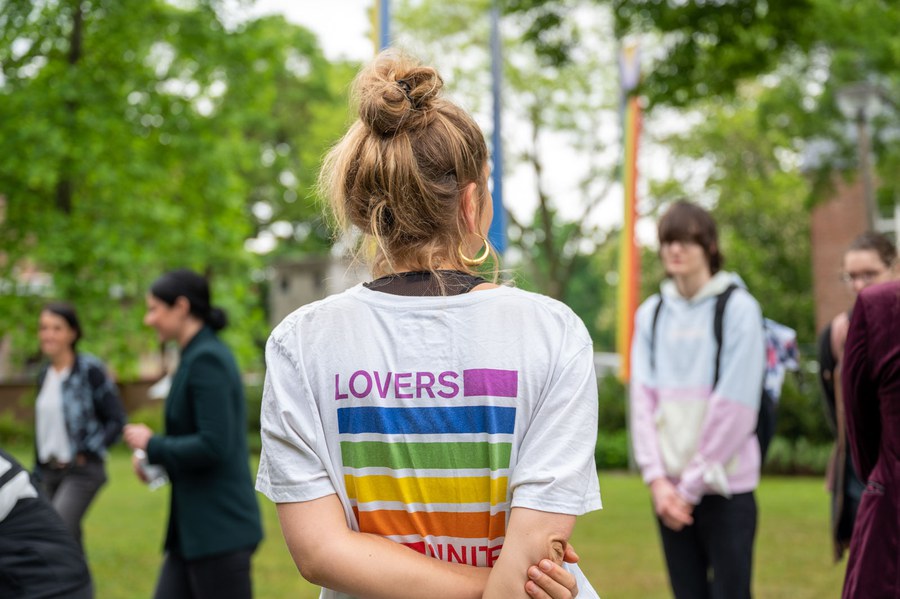
Diversity to go@TUD: Visibility and safety - The impact of right-wing counter-mobilizations on Pride participants in Saxony
Place online, Zoom: https: //tu-dresden.zoom-x.de/j/67638235426?pwd=FcICtSLYOpGwTKk1CUWf4OAuWEnIxx.1
Around May 17, the International Day against Homo-, Trans-, Bi- and Inter-hostility (IDAHOBIT), we are deliberately focusing on the visibility and safety of queer communities, including in the context of higher education. Universities and colleges see themselves as places of openness, diversity and critical debate. At the same time, they are part of social dynamics in which polarization and hostility are becoming increasingly noticeable. The question of how safe spaces for queer students and staff can be guaranteed is therefore becoming increasingly relevant here too.
In a compact 30-minute input, Lea Bellmann and Bastian Stock will present their current study "The effects of right-wing counter-mobilizations on Pride participants in Saxony". The results are based on a broad survey of 2,701 participants and show how organized counter-protests, threats and threats of violence shape the experiences around Prides and Christopher Street Day events.
While Prides are often experienced as spaces of solidarity and protection, insecurities arise above all in less protected transitions, for example on the way there. These dynamics also raise questions for universities: How can safe learning and working environments be designed when threatening situations do not end at institutional boundaries? What responsibility do universities have in supporting queer visibility - even beyond the campus?
Following the input, there will be space for questions and exchange with a view to practice.
Queer Science Panel
Friday, 12.06.2026 // 11.10-12.40 // hybrid
Queer research starts where things that are taken for granted are called into question: in bodies, spaces, stories, technologies and everyday practices. Its topics are correspondingly diverse, ranging from media and literary analysis, healthcare and law to urban planning and digital applications. Whether it's a series analysis of queer vampires or virtual reality to support trans* people in their transition, these projects are not linked by a subject, but by their view of queer life realities, diversity and social norms.
For the fifth edition of the Queer Science Panel, we invite students, doctoral candidates and researchers from all disciplines to present their work. Contributions from term papers or theses, dissertations, current research projects or internships are possible. They are also expressly welcome. The 7-10 minute short inputs can also include methodological challenges, open questions or critical research experiences.
All others are cordially invited to take part in the panel as listeners in a very benevolent way. It is intended as a benevolent colloquium in which the focus is on exchange, visibility and networking.
The Queer Science Panel will take place on Friday, June 12 from 11:10 a.m. to 12:40 p.m. in the digital and a barrier-free room on the TUD campus. Whispered translations and childcare can be organized. External contributors or listeners are very welcome.
Submissions should be received by 30.04.2026 and include a short abstract (approx. 150-250 words) as well as name, institutional affiliation (if any) and desired participation format.
Contributions or requests for participation can be sent to queersciencepanel@tu-dresden.de.
The Queer Science Panel is organized by Anja Wiede, the contact person of the complaints office for incidents of harassment, discrimination and violence at TU Dresden.
Queer peer counseling is also available for queer networking or counseling concerns: queerpeer@tu-dresden.de.
Self-assertion/self-defense for queers
Friday, 12.06.2026 5-8 pm/ location: tba
The taster course aims to give an insight into self-assertion strategies to strengthen confidence in one's own needs and boundaries and to develop options for action together in order to cope well with various anxiety-ridden situations. Perception exercises, the use of the voice and the development of an inner attitude are just as much a part of the course as an insight into liberation and striking techniques. The focus is on solidarity with one another.
All exercises are voluntary and can be modified.
Trainer:in: Jule, non-binary, white person, able-bodied
Language: German, no perfect English, but together we can communicate
Registration at:
Program 2024
Program 2023
Program 2022